


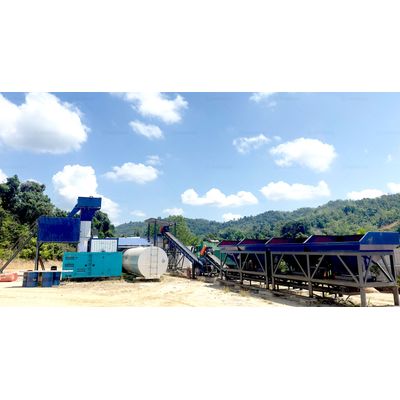
Asphalt Drum Mix Plant Cold Feed Engineering Replaces Screen Deck Separation With Dosing Precision
A continuous asphalt drum mix plant operates without the vibrating screen deck assembly that batch tower configurations use to verify aggregate fraction separation after drying — a structural absence that shifts the entire mix compliance burden onto the cold feed dosing system operating before the drum. Specialized mini asphalt plant manufacturers who understand this fundamental difference engineer cold aggregate dosing precision as the primary quality control mechanism rather than a production preparation step whose accuracy the screening tower would subsequently validate. On compact chassis footprints where space constraints compress both component dimensions and the distance between measurement points, achieving the dosing accuracy that mix specification requires demands proprietary variable-speed feeder technology whose engineering depth determines whether the drum mix plant produces compliant output or accumulates gradation errors that no downstream process corrects.
Why Screen Deck Absence Makes Cold Feed Dosing the Sole Compliance Control Point
In a batch tower configuration, hot aggregate passes through multi-deck vibrating screens after drying — separating fractions into hot bins whose individual weigh hopper draws confirm that each fraction entering the mixer matches the approved recipe. Gradation errors introduced at the cold feed stage are therefore partially recoverable through screening separation before bitumen contact. An asphalt drum mix plant carries no equivalent recovery mechanism — aggregate enters the drum at the proportion the cold feed system delivers and exits as coated mix whose gradation reflects cold feed accuracy without correction opportunity between entry and discharge.
This single-point compliance dependency amplifies the consequence of cold feed dosing errors beyond what batch plant cold feed inaccuracy produces. A proportioning deviation that a batch tower's screening deck would isolate into the correct hot bin fraction passes through a drum mix plant as an unadjusted recipe error that compounds across the production run until sampling detection triggers a manual feed rate correction. Mini asphalt plant manufacturers who acknowledge this compliance exposure design cold feed dosing architecture against the accuracy standard that screening deck separation previously provided — not against the more relaxed standard that batch plant cold feed systems support.
Proprietary Variable-Speed Feeder Technologies on Compact Chassis Footprints
Mini asphalt plant manufacturers engineering variable-speed feeder systems onto compact chassis footprints face a geometric constraint that full-scale drum mix plant designs avoid — conveyor length between bin discharge and weigh bridge is shortened by transport dimension limits, reducing the signal averaging distance that gravimetric belt scale accuracy depends on. Proprietary feeder technologies that address this constraint combine high-resolution load cells with digital signal processing algorithms that compensate for reduced averaging length through faster sampling rates and adaptive signal filtering — maintaining mass flow measurement accuracy within the compact layout that chassis dimension compliance imposes.
Variable-speed drive integration links each bin's belt conveyor speed to its individual gravimetric measurement in a closed-loop architecture that adjusts feed rate within seconds of deviation detection. When moisture-driven bulk density change alters a fraction's actual mass flow below the target proportion, the drive modulates belt speed to restore correct delivery before the deviation accumulates into a specification failure at the drum injection point. Mini asphalt plant manufacturers who document control loop response time and load cell resolution for their compact feeder configurations provide the specification evidence that mix compliance verification requires — not general VFD capability descriptions that leave dosing accuracy unquantified.
Verifying Cold Feed Dosing Specification Against Mix Compliance Requirements
The verification standard that confirms compact asphalt drum mix plant cold feed dosing meets mix compliance requirements is field proportioning accuracy data from equivalent configurations under comparable aggregate moisture variability — not factory calibration records under controlled dry conditions. Mini asphalt plant manufacturers with genuine dosing engineering experience maintain production records from active drum mix plant deployments showing recipe compliance rates across moisture fluctuation events.
Conclusion
An asphalt drum mix plant whose mini asphalt plant manufacturers engineer high-resolution gravimetric belt scales, closed-loop variable-speed drives with documented response time, and field-validated proportioning accuracy data delivers cold feed dosing precision that compensates for screen deck absence — making the cold feed specification the sole mix compliance control point whose engineering depth determines whether continuous drum production meets specification or accumulates uncorrectable gradation errors across every production shift.