- Home
- Companies
- Biorem Technologies Inc.
- Articles
- Cape Coral - Case Study
Cape Coral - Case Study
Cape Coral is the third-largest city in the State of Florida behind Jacksonville and Tampa in terms of total city area and the 12th most populated. The city’s most unique feature is a 400-mile network of dredged canals; more than any other city in the world, making it a popular destination for recreational boaters and waterfront living.
Background
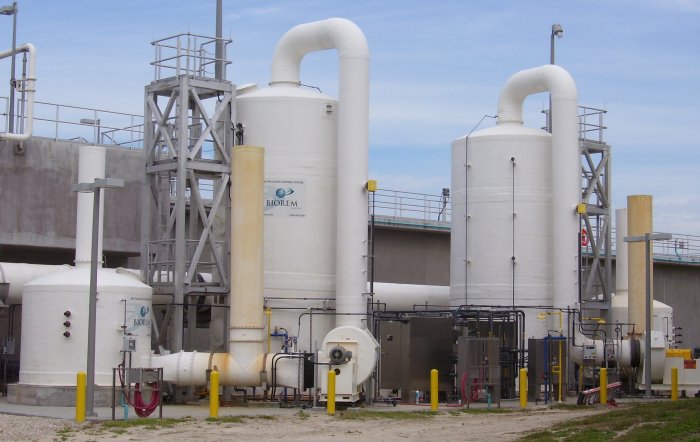
Two years ago city planners embarked on a plan to improve Cape Coral`s utilities in order to keep pace with user demands. The main elements of the plan included an upgrade to the city`s Southwest and Everest wastewater treatment plants, as well as an expansion of production capabilities at the Southwest reverse osmosis water treatment plant. The improvements are seen as critical to improving the city`s water and sewer infrastructure in coming years and to accommodate an expected doubling of the population by 2030. As part of the Southwest wastewater treatment plant expansion, the city installed an odor control system using two of Biorem`s biotrickling filters. The system was commissioned in March of 2009. Specially designed to remove hydrogen sulfide (H?S) odors from wastewater environments. Biorem biotrickling filters can remove a wide range of water-soluble contaminants from process airstreams at reasonable cost compared to other systems.
Randy Mikkelsen. Chief Facility Operator for Cape Coral`s Southwest water reclamation plant, said Biorem`s system was chosen as a lower-cost alternative to the plant`s older, chemical system of odor containment. "We went with a biological system because it was a lot cheaper to run than the old odor control system, which used bleach and caustic soda." said Mikkelsen. noting the chemical system was expensive to run and maintain, considering the high cost of buying chemicals and replacing the titanium sprayer. “It was a tremendous amount of money to run that chemical system versus a biological system like Biorem’s,” he said. The odor control system was a necessary addition to the Southwest treatment plant expansion because the plant is in close proximity to surrounding neighbors and schools.
“The the primary reason for an odor control system is to capture all the H2S odors and take them out of the air so we’re not getting complaints,” explained Mikkelsen.
Scientific and anecdotal observations indicate the system has achieved its objective of removing greater than 99 percent H2S.
Mikkelsen said when a large number of people gathered recently for a charity walk at the high school, the city received no odor complaints, compared to several the year before when no odor control system was in place.
In just under a year of operation, the system has taken the H2S from 25-30 ppm to .1 or .2 ppm, which works out to a 99.5 percent removal rate, or 99.9 percent after the air has passed through a carbon absorber. Measured in odor units (ou), the system has achieved 92 percent odor removal (98.8 percent past the carbon), taking in 18-30,000 ou, and releasing under 300 ou to the environment. “Altogether the system is working and doing the job we need it to do,” said Mikkelsen.
BIOTRICKLING FILTERS
Biorem’s biotrickling filters are built to remove contaminants from the wastewater airstream. The modular biofilter extracts foul air for treatment through the 12-by-22-foot FRP unit, moving the air at 5,500 cfm through porous media. Odorous compounds, primarily H2S, are consumed by bacteria living on the media and oxidized to carbon dioxide and water. The remaining clean air is discharged into the atmosphere. Water is recirculated through the vessel to add nutrients to the bacteria and to remove wastes.
Critical to the process is the maintenance of proper air temperature, moisture, pH and nutrient levels. Matt Hardy, Biorem’s engineer on the Cape Coral project, said the high levels of H2S at the plant made it the perfect fit for a biotrickling system. “The thing that drives our design in the case of a biotrickler versus a biofilter is H2S concentration,” said Hardy, noting the Southwest plant has average H2S concentrations of 150 ppm and 300 ppm at peak levels. “Anytime the H2S is that high, you almost have to go with a biotricker.”
KEY ADVANTAGE
Hardy said the system’s goal of removing 99 percent H2S depends on a delicate balance of air flow, pH level and air temperature to ensure that the biology is ready and capable of devouring the contaminants in the foul air. “As long as you’re not feeding too much air or affecting the process in a negative way, you’re going to get those removal rates,” he said.
Hardy said a key advantage of the system is it’s designed not only for the biology to remove the H2S, but also to keep a low pressure drop throughout the vessel, which saves electricity costs. Also, the biotrickling filter does not require the air to be pre-conditioned (heated or cooled) when entering the filter; as long at it stays within the accepted temperature range, it is humidified within the vessel.
Perhaps most significant for the plant operator, the key advantage of the biotrickler is its cost, which as Mikkelsen and Hardy both pointed out, is substantially less than a chemical odor control system. “There’s no chemical supplier so your operating costs are far lower with biological treatment,” said Hardy. “It’s just a matter of putting air through the system, and once you have it running you don’t have to do much, it’s very low maintenance.”