

Dissolved gas analysis supports volcanic groundwater monitoring in Tenerife (INVOLCAN)
Dissolved gas analysis is a critical component of volcanic groundwater monitoring. By evaluating gas, liquid and soil samples on-site or in the laboratory, operators can identify volatile signatures tied to active systems. Beyond the principal volcanic gases and sulfur species, dissolved-gas measurements capture rare gases and isotope information such as helium (He), neon (Ne) and argon (Ar), which inform degassing pathways and fluid connectivity. Elevated low-background gas concentrations in aquifers can indicate dissolution of volcanic gases into groundwater and reveal subsurface connectivity.
The Tenerife case illustrates the approach, drawing on INVOLCAN data from two groundwater galleries, Fuente del Valle and San Fernando, where time-series measurements show how dissolved gas behaviour correlates with seismic activity. The published datasets include the temporal evolution of dissolved CO2 alongside He/CO2 and He/N2 ratio trends. The observed pattern—a rise in dissolved CO2 and He content and associated ratio changes after a seismic event—supports a groundwater–hydrothermal connection in a volcanically active setting.
The study cites the Journal of Volcanology and Geothermal Research 424 (2022) 107512, with DOI 10.1016/j.jvolgeores.2022.107512, as the basis for the time-series interpretation.
Instrumentation and workflow
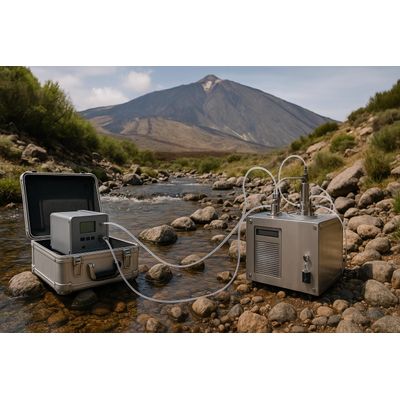
Volcanic monitoring and environmental research frequently require both gas-phase analysis and direct dissolved-gas measurements in liquids. Hiden Analytical's quadrupole mass spectrometry platforms enable these complementary measurements, with sampling via application-specific interfaces including membrane inlet probes where applicable.
For dissolved-gas workflows, membrane inlet mass spectrometry (MIMS) enables direct sampling of dissolved gases and volatile compounds from bulk liquid through a semi-permeable membrane, enabling real-time multi-species analysis.
Implications for monitoring programs
- Real-time interpretation: Dissolved-gas signatures, including CO2 and He-derived ratios, provide timely indications of hydrothermal-fluid exchange and subsurface connectivity.
- Seismic-event response: Temporal trends in CO2 and He after earthquakes can help delineate groundwater–hydrothermal coupling and potential pathways.
- Integrated sampling: Combining gas-phase and dissolved-gas measurements supports a more robust hydrogeochemical interpretation.
The application demonstrates the value of combining on-site and laboratory analyses for volcanic groundwater monitoring and the role of dissolved gases as diagnostic tracers in hydrothermal systems.
Original: https://www.hidenanalytical.com/news-press/volcanic-groundwater-monitoring-tenerife-involcan/?utm_source=rss&utm_medium=rss&utm_campaign=volcanic-groundwater-monitoring-tenerife-involcan