- Home
- Companies
- Regulator-Cetrisa
- Articles
- Eddy Currents
Eddy Currents
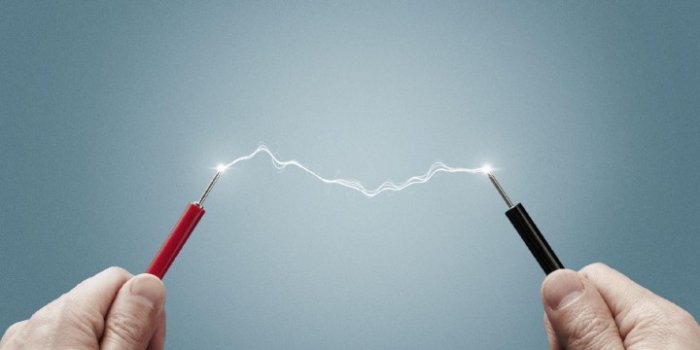
Eddy currents are an electrical phenomenon that occurs when a conductor (metal) passes through a changing magnetic field. The relative motion causes a circulation of electrons, or induced current within the conductor. These circular eddy currents create electromagnets with magnetic fields that oppose the effect of the applied magnetic field.
The eddy currents and the opposing fields generated will be stronger the
- The stronger the applied magnetic field
- The higher the conductivity of the conductor
- The greater the relative speed of movement
For a practical demonstration of eddy currents, cylindrical magnets are dropped vertically into a copper or aluminum tube. It can be verified experimentally that the force that opposes the weight is proportional to the speed of the magnet. The experience is illustrated in the attached drawing:
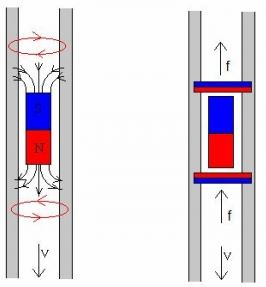
Let suppose that the cylindrical magnet descends with its North pole (red color) in front and the South pole (blue color) behind. In a magnet, the magnetic field lines are outgoing at the North Pole and incoming at the South Pole.
During the descent of the magnet, the magnetic field flux increases in the region near the North pole of the magnet. An induced current, Foucault current, originates in the tube, which opposes the increase in flow, in the direction indicated in the first figure.
The following figure shows the equivalence between currents (loops or solenoids) and magnets, so that the current induced in front of the North pole is equivalent to a magnet of opposite polarity, so they repel each other. However, the current induced behind the magnet has the same polarity so they attract each other. Both currents generate a force (f) that stops the movement of the magnet`s fall.
The same eddy current principle applies to dynamic truck brakes, a type of brake that most heavy-duty vehicles have today. Their great advantage is that they work without contact and, therefore, without wear. In these devices, disks attached to the transmission shaft rotate between electromagnets powered by a battery. To brake, current is sent to the electromagnets. The greater the speed of the vehicle, the greater the rotation of the discs between the electromagnets and the more effective the braking; that`s why they are ideal for the descents. On the other hand, its effectiveness decreases when the speed is low and disappears when stopped, which is why mechanical brakes must also be installed for slow gears.
An industrial application of eddy currents is found in motor variators. Variable speed drives are a typical application when high performance and power are required in the speed variation of an electric motor, since it is the most robust and reliable alternating current speed variation on the market. The variator is a device with magnetic coupling by eddy currents, with a total transmission of the torque from the motor to the output shaft, maintaining the torque even when the motor starts. This transmission is completely free of gears and friction. For this reason it is used in the drilling of oil wells, for example. If the shaft you are drilling gets stuck, when reaching a harder layer, the motor does not suffer as there is no direct connection through gears.
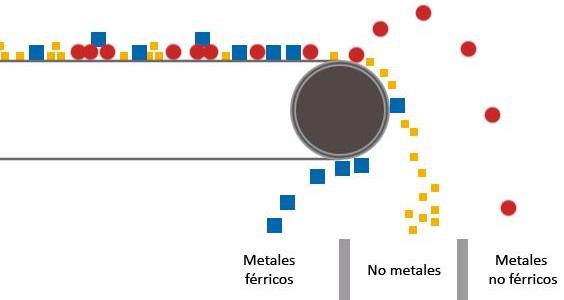
Foucault currents are those generated by induction in the metal parts that cross the inductor drum of a Foucault Current Non-Ferrous Metal Separator. In this way, a repulsive force is caused that is opposite to the effect of the inductor drum and a forward movement is thus achieved, separating from the rest of the materials that have no influence and that fall following a natural parabolic trajectory.