


Force measurement & destructive testing
What is Destructive Testing? As pinpointed by the name, Destructive Testing consists of various methods that break down a material in a controlled manner to determine mechanical properties including strength, toughness and hardness. It is often used in conjunction with non-destructive testing.
Destructive Testing — Determines robustness and specifies when and how the material is in danger of breaking/failing.
Non-Destructive Testing — Reveals if faults such as cracks and corrosion occur.
To summaries, Destructive Testing is the process of discovering if the quality of a material is good enough to withstand extreme conditions and/or to prove the material properties.
What is Destructive Testing used for? Destructive testing is most commonly used for mass produced items such as bricks and concrete, where the cost of destroying pieces during the test process is trivial.
Types of Material that undergo Destructive Testing
- Bricks
- Concrete
- Tanks
- Pipelines
- Steel
During the process, items undergo various loads which are analysed to conclude the point the material breaks. The materials need to be destructive tested as segments of the item need to be extracted before analysed.
Often regulations and/or guidelines are in place for products that under go Destructive Testing. Results are compared to determine if a product is up to standard.
Types of Destructive Testing
- Bend test
- Break test
- Tension test
- Hardness test
- Impact test
- Macro examination
- Micro examination
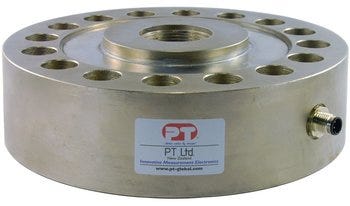
PT Limited LPCH Load Cell
Our LPCH Load Cell is available from 1t — 100t capacities and is used in Destructive Testing to measure the force applied to a load.
The LPCH is fitted with an industry standard M12 sensor connector with IP67 sealing and is supplied with a straight mating connector. The connector simplifies installation and maintenance and a cable type and length to suit the requirements of the installation can be selected from the cable packs offered by PT. Six wire cables should be installed by connecting the Sense+ with the Excitation+ to terminal 1 and the Sense- with the Excitation- to terminal 2 inside the connector.
High accuracy alloy steel construction
Ideal for materials testing, overhead and
low profile weighing.
Rugged with high overload capacity
Standard mountings-replaces LPC and
other market leaders
Recessed holes for flush mounting
Standard IP67 M12 sensor connector