


- Home
- Companies
- Picvisa Machine Vision Systems S.L.U
- Articles
- Glass sorting machine for automated ...
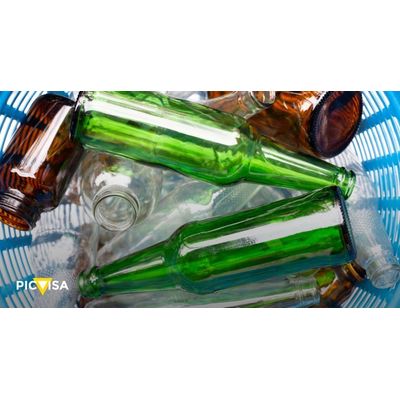
Glass sorting machine for automated cullet sorting
Glass sorting machine is designed to automate the separation of cullet based on colour, composition and the presence of contaminants. Within the glass recycling process, optical sorting is one of the key stages for producing more homogeneous cullet streams with higher purity levels.
What is a glass sorting machine?
A glass sorting machine is a system designed to automatically identify and separate glass fragments according to their composition, colour and other optical characteristics, while also detecting the presence of contaminants.
To achieve this, it combines optical sorting technology, including visible spectroscopy (VIS), near-infrared (NIR) sensors, high-resolution cameras and machine vision systems. Using the information collected by these sensors, the equipment classifies the material and produces cleaner, more homogeneous glass streams, improving the quality of the recovered material and increasing the efficiency of subsequent processing stages.
Where is a glass sorting machine integrated into a recycling plant?
A glass sorting machine can be integrated at different points within a recycling plant, depending on the facility layout and the treatment process. It is typically installed after the pre-treatment stages to sort cullet by colour and remove the contaminants defined for each process before the final quality control stages.
After crushing and screening
The glass sorting machine is installed after the pre-treatment stages, including crushing, screening and the removal of coarse contaminants.
Before cullet quality control
Installed before clean cullet storage or the final quality control stages, it acts as the optical sorting system responsible for ensuring the purity of the recovered material.
In container glass and municipal solid waste (MSW) recycling lines
In plants that recycle container glass collected through bottle banks, the incoming material is much cleaner. As a result, the optical sorting machine is installed after pre-treatment, where it performs the main optical sorting stage and removes contaminants.
In MSW recycling plants, glass is mixed with organic matter, plastics, metals and fines. For this reason, the glass sorting machine is not installed at the beginning of the process, but rather in the refining or final cleaning stage, where the material has already been screened and partially separated after the main mechanical treatment stages, allowing it to be sorted with greater accuracy.
How does automated glass sorting work?
Automated glass sorting is based on a continuous process in which different optical technologies analyse each glass fragment to identify its composition, colour and the presence of contaminants.
Based on this information, the system determines whether the material remains in the main stream or is diverted using a pneumatic ejection system.
Optical sensors and colour detection
Using visible spectrum (VIS) optical sensors, high-resolution cameras and other optical analysis technologies, the system identifies the colour of the glass and distinguishes it from other materials. This makes it possible to analyse the optical response of each fragment and automatically separate flint, green and amber glass.
Machine vision evaluates characteristics such as shape, texture and transparency to improve sorting accuracy. Detection takes place within milliseconds, allowing large volumes of material to be processed in real time.
Detection of CSP contaminants (ceramics, stones and porcelain)
CSP contaminants (ceramics, stones and porcelain) are one of the main challenges in glass recycling, as they do not melt in glass furnaces and can cause defects in new containers. To remove them, glass recycling equipment uses near-infrared (NIR) sensors and spectral analysis algorithms.
Air ejection and rejected material separation
Once the system identifies the colour or contaminant to be removed, it activates a matrix of pneumatic micro-valves to selectively eject each fragment. As the glass travels along an accelerated conveyor towards the ejection zone, precisely timed air jets divert the selected particles. CSP contaminants are directed to the reject stream, while glass of a specific colour is separated into the corresponding flint, green or amber stream. The result is clean, homogeneous material streams suitable for high-quality recycling.
What contaminants and defects can a glass sorting machine remove?
A glass sorting machine can detect and separate a wide range of contaminants and unwanted materials present in the cullet stream. Among the most critical are CSP contaminants (ceramics, stones and porcelain), which are considered one of the main challenges for the glass industry because they do not melt during the manufacturing process and can cause inclusions or breakages in new glass containers.
In addition to CSP contaminants, these systems can identify other mineral materials, including tiles, earthenware, ceramic tableware, stoneware, gravel, aggregates, minerals and technical ceramics. They can also detect different types of glass that are unsuitable for container glass recycling, such as opaque glass (ceramic glass and Pyrex®), laminated glass (windscreens), lead glass (crystalware) and enamelled or painted glass (opal or decorative glass). Thanks to their distinct optical properties, these materials can be automatically removed from the main cullet stream.
As for metals, magnetic separators and eddy current separators remove most ferrous and non-ferrous metals from the processing line. Depending on the system configuration, the optical sorting equipment can complement this process by detecting residual metal fragments, such as aluminium from caps and foils or steel from lids and screws.
Depending on the system configuration and treatment process, the machine can also detect other unwanted materials, including plastic bags and plastic film, paper and cardboard, organic matter, dust, soil and oversized uncrushed objects that could interfere with the performance of downstream equipment.
Glass colour sorting: flint, amber and green glass
Colour sorting makes it possible to detect fragments that do not belong in the target stream, such as green glass in a flint stream, amber glass in a green stream or other unwanted colour mixtures. This separation is essential for preserving cullet quality and meeting the specifications required by glass manufacturers.
The aim is to produce clean, stable cullet suitable for remelting, with purity levels above 99% in container glass recycling lines and more moderate purity levels in municipal solid waste (MSW) lines.
Technical criteria for choosing a glass sorting machine
A glass sorting machine identifies each fragment according to its colour, composition and the presence of contaminants, before separating it through a pneumatic ejection system to produce clean, homogeneous cullet.
Selecting the most suitable equipment is a technical decision directly linked to the required purity levels, processing capacity, operating costs and integration with the existing line. These are some of the main criteria to consider:
Optical and spectral technology
It is important to evaluate the detection technologies incorporated into the equipment, such as VIS and NIR sensors, high-resolution cameras and other optical analysis solutions. The system should provide an appropriate scanning speed and be capable of distinguishing colours, CSP contaminants, opaque glass, painted glass and other unwanted materials.
Detection accuracy and stream purity
The CSP contaminant removal rate, error rate and ability to correctly separate the different colour fractions — flint, green and amber — should be assessed. It is also advisable to verify that the system can maintain stable purity levels despite variations in the size or composition of the incoming material.
Processing capacity
In addition to the equipment’s nominal capacity, it is important to assess the number of tonnes per hour it can process under real operating conditions, stream stability, tolerance to variations in moisture and density, and its performance during peak loads.
Particle size range
The system’s ability to sort fine fractions below 6 mm, medium fractions between 6 and 20 mm and coarse fractions above 20 mm should be assessed according to the requirements of the container glass or MSW line.
Contaminant detection and rejection
The system should demonstrate its ability to identify and remove contaminants such as ceramics, stones, porcelain, plastics, organic matter and certain types of glass that are unsuitable for recycling, including opal glass and glass ceramics. Metal detection capabilities will depend on the equipment configuration and the complementary separation systems installed in the line.
Pneumatic ejection system
Parameters such as the number of valves, response speed, air-jet accuracy and actuator durability should also be considered, as these factors directly influence sorting quality.
Integration into the line
It is advisable to check the equipment’s compatibility with conveyor belts, vibratory feeders, screening systems and the available space within the plant, as well as how easily it can be integrated into the rest of the process.
Software, AI and traceability
Key elements include sorting algorithms, the machine’s self-learning capabilities, its data-recording functions, connectivity with Manufacturing Execution Systems (MES) and Enterprise Resource Planning (ERP) systems, and its auditing capabilities.
Operating costs, maintenance and robustness
Energy consumption, the availability and cost of spare parts, ease of cleaning and maintenance, and the service life of valves and sensors should all be considered. In municipal solid waste lines, it is also advisable to assess the equipment’s performance in the presence of moisture, mud, fine particles, residual organic matter and variations in stream composition.
Scalability
Finally, it is worth assessing whether the system allows processing capacity to be expanded, new detection technologies to be incorporated or a second optical sorter to be integrated for an additional refining stage.
ECOGLASS by PICVISA for automated glass sorting
The ECOGLASS optical sorter, developed by PICVISA, is designed to automate the sorting and separation of glass and other materials according to their composition and colour. Using near-infrared (NIR) technology, machine vision and artificial intelligence, ECOGLASS supports the recovery and cleaning of glass from different waste streams.
The latest ECOGLASS models specialise in CSP contaminant removal and colour sorting. They feature bullet valves that improve sorting accuracy and produce cleaner recovered material. As a result, the solution is suitable for both glass recycling plants and municipal solid waste treatment lines.
ECOGLASS can identify contaminants, dark glass and other unwanted materials present in the stream, helping to minimise rejects and increase recovery rates. Through the integration of artificial intelligence, it optimises material detection and separation, improving the efficiency of the sorting process.
When to upgrade a manual or outdated glass sorting line
If a line cannot guarantee purity levels above 95%, operates at a capacity below 6–8 tonnes per hour or relies on continuous manual inspection, it may be time to consider upgrading it. Incorporating technologies such as NIR and VIS sensors, high-resolution cameras and pneumatic ejection systems makes it possible to automate sorting, increase processing capacity and improve the quality of the recovered material.
One example is PICVISA’s automated glass sorting case study at TM Alcudia, a plant located in Mallorca. The facility processes up to 25 tonnes of glass per hour, maximises recovery rates and produces high-purity recycled glass fractions, contributing to the advancement of the circular economy in the Balearic Islands.
Upgrading a glass sorting line can improve cullet purity, increase processing capacity and reduce reliance on manual inspection. At PICVISA, we develop optical sorting solutions tailored to the characteristics of each material stream and the specific requirements of each plant.
Contact our team to learn how ECOGLASS can help optimise your glass sorting process.