Innovative Working Environment
Fat deposits in hoods cause fires – and in many industrial kitchens, indoor climate and working environment are anything but optimal. With a new solution, the Jimco Group makes elimination of fat particles affordable to everyone.
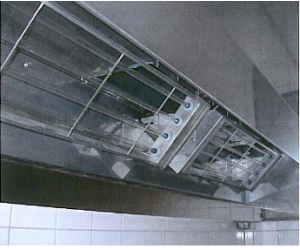
The Opera House in Oslo has mounted one of the most effective KPC facilities in their restaurant kitchen. The plant has now been operating for 1 1/2 years and as you can see the air ducts still perfectly clean.
The media often report fires and explosions in restaurants and large-scale kitchens, in many cases due to the combination of fat
deposits in hoods and spurts of flame – indeed an explosive cocktail. Jimco A/S of Denmark has since 1993 developed and manufactured UV-C based systems for air purification, and with the brand new product line, KPC-B, advanced oil and fat elimination technologies are offered at a price that suits even small restaurant keepers.
Initially, Jimco primarily supplied to the food industry, but since then UV-C technology has also become common amongst restaurants and caterers. - From the beginning, our air purification concept for food environments attracted great interest. At the same time, we learned that restaurants and other large-scale kitchens had a real challenge cleaning hoods and air ducts. Although it is statutory to keep the ducts clean in many countries, years often pass between each treatment That made us develop a solution suitable for any food preparation environment, says CEO Jimmy Larsen. Hence, in 1996, Jimco started manufacturing equipment for restaurants and the catering industry, labelled KPC (Kitchen Pollution Control). Today, the products are installed worldwide, e.g. in kitchens of nursing homes and hospitals and by international chains such as KFC, Hilton, Marriott and McDonald`s.
Fat Particles Are Converted into Water
KPC is based on Jimco`s UV-C technology that has received the EU Environmental Award. Basically, the products function in the same manner as the company`s systems for production environments which are e.g. used in food factories.
The KPC device is placed behind the grease filter of the hood. The air extracted is then treated with light from the system`s UV-C lamps, and the ultraviolet rays react against grease and odour particles. The grease is thus transformed into carbon dioxide, oxygen, and water which is derived , says Jimmy Larsen. That way, the deposition of oil and fry grease in the hood is prevented, while odours in the building and surrounding environment are minimized.
Up to 99% of the particles passing through are removed. The system also reduces concentrations of nitric oxide, which is unhealthy to inhale on a large scale. Hence, it contributes to better indoor climate and air quality, says the CEO. He also stretches that inside cleaning of hoods and ducts virtually becomes superfluous.
According to Jimmy Larsen, concerns regarding indoor climate, working environment and accident prevention are the customers` main reason for purchasing KPC products, but other considerations are also important. - Due to fat deposits, fan speed and hence the efficiency of the exhaust ventilation decreases over time. And when customers enter a place that smells strongly of cooking fumes or frying, they quickly lose their appetite, he says
Up to 40% Cheaper
The Jimco Group believes there is a substantial potential for increased sales of KPC systems -even to customers with limited budgets. This has made the company develop a new and cheaper series, KPC-B, with simplified design and assembly. - We know that KPC makes a difference in many kitchens, not least in preventing frying fires. With the new version you can save up to 40%: depending on individual needs and installation conditions, says Jimmy Larsen. At the same time, Jimco now introduces an optional CIP (Cleaning in Place) solution for the UV-C lamps of the KPC system. - With the new PLC controlled, automated solution for washing and rinsing the lamps, the KPC device virtually becomes maintenance-free. Jimmy Larsen concludes