
Refine by
Nir Spectroscopy Articles & Analysis: Older
212 articles found

Blooms or bombs? As the global population steadily increases, it is important that sufficient crops are produced each year to provide enough food, clothing, and other products. Crops such as corn, wheat, soy, and cotton receive nutrients from the soil they are grown in. Fertilizers play a crucial role in providing these crops with the nutrients they need to grow ...
ByB&W Tek

l Fluorometric assays: Offer higher sensitivity using fluorescent derivatives. l Near-Infrared (NIR) spectroscopy: Allows rapid, non-destructive estimation of proline levels in intact tissues. ...

This technical digest covers the fundamentals of raman spectroscopy and instrumentation. Topics include the history of raman spectroscopy, what raman is and how it works, raman instrumentation, and common applications. ...
ByB&W Tek

Fluorescent biopolymers are a critical link between biological science and advanced technology, finding essential applications in bioimaging, targeted drug delivery, and medical diagnostics. As their usage becomes more widespread, researchers and industry professionals often grapple with questions about their core properties and practical challenges. This article aims to clarify these key points. ...
ByMatexcel

How are recycling robots using AI to improve waste management? The scale of the task means that manual sorting is slow, costly, and inefficient. However, thanks to technological advances, everything we discard—and that used to end up abandoned in landfills—can now be identified, selected, sorted, and analysed at high speed and with great precision, thanks to optical sorters and recycling robots, ...

For example, with textile waste, we use artificial vision, which captures and analyzes real-life images, combined with near-infrared spectroscopy (NIR) to identify composition. This technology, mainly represented by our ECOSORT TEXTIL, enables the administration of thousands of tons of textiles annually. For glass, the ECOGLASS optical separator classifies and ...

Optical and Physical Properties of UCNPs The luminescence of UCNPs originates from the step-by-step energy level transition of lanthanide ions. For example, after Yb³⁺ absorbs NIR photons (980nm), it excites Er³⁺ (emitting green light, 550nm) or Tm³⁺ (emitting blue light, 450nm) through energy transfer, and finally emits visible light through the anti-Stokes effect. By adjusting ...

Cut waste, catch problems early, and hit quality targets—biofuel producers use Fourier transform near-infrared (FT-NIR) spectroscopy to make that happen. This real-time tool measures key chemical properties in ethanol, biodiesel, and renewable diesel as production runs. FT-NIR keeps operations tight by tracking critical variables without ...
Upconverting nanoparticles (UCNPs) break through the traditional Stokes limit and achieve "anti-Stokes luminescence" by absorbing low-energy near-infrared photons and emitting high-energy visible/ultraviolet photons. This feature makes it show revolutionary potential in the fields of biomedicine and energy, especially in deep tissue penetration and low background noise. High quantum yield UCNPs ...
Fourier-transform near-infrared (FT-NIR) spectroscopy is an indispensable tool for polymer manufacturers, providing rapid, non-destructive analysis that enhances quality control and streamlines manufacturing workflows. By integrating real-time FT-NIR analysis, manufacturers can achieve greater accuracy, reduced waste, and improved efficiency, ...
As production processes become more complex, the need for real-time, data-driven quality control has never been greater. Near-infrared (NIR) spectroscopy is essential for advanced monitoring of drug manufacturing, enabling rapid, non-destructive analysis throughout the production chain. By integrating NIR spectroscopy into ...
Pharmaceutical manufacturers face growing challenges in ensuring product quality, maintaining regulatory compliance, and safeguarding against counterfeit drugs. Near-infrared (NIR) spectroscopy is an important tool in this arena, offering rapid, non-destructive analysis for raw material identification, impurity detection, and counterfeit screening. By integrating ...
With the increasing demand for precision in livestock nutrition, accurate feed analysis has never been more essential. Near-infrared (NIR) spectroscopy has enhanced quality assessment, providing rapid, non-destructive analysis of key parameters such as moisture, protein, fat, and ash content. ...
Farmers and agronomists must make informed decisions about soil health, fertilizer application, crop nutrition, and overall quality control to maximize yields while minimizing environmental impact. Near-infrared (NIR) spectroscopy is a key technology in enabling rapid, non-destructive analysis of agricultural samples. By delivering real-time, actionable insights, ...

The importance of enhanced sorting and separation in material recovery Enhanced sorting and separation in material recovery is crucial due to the complexity and diversity of waste materials. Effective separation is essential for recycling operations to recover valuable materials, reduce contamination and improve the quality of recycled products. But sorting also poses challenges because of the ...

In the rapidly evolving field of bioimaging, researchers are continually seeking innovative methods to enhance the sensitivity and resolution of their imaging techniques. One such method that has gained significant attention in recent years is Quantum Dot Labeling (QDL). This article will delve into the principles of QDL, its benefits, and its vast applications in biological research and ...

We offer traditional methods, such as Karl Fisher coulometric titration, thermo-gravimetric analysis (TGA), near-infrared (NIR) spectroscopy, and frequency modulation spectroscopy (FMS). We also offer new technologies: headspace vapor measurement method. ...
This article investigates the effect of temperature on near-infrared (NIR) absorption spectroscopy and why it is crucial to control it – especially when analyzing liquid samples. These insights will help you to understand how to improve the accuracy and repeatability of NIRS measurements. ...
ByB&W Tek
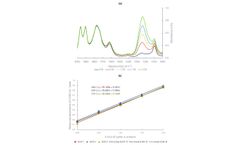
The optimal pathlength for an on-line FT-NIR process measurement needs to be determined by experimentation. Here we demonstrate the feasibility of measuring water in acetone by NIR spectroscopy at various pathlengths using an adjustable Spyder™ process flow cell, as a prelude to full-scale implementation of NIR process analysis ...
BySpecac

The capability of Sentinel-5p foraerosol monitoringis currently not used to its full potential. However, satellite observations in the spectral range from approximately 340 to 400 nm are known to have unique sensitivity to elevation and absorption of tropospheric aerosols. Traditionally, this sensitivity is used in many ozone monitoring instruments such as TOMS, GOME-1, SCIAMACHY, OMI and GOME-2 ...