

Persistent Lagoon Problems: A Systemic Fix
Lagoon management for livestock operations often devolves into a cycle of recurring issues. Crusting at the surface, inconsistent pump-out, rising odor, and persistent fly pressure recur even with regular treatment. These outcomes reflect how the lagoon functions as a dynamic biological system rather than a simple storage vessel.
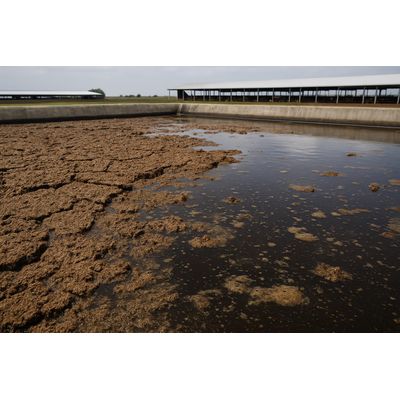
Manure lagoons receive a continuous load of organic material—manure, feed residue, bedding, and wash water. Over time, not all material fully degrades; it accumulates, segregates into layers, and forms stable structures. The surface layer is especially critical: lighter materials bind to create a crust that traps moisture and nutrients while sustaining microbial activity. Beneath the crust, decomposition remains incomplete, allowing partially degraded material to persist.
\n
As organic material stabilizes, the lagoon`s processing efficiency declines. Operators observe thicker sludge, reduced flow, and difficulties during pump-out. The surface environment also becomes optimal for fly development, as moisture and nutrients support reproduction. These issues are interrelated, driven by a system that has become structurally resistant to change.
\n
Traditional treatments tend to target individual symptoms—odor control, fly control, or chemical adjustments—without altering the underlying lagoon structure. Biofilm and bound organic material continue to maintain the conditions that enable persistence, so treatments may yield temporary relief before the system reverts to prior conditions.
\n
A holistic approach treats the lagoon as a connected system, addressing both its physical structure and how organic material is processed. The strategy combines biosurfactant technology with stabilized oxidative chemistry to disrupt the structural integrity of the surface and improve material turnover.
\n
FlyGuard JC-9620 is designed to disrupt the surface structure that supports crust and biofilm. By interacting with water and organic material, it weakens the forces that maintain the crust, releasing trapped moisture and redistributing material throughout the lagoon. This reduces surface stability and makes the environment less conducive to ongoing fly development, effectively removing the conditions that enable persistence rather than directly targeting flies.
\n
JC-9465 complements this by strengthening the oxidative environment, enhancing the breakdown of organic compounds and stabilizing microbial activity. This enables more efficient processing of accumulated material and helps regulate odor-causing compounds, leading to improved water quality over time.
\n
When deployed in sequence, these approaches restore system function: structural barriers are disrupted, the lagoon regains processing capacity for incoming organic load, and metrics such as crust formation, pump-out performance, odor, and fly pressure improve with greater consistency. The benefit extends beyond the lagoon to facility hygiene and downstream processes, reducing the need for reactive treatments.
\n
Industry pressures—both regulatory and operational—are increasing, elevating the importance of solutions that improve overall system performance rather than solely managing symptoms. Treating the lagoon as a dynamic system supports a more sustainable and effective waste-management model.
\n
When lagoon issues persist despite consistent treatment, the root cause lies in an unaddressed core structure. Disrupting that structure and enabling effective processing yield lasting improvements in lagoon performance.
\nOriginal: https://jenfitch.com/livestock-lagoon-treatment/