


- Home
- Companies
- Oizom Instruments Pvt. Ltd.
- Articles
- Role of Humidity Sensors in Forecasting ...
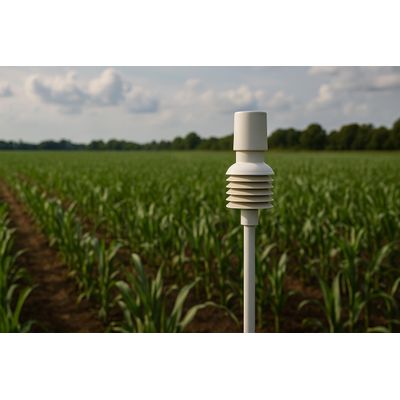
Role of Humidity Sensors in Forecasting Crop Moisture Needs
Humidity sensors measure atmospheric water vapor concentration to forecast crop water loss and optimize irrigation timing. As relative humidity declines, vapor pressure deficit rises, increasing crop transpiration and irrigation requirements. When combined with temperature, wind speed, and solar radiation, humidity data underpin ET0-based irrigation scheduling—the FAO Penman-Monteith method for estimating actual crop water needs. In the Indian policy context, continuous humidity measurement is being integrated into PMFBY weather-based claim verification and is promoted under ICAR's Precision Agriculture Mission for data-driven irrigation scheduling. Deploying humidity sensors on farms or via agri-tech providers enables reductions in irrigation water use by 20–35% without compromising yields, while meeting evolving regulatory requirements.
Why Predicting Crop Moisture Needs Is Getting Harder
- Monsoon unpredictability: The monsoon rains have become less predictable in timing and spatial distribution, with the southwest monsoon contributing about 70% of India’s annual rainfall; farmers experience drought and flood years in many districts.
- Accelerating evapotranspiration: Global temperature rise increases atmospheric moisture loss from crops and soil; the Penman-Monteith equation remains the reference for ET0 and includes humidity as an input, so lower humidity increases ET0 for the same rainfall.
- Irrigation inefficiency: Estimates suggest 30–40% of irrigation water is lost due to over-application or fixed schedules, underscoring the need for crop-specific water indicators under current conditions.
What Are Humidity Sensors, and How They Work?
Humidity sensors, or hygrometers, measure atmospheric water vapor concentration, typically expressed as relative humidity (RH). In agriculture, they are deployed at canopy height in open fields, integrated with greenhouse climate controls, or mounted on weather stations at field perimeters.
- Capacitive Humidity Sensors: measure moisture via changes in electrical capacitance, offering high accuracy (approximately ±2 to 3% RH), good long-term stability, and operation from 0 to 100% RH.
- Resistive Humidity Sensors: measure moisture by conductivity changes; lower cost but higher susceptibility to contamination and drift in dusty farm environments.
- IoT-Enabled Digital Humidity Sensors: integrate sensing with wireless connectivity (LoRaWAN, 4G, NB-IoT) for real-time data transmission to centralized dashboards, essential for large-scale deployments.
Why Air Humidity Directly Affects Crop Water Demand
Evapotranspiration (ET) combines soil evaporation and plant transpiration, and humidity is a key input. Low RH raises vapor pressure deficit (VPD) between the plant and ambient air, increasing transpiration and water loss. High RH lowers VPD and reduces transpiration. Consequently, fields with identical crop, temperature, and soil moisture can require different irrigation amounts depending on daily humidity. The following ranges reflect indicative RH thresholds for common crops, drawn from crop science research and validated through field deployments:
- Wheat: Optimal RH 40–70%; critical growth stage during grain filling; risk of water stress and reduced yield below threshold; risk of fungal disease above threshold (rust, powdery mildew).
- Rice / Paddy: Optimal RH 70–90%; critical during flowering; risk to pollination below threshold; blast disease and sheath blight risk above threshold.
- Maize / Corn: Optimal RH 50–80%; critical at tasselling; risk of heat stress and pollen viability loss below threshold; gray leaf spot and northern leaf blight risk above threshold.
- Cotton: Optimal RH 50–70%; critical at boll formation; risk of premature boll drop below threshold; boll rot and increased pest pressure above threshold.
- Greenhouse Vegetables: Optimal RH 60–80%; all growth stages; tip burn and wilting below threshold; botrytis and downy mildew infection above threshold.
- Sugarcane: Optimal RH 70–85%; grand growth phase; reduced juice content and stunted growth below threshold; red rot and smut susceptibility above threshold.
- Tea / Coffee: Optimal RH 70–90%; flush/berry development; leaf scorch and twig dieback below threshold; blister blight and black rot risk above threshold.
Evapotranspiration: The Science Connecting Humidity To Irrigation Needs
ET0 is a principal variable linking atmospheric conditions to crop water requirements; the Penman-Monteith equation is the standard reference method for determining ET0 and incorporates four primary inputs: air temperature, solar radiation, wind speed, and relative humidity. In simplified terms: ET0 is a function of temperature, solar radiation, wind, and humidity. A humidity drop of 20% on a hot, calm afternoon can increase ET0 by 30–50%, raising midday crop water demand. Fixed irrigation schedules cannot adapt; sensor-driven systems can. Humidity, when interpreted with other inputs, is among the most actionable signals for precision irrigation planning.
— Sohil Patel, CTO, Oizom
The 4-Step Humidity-to-Irrigation Workflow
- Measure real-time RH using canopy-height sensors to capture crop-level moisture conditions.
- Calculate vapor pressure deficit (VPD) by combining RH and temperature to gauge atmospheric water-demand intensity.
- Run Penman-Monteith ET0 calculations using humidity, solar radiation, and wind data to estimate crop water loss.
- Trigger irrigation when the crop water deficit reaches a defined threshold, automating decisions based on actual crop demand rather than fixed schedules.
India Focus: Regulatory And Scheme Context For Humidity Monitoring
- PM-KUSUM: Solar-powered pump scheduling; weather and humidity data increasingly required for water audits.
- PMFBY Crop Insurance: Automated weather data, including humidity, mandated for weather-based claim validation.
- ICAR Precision Agriculture Mission: Promotes IoT-based field monitoring, including humidity sensors for irrigation scheduling and stress detection.
- National Clean Air Programme: Humidity data used to assess fire weather and dust suppression related to agricultural burning and tilling.
- State Smart Agriculture Pilots: Funding for sensor deployment and real-time weather-humidity monitoring infrastructure.
Sector -Wise Application Of Humidity Monitoring
Open-field Cereal Crops (Wheat, Maize, Sorghum)
The primary function is ET0-based irrigation scheduling; humidity at canopy height paired with temperature and wind allows triggering irrigation 18–24 hours before stress becomes visible, protecting yield during critical grain-filling periods, particularly in regions such as the Rabi season in northern India.
Paddy / Rice Cultivation
Rice, as a water-intensive crop, benefits from humidity monitoring for disease risk management: prolonged humidity above 85% during flowering and grain filling increases blast disease and bacterial blight risk; humidity-enabled timing supports targeted fungicide application, reducing chemical use and protecting yield.
Protected Horticulture and Greenhouse Farming
Greenhouses require maintaining RH within about 60–80% to avoid heat stress and humidity-driven diseases; continuous humidity monitoring enables automated control of fans, foggers, and vents to sustain optimal conditions and protect yield and quality within 24–48 hours of excursions.
Plantation Crops (Tea, Coffee, Sugarcane)
Sugarcane deployments have shown irrigation cycle reductions of about 15–25% when integrating humidity data with ET0; for tea and coffee, humidity monitoring primarily supports disease suppression and harvest timing optimization.
How Humidity Sensors Improve Crop Moisture Forecasting
Continuous humidity data transforms irrigation management from reactive to proactive. When integrated with temperature, wind, and solar radiation, humidity trends enable ET0 calculations and irrigation alerts across multiple locations from a single platform.
Humidity Sensors vs Soil Moisture Sensors: A Direct Comparison
- Parameter — Humidity Sensors vs Soil Moisture Sensors
- Measures — Atmospheric water vapor (RH%) vs Water available in root zone
- Primary Purpose — Forecast crop water demand via ET0 and VPD vs Measure current soil water availability
- Decision Insight — Predicts future water needs vs Confirms current availability
- Response Timing — Early warning of atmospheric demand vs Confirms depletion status
- Best For — Irrigation scheduling, disease forecasting, greenhouse climate control vs Irrigation validation, preventing under- or overwatering
- Typical Placement — Canopy height or weather station mast vs Root depth sensors
- Limitation — Cannot confirm root-zone water status vs Cannot predict future atmospheric demand
- Best Practice — Combine with weather variables for ET0 calculation vs Combine with humidity-based forecasting for full irrigation intelligence
How Integrated Environmental Monitoring Improves Forecasting Accuracy
Humidity sensors are most effective when integrated into a broader field-monitoring system that also measures temperature, wind, solar radiation, rainfall, and CO2. A field station that captures these parameters enables Penman-Monteith ET0 calculations and supports cross-location irrigation decisions. Some platforms provide integrated sensors and dashboards to visualize humidity trends, ET0, and irrigation alerts across multiple fields.
Weathercom measures all four Penman-Monteith inputs—temperature, humidity, solar radiation, and wind speed—in a single field-deployable unit, reducing data gaps that arise from sourcing parameters separately. It feeds into an integrated platform for centralized monitoring of humidity trends, ET0, and irrigation alerts across locations. Broader environmental intelligence can be layered through complementary systems for ambient air quality and dust monitoring in agri-industrial zones where external atmospheric disturbances may influence crop microclimates.
Case Study: Department of Agriculture, Region IV-A, Philippines
In August 2025, the Philippines Department of Agriculture partnered to deploy 11 Weathercom stations in Lobo, Batangas, under the Adaptation and Mitigation Initiative in Agriculture program. The solar-powered stations monitor temperature, relative humidity, precipitation, solar irradiance, wind speed/direction, and barometric pressure, transmitting data in real time via 4G and LoRaWAN to an integrated platform. This enables data-driven planting, irrigation, and harvest timing decisions, supporting climate-smart practices and alignment with national resilience and SDG objectives.
What A Well-Monitored Farm Looks Like
Deploying humidity sensors is an ongoing system design and maintenance task. A practical deployment timeline:
- Month 0–1: Assessment and Sensor Network Design
- Identify priority crops, field sizes, and irrigation infrastructure
- Site survey for wind patterns, microclimate variation, proximity to water bodies, and humidity gradients
- Define monitoring approach: perimeter weather station, canopy-height sensors, or greenhouse-integrated sensors
- Determine data transmission approach: LoRaWAN for open fields, Wi-Fi or 4G for greenhouses
- Month 1–2: Deployment and Integration
- Install calibrated sensors at defined heights (1.5–2 m for open fields; 0.3–0.5 m above canopy in greenhouses)
- Integrate with central data platform and irrigation control or ERP systems
- Configure crop-specific RH thresholds
- Month 2–3: Baseline Establishment
- Run continuous monitoring to establish baseline RH, temperature, ET0 patterns
- Validate data quality and identify sensor drift or data gaps
- Correlate readings with irrigation events and crop observations
- Month 3 Onward: Operational Irrigation Management
- Activate ET0- or VPD-based irrigation triggers
- Train operators to interpret alerts and distinguish anomalies
- Generate weekly and monthly humidity and ET0 summaries for regulatory reporting
The transition point is when the farm operator shifts from checking a weather app to monitoring the sensor dashboard.
Factors To Consider When Deploying Humidity Sensors
- Sensor Placement Outdoors: mount at 1.5–2 m; in greenhouses: 0.3–0.5 m above canopy; expect 10–15% RH variation across large structures.
- Coverage Area and Density Outdoor: 1 sensor per 2–5 ha; greenhouse: 1 per 500–1000 m2; higher value crops or stricter compliance justify higher density.
- Durability and Ingress Protection Ensure devices withstand field conditions (0–100% RH, -10 to +60 C) and have IP65 rating for outdoor use.
- Integration with Irrigation Systems Ensure compatible protocols (MODBUS, MQTT, REST API) for seamless control.
- Calibration and Maintenance Calibrate every 6–12 months; document calibration events for compliance; use automatic drift alerts.
Common Humidity Sensor Deployment Failure Modes
- Sensor placement near irrigation lines or wet soils can bias readings, with post-irrigation RH readings overestimating ambient conditions.
- Proximity to bodies of water, depressions, or waterlogged areas can create localized RH that misrepresents broader conditions.
- Misplaced sensors high or low may measure ambient air rather than crop stress; cross-check across locations to detect anomalies.
- Mitigation: implement automated anomaly detection and correlate with agronomic observations.
Measurable Benefits Of Humidity-Based Crop Monitoring
- Water Efficiency: ET0- and humidity-based irrigation can reduce water use by 20–35% in drip systems without yield loss.
- Yield Improvement: Sensor-guided climate control in greenhouse environments can raise yields by 20–25% vs fixed schedules.
- Disease Cost Reduction: Humidity-triggered fungicide timing in rice and tea can reduce unnecessary applications by 30–40% while maintaining disease control.
- Irrigation Labor Reduction: Automated triggers reduce manual irrigation decisions and labor in large operations.
- Regulatory and Insurance Compliance: Calibrated humidity records support PMFBY data requirements and enable faster automated claim processing.
Conclusion
Humidity is a key driver of crop water demand, disease risk, and irrigation efficiency. As policy frameworks favor automated monitoring, humidity sensors transition from optional equipment to essential infrastructure. Organizations that integrate humidity into their irrigation intelligence yield advantages in water efficiency, crop health, and compliance readiness. Data supports agronomic judgment rather than replacing it; in peak-season conditions where a single trend can determine yield outcomes, humidity data sharpens decision-making.
FAQs
Q1. How do humidity sensors help agri-tech platforms decide when to irrigate?
They feed ET0 and VPD calculations, measuring atmospheric water loss and pressure deficits. Platforms that integrate RH with temperature and solar radiation can dynamically calculate ET0 and trigger irrigation based on actual crop water deficit, avoiding under- or over-irrigation.
Q2. What is the difference between humidity sensors and soil moisture sensors?
Humidity sensors forecast future water demand by measuring atmospheric humidity, while soil moisture sensors quantify current water availability in the root zone. A complete irrigation intelligence system relies on both to compare predicted demand with actual soil moisture.
Q3. Which crops in India benefit most from humidity monitoring?
All major crops benefit, with crop-specific advantages: wheat and maize through ET0-based scheduling during critical growth stages; rice through irrigation efficiency and disease-risk management; greenhouse vegetables for yield quality and disease control; tea, coffee, and sugarcane for disease suppression and irrigation reduction.
Q4. Can humidity monitoring data be used for PMFBY crop insurance compliance?
Yes. As PMFBY claim validation shifts toward automated weather-station data, continuous humidity records become a compliance requirement, enabling faster automated claim processing with verified data continuity and calibration records.
Q5. How do I choose the right humidity sensor system for a precision farming deployment?
Match the system to scale and integration needs: for open fields, prioritize IoT-enabled capacitive sensors with LoRaWAN or 4G, IP65 protection, and ET0 support; for greenhouses, ensure multi-node support and compatibility with MODBUS or MQTT. Evaluate total cost of ownership over three years, including calibration, maintenance, and data downtime, not just upfront hardware cost.
Original: https://oizom.com/role-of-humidity-sensors-in-forecasting-crop-moisture-needs/