

- Home
- Companies
- ARTang Group
- Articles
- Several commonly used flowmeters
Several commonly used flowmeters
Vortex Flowmeters
Vortex flowmeters have a wide adjustable range and can be used for the measurement of the flow of a variety of process media, such as liquids, gases and steam can be measured. However, due to the Carmen vortex needs to be generated under certain speed conditions, so the vortex flowmeter has a high zero cut point. The minimum flow rate that can be measured by a vortex flowmeter is limited by the Reynolds number, the flow rate of the fluid and the signal-to-noise ratio (frequency interference).
Usually vortex flowmeter selection:
1. Reynolds number can not be lower than 20000, in normal or abnormal process conditions, the Reynolds number is higher than 40000 better. 2.
2. When measuring liquids, pay attention to prevent cavitation phenomenon, cavitation phenomenon will lead to the loss of the measurement signal and damage to the flowmeter and downstream piping;
( 3) vortex flowmeter should not be used for wet gas or wet steam and other two-phase flow measurement;
( 4) vortex flowmeter can not be used for particularly viscous, waxy or erosive media;
( 5) usually for the purpose of ensuring that the vortex flowmeter in the smallest possible flow conditions (such as start-up), the flowmeter diameter is usually higher than the minimum flow conditions can be operated (e.g., the flowmeter is not suitable for the flowmeter). (5) Usually to ensure that the vortex flowmeter can be operated under the minimum flow conditions (such as start-up), the caliber of the flowmeter is usually reduced by 1 or 2 levels compared with the pipe diameter (such as pipe diameter of DN100, the caliber of the flowmeter selected should be DN80 or DN50). And if both levels of flowmeter can cover the maximum and minimum flow, should choose the smaller diameter flowmeter.
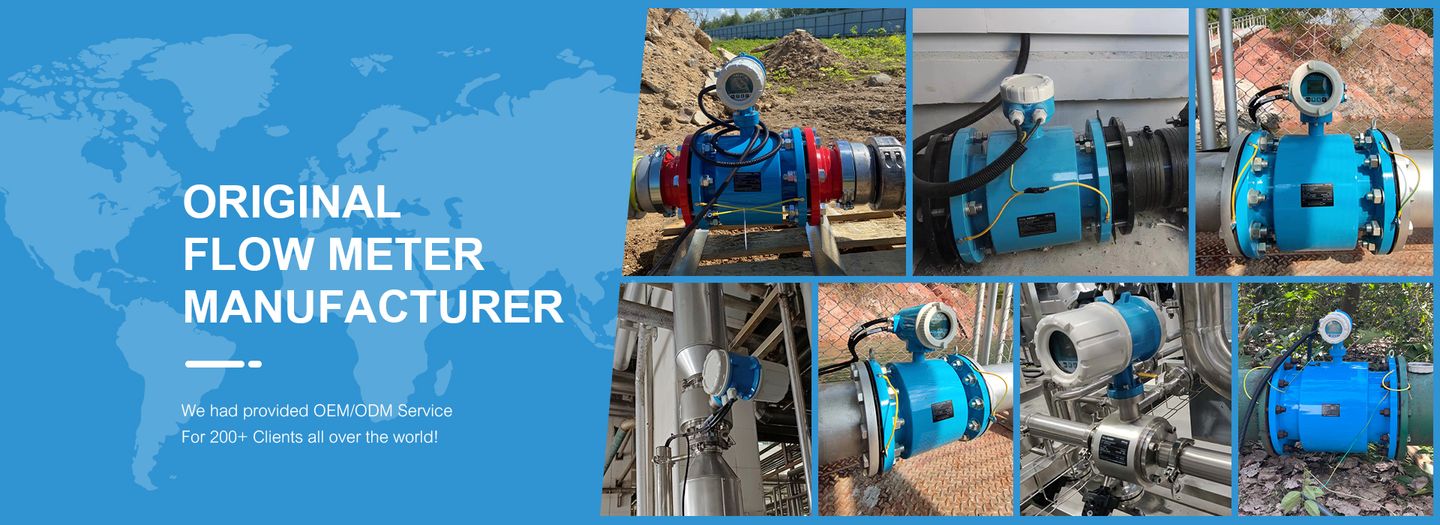
Electromagnetic Flow Meters
Electromagnetic flow meters are based on the principle of electromagnetic induction. It is suitable for flow measurement of most electrically conductive liquids, but not for gases and steam. Can be used for flow measurement of dirty, greasy media as well as untreated sewage and liquids containing solids.
Electromagnetic flowmeter selection
( 1) Consider the conductivity of the fluid. The minimum required conductivity should refer to the manufacturer's recommendations, generally required conductivity of 0.05 to 20 μS / cm;
( 2) the choice of lining materials, generally there are PTFE, PFA, ceramic and rubber and other optional materials.
PTFE is the most commonly used lining material. Because it can not be pasted on the inside of the shell, it is not suitable for vacuum conditions. At the same time, some liquids are able to penetrate PTFE, resulting in short circuits and corrosion of the flowmeter components;
② PFA, less permeable than PTFE, but easily deformed by temperature and pressure changes;
③ ceramics, suitable for a variety of application conditions, but this material is more sensitive to temperature fluctuations and pipeline stress;
④ rubber, neoprene or natural rubber is the cheapest lining, mainly used for the measurement of water;
( 3) When choosing the electrode material for electromagnetic flowmeter, not only the corrosion resistance to the measured medium should be considered, but also the avoidance of electrode surface effect.