


Strategic Innovations in High-Performance Lithium Batteries: Synergistic Approaches to Sustainable Material Recycling, Advanced Interface Engineering, and High-Safety Electrolyte Systems
The Battery Research Center of Green Energy (BRCGE) at Ming Chi University of Technology (MCUT) in Taiwan leads energy storage innovation in high voltage, high safety chemistries. The center advances sustainable material recycling, advanced interface engineering, and high-safety electrolyte systems through targeted cathode, electrolyte, and separator architectures.
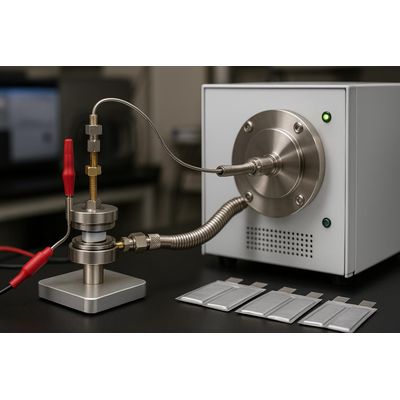
A critical validation tool is the Hiden HPR-40 DEMS. Differential Electrochemical Mass Spectrometry combines in situ electrochemical testing with real-time gas analysis to reveal electrolyte decomposition and interfacial reactions by monitoring gas evolution such as hydrogen, carbon dioxide, carbon monoxide, oxygen, hydrogen sulfide, and sulfur dioxide.
Case studies and supporting evidence
- Sustainable cathode and Ta-modification stability. Recycled LiNi0.5Mn1.5O4 (LNMO) demonstrates zero detectable O2 evolution at 5.4 V. Operando DEMS on Ta-modified Ni-rich NCM92 cathodes shows substantially reduced CO2 and H2 outgassing, indicating the Ta-enriched layer suppresses electrolyte decomposition and surface reactions.
- Solid-state and hybrid safety validation. For the solvent-free dual-salt polymer electrolyte system, in situ DEMS confirms no CO2 or O2 evolution during cycling. Thermally extruded composite solid electrolytes (TECSEs) show high interfacial stability with no detectable H2, CO2, or O2 during cycling. In bilayer hybrid solid electrolytes (Bi-HSEs) with modified Li anodes, DEMS reports much lower gas intensities for O2, CO, and C2H4 than in liquid electrolytes, consistent with protective coatings (g-C3N4/ZIF-8/PVDF) on the Li metal anode for all-solid-state Li metal batteries.
- Suppressing gas evolution in Li-rich, Li-SPAN, and NCM811 cathodes. LaF3 coatings suppress reactive oxygen release in cobalt-free cathodes. Real-time detection of sulfur species confirms suppression of moisture-induced gas evolution via multifunctional separators. For Li-rich NCM811 cathodes modified with Li-BTJ oligomer and PDA-VGCF, in situ DEMS verifies zero O2 evolution at high voltage, indicating improved structural stability and thermal safety relative to bare NCM811.
The HPR-40 DEMS serves as an essential validation engine for MCUT, delivering high-resolution, real-time gas data to enhance the safety and performance of next-generation lithium batteries for a sustainable energy future.
Key publications supporting these findings include:
- Journal of Colloid and Interface Science 689 (2025) 137221
- Journal of Colloid and Interface Science 661 (2024) 289
- Journal of Energy Storage 110 (2025) 115335
- Journal of Energy Storage 136 (2025) 118457
- Journal of Energy Storage 76 (2024) 109757
- Small 22 (2026) e13303
- ACS Applied Materials & Interfaces 16 (2024) 21034
- Journal of Colloid and Interface Science 707 (2026) 139743
Project summary by Yi-De Tsai, Yi-Shiuan Wu, and Chun-Chen Yang, Battery Research Center of Green Energy, Ming Chi University of Technology, New Taipei City, Taiwan, ROC.
The HPR-40 DEMS product line provides high-resolution, in real-time gas monitoring to validate material innovations that enhance safety and performance in next-generation lithium batteries.
Original: https://www.hidenanalytical.com/research/strategic-innovations-in-high-performance-lithium-batteries-synergistic-approaches-to-sustainable-material-recycling-advanced-interface-engineering-and-high-safety-electrolyte-systems/?utm_source=rss&utm_medium=rss&utm_campaign=strategic-innovations-in-high-performance-lithium-batteries-synergistic-approaches-to-sustainable-material-recycling-advanced-interface-engineering-and-high-safety-electrolyte-systems