


- Home
- Companies
- Claytek, Inc.
- Articles
- The Mixing Process - Case Study
The Mixing Process - Case Study
Claytek operates several patented shear mixing systems, each of which can be adapted to the clients needs. In general, one system has a throughput of 25 m3/hr. Both portable or stationary options are available.
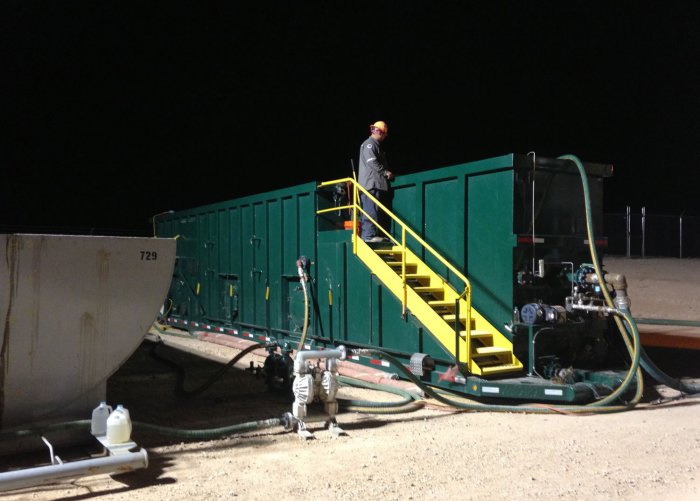
We have developed a range of solidification technologies and solutions to address specific challenges around the world, to tie up excess liquids, heavy metals and other inorganic contaminants and organic constituents, including hydrocarbons.
The Claytek process has proven that it can reliably and effectively convert drilling wastes into more manageable solid waste for enhanced material handling and cost effective disposal. The resulting treated waste is reduced in weight and volume. By way of contrast, sawdust and other materials can result in a 100 – 300% increase in volume to be handled.
More efficient material handling translates to the elimination of spill liability and the inherent cost of dealing with variable liquid streams. Claytek’s process has proven that treated drill waste will surpass PFT and slump test criteria reliably under a wide range of operating conditions.
Claytek’s solidification process was proven to convert liquid drill waste into manageable (eg. stackable; passes landfill stability tests) solid waste for enhanced material handling and cost effective disposal. The resulting treated waste is reduced in weight and volume. Meanwhile, the treatment itself tied up and encapsulated heavy metals, as well as oil and grease, without additional conditioning, leaving a non-leachable sludge to be hauled off as a non-hazardous waste. In addition, the Claytek process has been approved by the Alberta Energy Regulator and the BC Oil and Gas Commission for mix-bury-cover applications, completely eliminating the need for transporting the waste off site (AER Directive 050 and BC Oil and Gas Handbook, respectively).
Claytek can provide a variety of ST1 blends to meet a broad range of solidifying needs, such as compression strengths, permeability, pH, etc. to meet your disposal specifications.