


When High-Rate Anaerobic Systems Make Sense for Industrial Wastewater Treatment
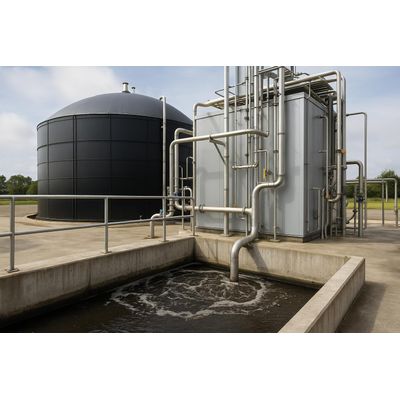
High-rate anaerobic systems provide a compact, energy-efficient pretreatment option for industrial wastewaters with high organic load and relatively low solids. Fluence's externally forced circulation (EFC) approach enhances process stability and biomass retention, enabling reliable pretreatment before discharge to POTWs and improving overall compliance performance.
The Shift from Traditional Digestion to Industrial Pretreatment
Anaerobic digestion is frequently associated with municipal solids handling and biogas maximization. Industrial wastewater, particularly in the food and beverage sector, typically exhibits low solids content but high dissolved organic load. In these applications, the primary objective is reliable pretreatment, cost reduction, and stable plant operation prior to POTW discharge, rather than maximizing methane production.
This shift places anaerobic systems at the core of process optimization rather than simply solids management, helping explain why high-rate systems can outperform conventional aerobic treatment at high organic load and in space-limited facilities.
Why Aerobic Treatment Reaches Its Limits
As wastewater strength increases, aerobic systems demand more oxygen transfer, raising blower energy use and aeration equipment size. Oxygen transfer efficiency declines with higher aeration rates due to bubble coalescence and mixing constraints. Larger basins, longer hydraulic retention times, and increased sludge handling follow, elevating capital and operating costs. At higher food-to-microorganism ratios, sludge production also rises, affecting disposal and handling costs. This often creates a threshold where aerobic treatment becomes technically or economically impractical for high-strength industrial effluents, opening the case for high-rate anaerobic pretreatment at COD levels typically around 3,000 to 4,000 mg/L depending on wastewater composition and objectives.
Understanding High-Rate Anaerobic Digestion
High-rate systems are designed to treat strong industrial wastewater with very short retention times while delivering high organic removal. A key feature is dense granular biomass that maintains stability under high hydraulic loading due to superior settling properties, reducing washout risk even at elevated flows. Anaerobic granules enable biomass concentrations exceeding 60 g/L MLVSS, allowing compact reactors with significantly shorter HRTs for effective COD reduction. The decoupling of solids retention time (SRT) from hydraulic retention time permits active microorganisms to persist while wastewater moves rapidly through the system, yielding a compact, energy-efficient treatment process with high loading capability.
Granular Biomass and Reactor Hydrodynamics
Granules range roughly 0.5 to 3 mm in diameter and exhibit layered structure with fast-growing organisms on the exterior and methanogenic populations in the inner core. This stratification supports stable performance under varying conditions. In high-rate systems, controlled upflow velocities create a fluidized bed that maintains constant contact between wastewater and biomass, while allowing lighter granules to be displaced and retained by the heavier granules. This hydraulic selection improves long-term biomass quality and reactor performance.
Reactor Hydrodynamics and Process Control
Effective mixing and biomass retention hinge on carefully managed upward liquid velocities to expand the granular bed without causing washout. During startup and acclimation, upflow adjustments support granule development and microbial stability. Poor mixing can lead to biomass stratification, reduced treatment efficiency, and unstable operation.
How the EFC Process Differs
Fluence’s EFC design separates mixing from biogas-driven agitation through external liquid recirculation, providing stable and predictable reactor velocities independent of gas production fluctuations. This decoupling improves granule retention, bed expansion control, hydraulic stability, process predictability, and overall treatment reliability.
Eliminating Pre-Acidification
The EFC approach enables treatment of many industrial wastewaters without a separate pre-acidification stage. For wastewaters dominated by dissolved organics, direct treatment can yield higher methane production, better pH and alkalinity stability, lower capital costs, simpler operations, and reduced process complexity, compared with pre-acidification strategies that can destabilize microbial populations or produce lower-quality off-gas.
Secondary Solids Separation and Biomass Retention
An external solids separation stage captures fine granules that escape the reactor, recirculating them to promote continued granule development and minimize biomass inventory loss. This retention step supports stable biomass concentrations, higher solids retention efficiency, higher allowable organic loading, resilience to hydraulic shocks, reduced seeding requirements, and lower suspended solids in the effluent.
Industries and Applications
- Alcohol production
- Dairy processing
- Soft drink and juice manufacturing
- Fermentation and biotechnology facilities
- Sugar and starch processing
- Certain pulp and paper operations
- Food ingredient manufacturing
A Practical Solution for High-Strength Industrial Wastewater
As industrial wastewater strength increases, aerobic treatment becomes more energy-intensive and challenging. High-rate anaerobic systems offer a compact, energy-efficient pretreatment option that reduces energy demand and sludge production while improving process stability. The EFC configuration enhances mixing control, eliminates unnecessary pre-acidification in many cases, and reinforces biomass retention strategies for reliable performance.
Facilities facing rising wastewater strength, energy costs, or pretreatment surcharges can consider high-rate anaerobic pretreatment to achieve regulatory compliance with a smaller footprint and lower operating costs.
High-Rate Anaerobic Wastewater Treatment FAQ
- What industries benefit most from high-rate anaerobic treatment? High-rate anaerobic treatment is most effective for industries generating wastewater with high dissolved organic content and relatively low solids, including dairy processing, alcohol production, beverage manufacturing, food ingredient processing, fermentation facilities, sugar and starch production, and certain pulp and paper operations.
- What is the difference between aerobic and anaerobic wastewater treatment? Aerobic treatment relies on oxygen for biological activity and requires significant aeration energy and infrastructure, whereas anaerobic treatment proceeds without oxygen, using specialized microorganisms to decompose organics. Anaerobic systems typically consume less energy and generate less sludge in high-load industrial pretreatment scenarios.
- When does anaerobic pretreatment become cost-effective? Economies typically emerge when wastewater COD is in the range of 3,000 to 4,000 mg/L, though exact thresholds depend on wastewater composition, discharge requirements, and facility goals. At higher loads, aerobic systems may require larger basins, greater aeration energy, and increased sludge handling, making high-rate anaerobic pretreatment a more compact, energy-efficient option.