


- Home
- Companies
- Zygo Corporation - AMETEK, Inc
- Articles
- ZYGO - Power Spectral Density
ZYGO - Power Spectral Density
Power Spectral Density (PSD) is a very useful concept when it comes to specifying many types of optics and has been proven to be a valuable metric in extreme application spaces such as laser fusion. This specification method can also be applied to demanding applications, high energy laser optics, particularly because it helps in understanding and managing the quality of optical surfaces in a detailed way not captured by conventional methods.
Let`s break down why PSD is so valuable.
Understanding Surfaces at Different Scales
Imagine you`re examining the surface of a mirror or a lens used in a high-energy laser system. This surface might look smooth to the naked eye, but at a microscopic level, it can have all sorts of tiny imperfections or roughness. These imperfections can scatter light, which can be detrimental in applications where precise control of the laser beam is critical.
Typical optical specifications such as Peak-to-Valley (PV), Root Mean Square (RMS) roughness, power, and irregularity are widely used to describe the overall smoothness and figure of optical surfaces. These metrics are quite effective for general commercial applications, with PV indicating the maximum height difference between the highest and lowest points on the surface, RMS providing a statistical average of surface deviations, and irregularity measuring the deviation from the best fit sphere.
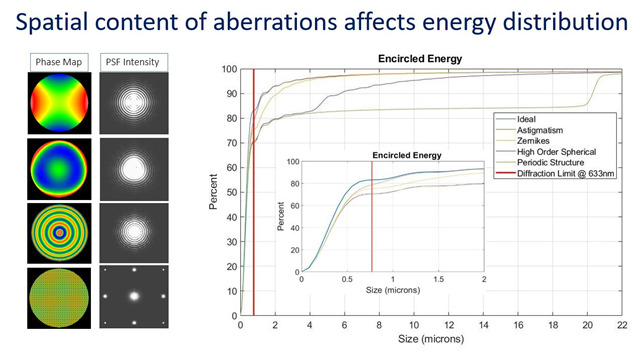
However, these measures provide only a limited perspective — they give a summary view without detailed insight into how surface features of various sizes contribute to the overall surface texture. Certain aberrations caused by surface figure error can affect the energy distribution of a beam, which is especially critical in HEL applications. This is illustrated in Figure 1.
On the other hand, PSD — which analyses the surface features of an optical component by transforming the surface topography data from the spatial domain into the frequency domain — offers a much more detailed analysis by breaking down the surface texture into its constituent spatial frequencies.
PSD can tell how much each different size of surface feature contributes to the overall roughness, which is vital for high-precision applications like high-energy lasers where the efficiency of system is a critical driver of energy demand, and therefore cost. Unlike traditional metrics like PV or RMS, PSD allows for the identification and control of specific types of surface imperfections that can critically impact the propagation and quality of a laser beam, thus providing a more robust framework for predicting and enhancing optical performance in advanced applications.
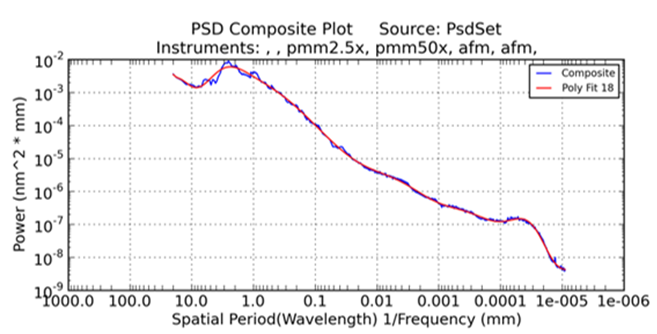
Figure 2 illustrates a PSD plot for a polished surface measured using multiple interferometers and atomic force microscopes. The plot covers a very wide range of spatial periods ranging from 10 mm to 10 nm, or six orders of magnitude, providing information about different scales of surface artifacts that affect scatter and haze.
Improving Laser Performance and Predictability
By using PSD, we can specify how smooth or rough the surface of an optical component needs to be to perform optimally in a high-energy laser system. This is important because:
- High-energy lasers need to focus very intense light beams very precisely. Even small amounts of scattered light can lead to inefficiencies, reduced performance, or even damage to other parts of the optical system. PSD allows engineers to understand and limit this scattering by controlling the types of surface imperfections.
- Using PSD as a specification tool helps us ensure that every optical component produced meets the same high standards. This consistency is key in systems where high performance is critical and can also help in troubleshooting or refining the production process.
- Modern manufacturing techniques that improve the surface quality of laser optics rely on precise measurements. PSD provides a quantitative way to assess improvements and guide manufacturing processes, such as polishing and coating, to achieve desired outcomes.
In summary, PSD is like us having a detailed map that shows not just the mountains and valleys on an optical surface, but also the fine details of the terrain. This map allows for better design, manufacturing, and application of high-energy laser optics, ensuring that these systems are both efficient and effective in their roles.
Contact Zygo today, and let’s discuss how our expertise in the measurement of optics can stimulate innovation in your precision optics manufacturing.