

IWA Publishing
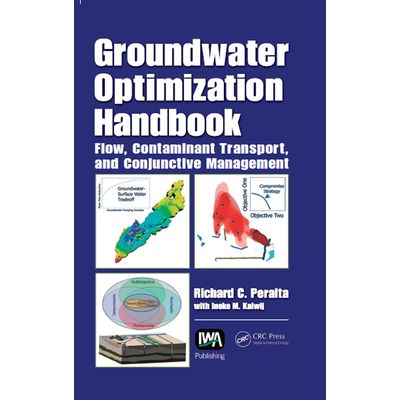
Groundwater Optimization Handbook
May. 31, 2012- By: Richard C. Peralta
Courtesy ofIWA Publishing
Presents a thorough introduction to groundwater systems analysis and optimization terminology, principles, and techniques Identifies which S-O approaches are appropriate for different types of groundwater quantity (hydraulic optimization) and quality (contaminant transport optimization) problems, whether they be deterministic, stochastic, single-objective, or multiobjective in nature Teaches you how to build your own S-O model or how to choose from available transferrable S-O models Offers guidance and flowcharts for simplifying and solving real-world optimization problems Uses a systems analysis approach to emphasize clear goals, inputs, stimuli, processes, responses, and outputs Teaches you how to develop and adapt optimal management strategies, for implementation or use as metrics (such as for performance-based contracting) Reinforces learning with numerous flowcharts, examples, illustrations, case studies, and a glossary Supplies ancillary material online, including spreadsheets performing as S-O models, PowerPoint slides, reference materials, numerical simulation programming instructions, and a simulator Existing and impending water shortages argue for improving water quantity and quality management. Groundwater Optimization Handbook: Flow, Contaminant Transport, and Conjunctive Management helps you formulate and solve groundwater optimization problems to ensure sustainable supplies of adequate quality and quantity. It shows you how to more effectively use simulation-optimization (S-O) modeling, an economically valuable groundwater management tool that couples simulation models with mathematical optimization techniques. Written for readers of varying familiarity with groundwater hydrology and mathematical optimization, the handbook approaches complex problems realistically. Its techniques have been applied in many legal settings, with produced strategies providing up to 57% improvement over those developed without S-O modeling. These techniques supply constructible designs, planning and management strategies, and metrics for performance-based contracts. Learn how to: Recognize opportunities for applying S-O models Lead client, agency, and consultant personnel through the strategy design and adaptation process Formulate common situations as clear deterministic/stochastic and single/multiobjective mathematical optimization problems Distinguish between problem nonlinearities resulting from physical system characteristics versus management goals Create an S-O model appropriate for your specific needs or select an existing transferrable model Develop acceptable feasible solutions and compute optimal solutions Quantify tradeoffs between multiple objectives Evaluate and adapt a selected optimal strategy, or use it as a metric for comparison Drawing on the author’s more than 30 years of research, consulting, and teaching experience, this practical handbook supplies real-world design procedures, detailed flowcharts, solved problems, lessons learned, and diverse applications. It guides you through the maze of multiple objectives, constraints, and uncertainty to calculate the best strategies for managing flow, contamination, and conjunctive use of groundwater and surface water. Review "Extremely thorough... covers the types of problems of practical interest to groundwater professionals... a "must own" book for the groundwater modeling professional." JAMES RUMBAUGH, Lead Developer, Groundwater Vistas, President, Environmental Simulations, Inc. About the Author As the Utah Cooperative Extension Service water quality coordinator, Richard Peralta, PhD, PE, optimized nonpoint and point source contamination management, and collaborated closely with state and federal agencies in technology transfer and public education. Through the University of Arkansas, and subsequently Utah State University, private work, and the U.S. Air Force Reserve, he worked in 25 U.S. states and in numerous countries. For the military, he participated in and led many environmental contamination remediation evaluation teams and helped provide optimal solutions that were successfully constructed or implemented in the field. After several years of advising on environmental matters in the Pentagon, Colonel Peralta retired from the U.S. Air Force Reserve as a chief bioenvironmental engineer. He is a professor in the Civil and Environmental Engineering Department at Utah State University and consults privately. He is the exclusive distributor of SOMOS software. For more information, see Dr. Peralta’s page at the College of Engineering at Utah State University. Contributing author Ineke M. Kalwij, PhD, PEng, collaborates with Dr. Peralta, working on groundwater optimization software development and publications. She also provides consulting services to clients, primarily in the area of groundwater system management. For more information, see Kalwij Water Dynamics Inc. Table of Contents Needs and Goals; Introduction to Mathematical Optimization for Groundwater Strategy Design; Introductory S-O model simulator types and use-modes; Introductory Groundwater-Related Optimization Problem Types and Features; S-O Process; Case Studies; Closure; Sample problems solved by hand or using analytical S-O model; Sample problems solved by hand or using numerical s-o model; Selected Part A Chapter 2, and Part B problems solved using Lingo and GAMS This book is co-published with CRC Press
Most popular related searches
contaminant transport
groundwater management
water quality
groundwater hydrology
contaminant remediation
water shortage
environmental contaminant
numerical modeling
surface water
groundwater vistas
ISSN: 9781780401119
Launch: 2012