


Springer-Verlag GmbH
- Home
- Companies
- Springer-Verlag GmbH
- Books
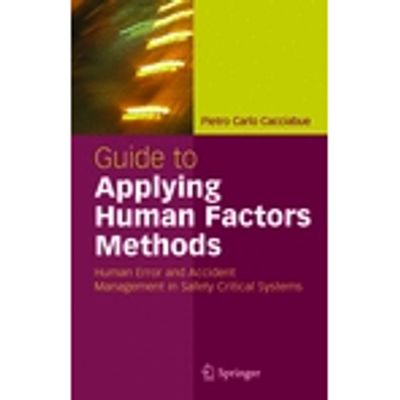
- Guide to Applying Human Factors Methods
Guide to Applying Human Factors Methods
Jul. 5, 2026- By: Cacciabue, Carlo
Courtesy ofSpringer-Verlag GmbH
Human error plays a significant role in many accidents involving safety-critical systems. Because of this, it is now a standard requirement in both the US and Europe for Human Factors (HF) to be taken into account in system design and safety assessment. This book will be an essential guide for anyone who uses HF in their everyday work, providing them with consistent and ready-to-use procedures and methods that can be applied to real-life problems. The first part of the book looks at the theoretical framework, methods and techniques that the engineer or safety analyst needs to use when working on a HF-related project, and also generates guidelines for using them in the key areas of design, safety assessment, training and accident investigation.
The second part presents four case studies that show the reader how the above framework and guidelines work in practice. The case studies are based on real-life projects carried out by the author for a major European railway system, and in collaboration with international companies such as the International Civil Aviation Organisation, Volvo, Daimler-Chrysler and FIAT. Focusing on the four key areas outlined above, they cover:
- The design of a human-machine interface for the automotive environment
- The development of non-technical training in civil aviation
- A recurrent safety audit in a railway system
- An accident investigation in the energy production domain
The book will be useful to designers and safety engineers, and also to regulators who need to develop new safety standards and requirements for technologically advanced and complex systems. It will also provide useful background reading for masters and PhD students on engineering and safety, cognitive ergonomics and environmental safety courses.
The second part presents four case studies that show the reader how the above framework and guidelines work in practice. The case studies are based on real-life projects carried out by the author for a major European railway system, and in collaboration with international companies such as the International Civil Aviation Organisation, Volvo, Daimler-Chrysler and FIAT. Focusing on the four key areas outlined above, they cover:
- The design of a human-machine interface for the automotive environment
- The development of non-technical training in civil aviation
- A recurrent safety audit in a railway system
- An accident investigation in the energy production domain
The book will be useful to designers and safety engineers, and also to regulators who need to develop new safety standards and requirements for technologically advanced and complex systems. It will also provide useful background reading for masters and PhD students on engineering and safety, cognitive ergonomics and environmental safety courses.
Most popular related searches
human machine interface
accident investigation
safety auditing
safety training
safety audit
ergonomic safety
safety system
aviation safety
safety regulations
Price: 86.95 EUR; 119.00 USD; 78.50 GBP
ISSN: 978-1-85233-705-6