


- Home
- Companies
- Germann Instruments
- Products
Germann Instruments products
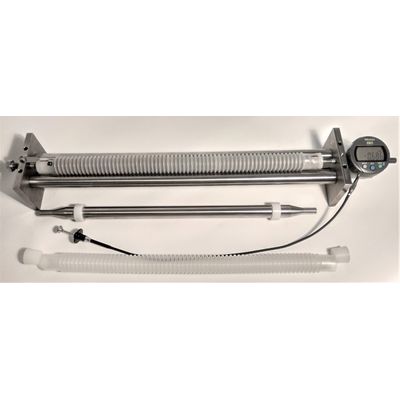
Germann Instruments - Model Auto-Shrink - Digital Dilatometer
The Auto-Shrink digital dilatometer from Germann Instruments is an advanced tool used for the measurement of unrestrained autogenous shrinkage in cement paste or mortar cured under sealed conditions. This device allows for precise linear measurement of the autogenous shrinkage, which is the reduction in volume that occurs as the cement-based material hardens. Utilizing a specialized corrugated plastic mold, the Auto-Shrink prevents moisture loss and ensures free shrinkage of the specimen. The dilatometer is composed of a rigid frame made of Invar, a steel alloy known for its minimal thermal expansion at room temperature, and includes a high-precision digital dial gauge with remote control and an Invar reference bar. Optional components like a dedicated USB input cable and data-logging software enable automated data collection from multiple gauges, making it possible to monitor time-dependent deformation over extensive periods, from weeks to years. The comprehensive Auto-Shrink AS-1000 Kit includes all necessary hardware, with additional consumables and optional data-logging tools available for specialized applications in concrete mixture optimization.
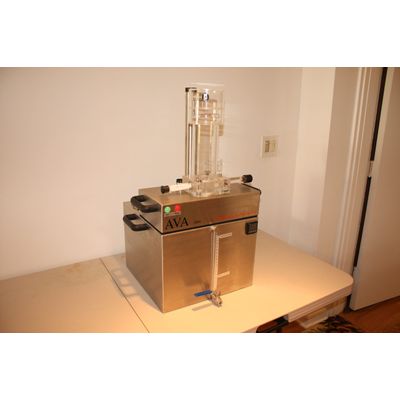
Germann Instruments - Model AVA-3000 - Air Void Analyzer
The AVA-3000 by Germann Instruments is an advanced air void analyzer designed to measure the size distribution of voids and air-void parameters in fresh concrete. Utilizing a sample of air-entrained mortar from fresh concrete, the device employs a blue AVA release liquid and a riser column filled with water to facilitate the separation of air bubbles. As the sample is gently introduced into the release liquid, air bubbles are freed and ascend through the water column following Stoke's Law, where larger bubbles rise faster than smaller ones. A buoyancy pan at the column's top, connected to a balance, records the weight changes due to the ascending bubbles. These continuous measurements, collected over a test duration of 25 minutes, provide a comprehensive analysis of bubble size distribution. The system boasts rapid quality control and assurance testing capabilities, making it essential for assessing freeze-thaw resistant concrete. Packed with a USB interface for real-time data acquisition, the AVA-3000 outputs detailed size distribution reports and histograms for bubbles smaller than 2 mm and employs algorithms that calculate the spacing factor and surface area in compliance with ASTM C457 standards. The device also features operational voltage settings, a magnetic stirrer, a heater-equipped 35 L bath tank, and precise measurement tools, making it indispensable for both research and industrial applications.
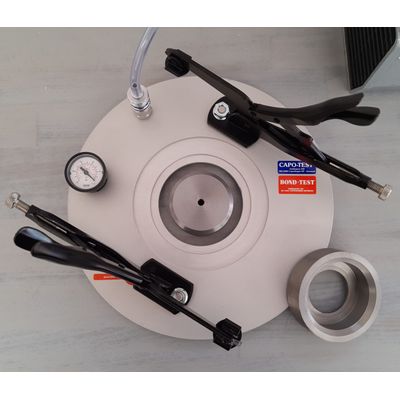
Germann Instruments - Model BOND-TEST - Pull-off Test System
The BOND-TEST is an advanced device specifically designed to conduct pull-off tests in compliance with ASTM C1583, which measures the tensile strength of concrete surfaces and evaluates the bond strength or overlay materials using direct tension. The equipment features a disc that bonds to a prepared surface, and a partial core is cut around the disc, which is then pulled off using a handheld hydraulic pulling machine. The pulling force is registered by an electronic gauge that provides accurate readings of the pull-off strength. The BOND-TEST kit includes essential accessories such as a hydraulic pull machine with an electronic gauge, AMIGAS printout software, strength conversion table and manual, and various other tools necessary for comprehensive testing and analysis. This sophisticated system ensures reliable and precise measurements, making it an indispensable instrument for professionals working in concrete repair and construction quality assurance.
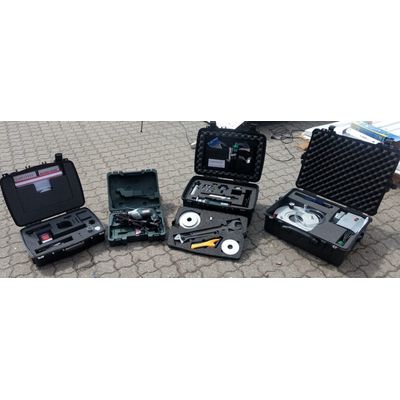
Germann Instruments - Model CAPO-TEST - In-situ Concrete Strength Test System
The CAPO-TEST system is designed to provide accurate estimates of the in-place compressive strength of concrete in existing structures using the pullout test method conforming to ASTM C900, BS 1881:207, and EN 12504-3 standards. The process involves grinding the test surface, drilling an 18.4 mm hole, routing a 25 mm recess, and expanding a split ring in the recess. By pulling the ring with a hydraulic machine against a counter pressure ring, the force required is directly related to the concrete's compressive strength. The system is pivotal for quality assurance, evaluating fire-damaged structures, and verifying the strength of structures when standard-cured specimens fail. The CAPO-TEST includes a digital precision gauge, a robust hydraulic pull machine with a force capacity of 100 kN, and an operating temperature range from -10°C to 50°C. Additionally, it offers extensive data storage and PC connectivity via USB. There are two versions: the C-1000 CAPO-TEST Complete System and the C-2000 CAPO-TEST Lite.
Germann Instruments - Model COMA-Meter - COncrete MAturity-Meter
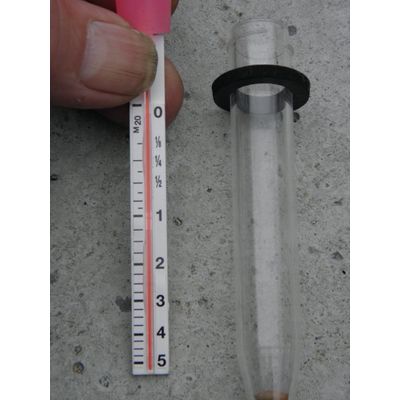
The COMA-Meter is a state-of-the-art maturity reader designed for newly cast concrete, providing key metrics for engineers and construction professionals. Utilizing a glass capillary tube containing a specially formulated liquid, the device measures the evaporation rate, which varies according to the temperature, to determine the concrete’s maturity. Embedded at a depth of 80 mm into the concrete, it operates based on the Arrhenius equation for temperature-dependent rate processes. The maturity level, expressed in M20 units, equates to days of curing at 20 ºC, allowing precise monitoring of early-age compressive strength and effective in-place curing temperature. With models reading up to 5 or 14 M20 days, this tool is crucial for managing concrete curing and timing pullout tests like LOK-TEST.
Germann Instruments - Model ERE-Probe - Half-cell Reference Electrode
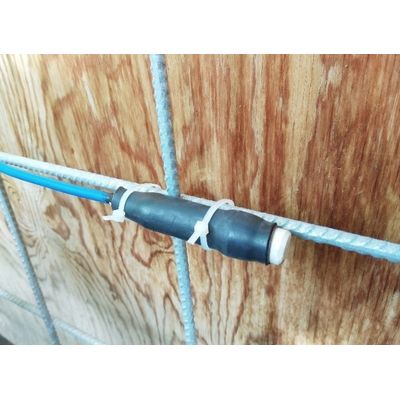
The ERE-Probe is a sophisticated half-cell reference electrode designed for embedding in concrete to monitor the corrosion activity of steel reinforcement. This robust, long-lived reference electrode uses manganese dioxide for stable performance in new or existing concrete structures. For new constructions, the ERE-Probe is attached to the reinforcement using plastic straps before concrete placement. In existing structures, it is embedded by drilling a hole to the required depth and secured with an appropriate cementitious mortar. Suitable for concrete exposed to chlorides or carbonation, the probe does not induce corrosion or alter the steel's natural potential. A high impedance voltmeter is connected to the ERE-Probe's cable to measure half-cell potential between the probe and reinforcement, providing an accurate assessment of corrosion activity.