

- Home
- Companies
- Fire Shield Systems Ltd
- Products
- Aerosol Fire Suppression Systems
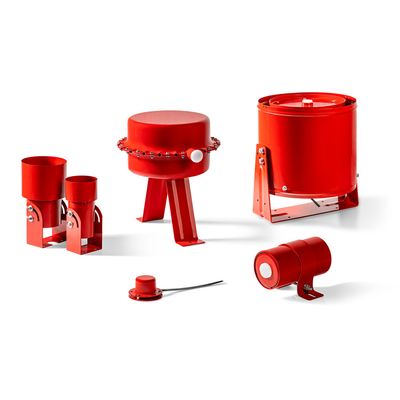
Aerosol Fire Suppression Systems
High-risk environments need suitable fire suppression systems to ensure safety. Aerosol fire suppression systems have a range of applications, meaning they can be used effectively in a wide range of high-risk, operating environments. Condensed aerosol fire suppression systems consist of a compact fire suppression unit, with a solid-chemical extinguishing agent that breaks down and releases once the system is activated. This acts to extinguish fires on a molecular level, preventing the combustion chemical chain reaction. Aerosol suppression systems offer a non-toxic, environmentally friendly suppression solution. With no need for piping, nozzles or pumps, aerosol suppression systems can be a space-saving, cost-effective fire safety solution.
Once activated, the extinguishing agent disrupts the fire’s chemical chain reaction by removing the oxidants from the burning process. This works to extinguish the fire both chemically and physically.
The resulting endothermic reaction also draws heat away from the burning process, reducing the chance of reignition at the site.
Aerosol suppression systems are automatically activated using a heat activation cable. For larger-scale installations, where the system is integrated with a control panel and energy source, you can also manually activate the system using the control panel.
These types of suppression systems are effective in high-risk industries, where the priority is to extinguish the fire – fast.
For areas with important equipment or machinery and minimal space – such as server rooms or switch rooms – aerosol suppression systems can be a great solution, as the compact units can be installed into almost any space.
If you’re looking for a cost-effective solution that doesn’t compromise on safety, an aerosol suppression unit can be installed quickly, with low maintenance costs and up to a 10-year lifecycle.
Aerosol fire suppression systems are most effective when used in a sealed space, as the gas extinguisher it disperses won’t be disrupted by artificial ventilation.
- CNC machines: in production lines, CNC machines create unique fire risks, as the parts are constantly moving. This process is supported by an oil lubricant, meaning that, should ignition take place, the machine fills with oily air. An aerosol suppression system prevents this air from burning, extinguishing the fire and preventing reignition.
- Electric vehicles: li-ion batteries that are used in EVs or HEVs can be especially dangerous should they catch fire. When alight, batteries can enter a state called ‘thermal runaway’ where the battery cells can produce their own oxygen source – burning from the inside – making suppression challenging. Aerosol systems prevent the flame from escaping the battery, containing any damage to within the battery cells, preventing fire spread.
- Power generation and storage: due to the nature of burning electronics, aerosol systems can be very effective in extinguishing electrical fires. Additionally, the extinguishing agent can continue to ‘hang’ in the air, where there’s no forced ventilation, preventing reignition.
- Server rooms and switch rooms: as above, aerosols can be extremely effective in tackling electrical fires. They can also be fitted into these environments quickly and easily due to their small and compact nature.
- Maritime and offshore industries: aerosols can be used to protect large diesel generators and generator rooms, providing efficient, compact fire suppression.
- Warehouses and storage: in large areas, aerosol systems will discharge the extinguishing agent to fill an entire room or area with a flooding method. Aerosols also require minimal clean up, as you can simply ventilate the area following activation.
-