SEVAR - Belt Dryer System
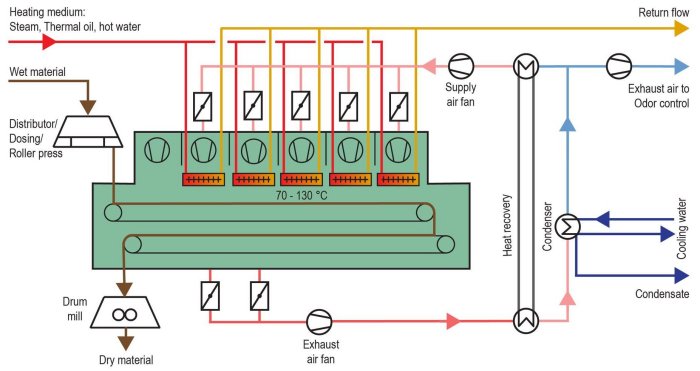
The SEVAR belt dryer is operated for convective drying of watercontaining products such as sewage sludge and digestate. The drying temperatures of the circulating drying air are in the range of 70 - 130 °C, depending on the type of heating. Further applications for the double-path belt dryer are the drying of wood chips, bark, grass, leaves, green cuttings, hulls and husks as well as animal waste, pomace, press residues, biowaste, biochar and animal faeces.
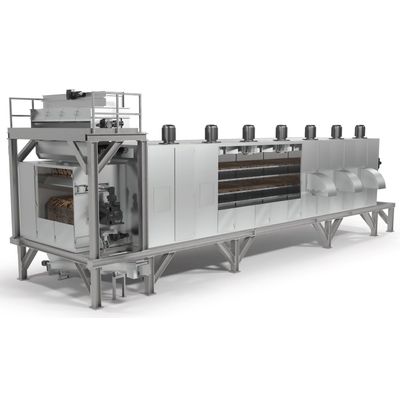
The belt dryer is of modular design, it consists of an inlet/outlet module, a number of dryer modules designed according to the throughput or the water evaporation, and a return module. Horizontally the dryer is traversed by two perforated stainless steel conveyor belts arranged one above the other.
The sewage sludge, mechanically dewatered to 18 - 30% dry solids, is continuously and uniformly distributed on the dryer belt via the inlet unit (distribution / dosing / roller press). The roller press - consisting of two counter-rotating grooved rollers - forms the sewage sludge into strands with the effect of increasing the surface area of the material to enhance the heat transfer and water evaporation.
As the wet material is transported on the upper dryer belt through the dryer modules, the drying temperature increases and the residual moisture in the material decays. The lower dryer belt transports the material back to the discharge screw. In the front section of the dryer the dry product cools down. At the outlet of the discharge screw the temperature is approx. 40 °C.
In general the belt dryer is used for full drying up to 90% dry solids.
The product is dried gently, as the material is subjected to little mechanical stress. This minimizes dust formation. The temperatures and the negative pressure in the dryer modules are measured and the belt speed is controlled. This ensures effi cient drying time and constant product quality.
- Slow moving parts: Gentle drying process
- Low dust formation: Safe atmosphere
- Low drying temperatures: 70 - 130 °C
- Perforated dryer belt made of stainless steel 304 / 316L: High corrosion and temperature resistance, long service life
- Easy accessibility
- Belt speed / retention time variable: 60 - 180 min
- Modular design: Expandability for higher throughput / water evaporation capacity
- Various heating options
- Energy optimized: Heat recovery
- High thermal efficiency: Optimized process air circulation
- Continuous operation: Low operating and maintenance costs
- Operation with negative pressure: Low odor emission
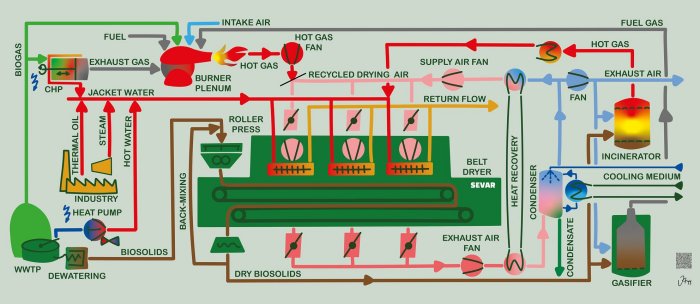
The modular design of the belt dryer enables its adaptation to a wide range of site conditions.
Direct heating is realized by burning biogas/ digester gas, natural gas, fuel oil or using high-temperature exhaust gas of the CHP unit in a burner plenum.
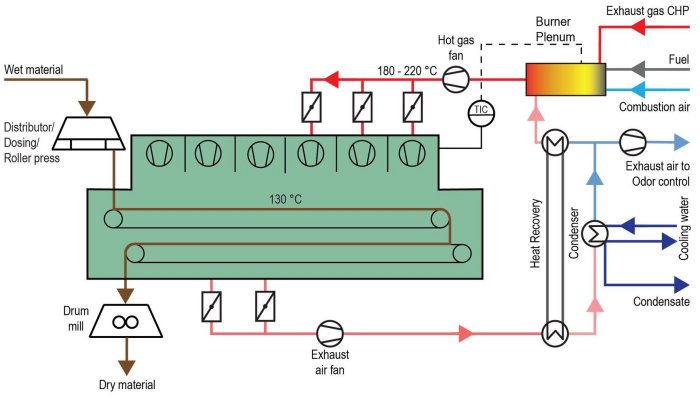
The modular design of the belt dryer enables its adaptation to a wide range of site conditions.
Indirect heating of the belt dryer is technically implemented with internal heat exchangers fed with hot water, steam or thermal oil. Jacket water of a CHP unit is used as heating medium. The hot exhaust air of the belt dryer as well as the final effluent of a WWTP contain a thermal energy potential for drying. The operation of a heat pump uses this energy potential to generate hot water.
A combination of direct and indirect heating is technically possible.