


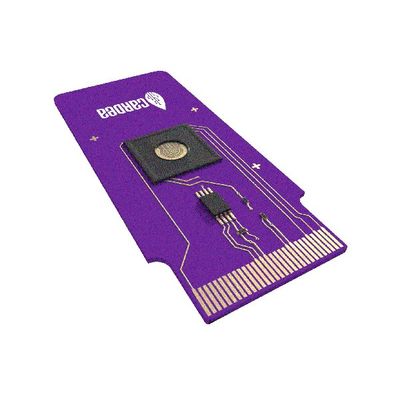
CardeaBio - Model BPU -Biosignal Processing Unit
nside your computer, the CPU is the processor that makes the computer work. There is also a GPU that draws the graphics on your screen. Cardea is the first and only company to offer a BPU™ - a Biosignal Processing Unit.
The BPU™ is the first mass produced chip that creates a gateway between the live signals in biology and the digital world. In other words, the BPU™ offers direct communication with biology by translating near real-time streams of multiomics signals into digital information.
Not only does the BPU’s direct signal detection expand on current optical and static measurements in life science, it also removes many of their limitations. Cardea is paving the way to an entirely new generation of innovations, applications, devices, and products in and around life science.
A BPU™ is an electrical chip that is a type of microprocessor. It does not process digital signals. Instead, it processes biological signals or “biosignals.” What this means is that a BPU™ converts biological interactions such as an antibody binding a virus into the kind of electrical signals we’re used to seeing in conventional electronics.
You may be familiar with the term “biomarker.” If a “biomarker” is a picture of the current state of some biology, then a “biosignal” is a video of that state of biology. It’s adding the real-time component of recording to our familiar understanding of biomarkers.
Some examples of interactions recorded in biosignals are binding of antibodies to viral proteins, and strands of DNA binding to complementary DNA. However, there are a tremendously large number of potential biosignals that could be measured. A BPU can be characterized by it’s biosignal bandwidth. The biosignal bandwidth is roughly the number of types of biological interactions that can be monitored on one chip, multiplied by the number of input or output modes available to each of those interactions.
As biological research has synthesized genomics, proteomics, metabolomics, and transcriptomics into systems biology, a new multiomics approach to biological research has emerged. Today, multiomics studies are challenging and expensive.
Cardea has developed a platform for experimental work that unifies the multiple omics approaches to measurement.
This increases access to multiomics data by enabling more individual labs to successfully attempt multiomics studies.
As we are building semiconductor based BPUs we can package the much smaller transistors later so the BPU can work off the same sample, but for now we just run more BPUs next to each other. But our platform allows us to measure both DNA, RNA and Proteins, as the only platform in production. And we do already have next gen BPUs with multiplexing - more measurements next to each other - in small batch production for our Innovation R&D groups.
Today, we run one real-time multiomics measurement a lot and that is RNA binding proteins that is e.g. gRNA to CAS protein binding.