


- Home
- Companies
- BKV Vana Makina İnşaat Tesisat San. and ...
- Products
- BKV Valve - Model GF16YMP - Booster ...
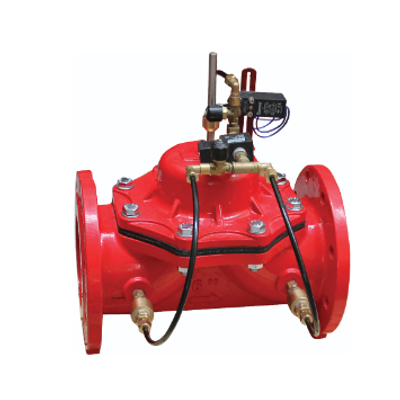
BKV Valve - Model GF16YMP -Booster Pump Control Valve
BKV 116 Series Pump Control Valves are designed lo automatically start or stop booster {horizontal shaft) pumps used in water supply systems. They are active check valves that open or close completely in response to electrical signals. From the moment the pump`s start button is pressed until the pump reaches its operating speed, the pump control valve opens more slowly than the pump. When the pump`s stop button is pressed, the pump control valve first begins to close slowly without creating a shock, and then, when the valve is fully closed, the pump is switched off by the limit switch on the valve. In the event of a power failure, the pump control valve acts as an active check valve to prevent backflow to the pump, eliminating the need for an additional check valve in the system.
- Normally open/normally closed solenoid valves.
- Wide pressure and voltage ranges.
- Safe mechanical shut-off.
- Remote motor on/off capability.
- Active check valve feature.
- Minimizing surge damage.
- Individually adjustable opening and closing ratios.
- Maintenance can be performed without removing it from the pipeline.
- Open the valves indicated by (e) on the valve.
- Open the needle valve indicated by (cl) 3 turns. Open the needle valve indicated by (c2) 2 turns.
- Check the pump panel electrical circuit diagram.
- The pump control valve will open completely.
- Restart the pump by opening the isolation valve located at the outlet.
- You can adjust the opening speed of the valve with the needle valve indicated by (cl).
- When you stop the pump, you can adjust the closing speed of the valve with the needle valve indicated by (c2).
- Start the pump.
- Agricultural irrigation
- Fire extinguishing
- Industrial applications
- Irrigation and drinking water systems
- Closed position: The valve is closed by applying pressure to the diaphragm through fluid pressure.
- Open position: Internal line pressure moves the diaphragm upwards, allowing flow.
- Modulation position: The diaphragm remains in a fixed position by balancing the internal and external line pressures.