

- Home
- Companies
- Govoni Handling Systems Srl
- Products
- Centralized Chip Handling System
Centralized Chip Handling System
The creation of a centralized system allows for the swarf to be transported automatically and continuously, from machine tools to a single collection centre without any supervision. The automation of all operations related to the swarf allows operators of the manufacturing department to focus on the core-production of the company, not having to worry about the swarf that exits from the machine tool and disappears into the system and then is channelled into a single collection centre.
A centralized system thus eliminates all risks associated with contact with the swarf and the coming and going of forklifts for swarf collection, in full compliance with regulations of the new directives in the field of health, hygiene and work safety.
Govoni has created thousands of evacuation systems and several hundred centralized transportation systems in Italy and abroad and can boast complete customer satisfaction.
The design of a centralized system for the transport of swarf initially comes from the needs of a production facility where swarf is a daily problem and the advice and experience of Govoni employees who interact with the client and study the conditions needed to create and implement the system.
In the construction of centralized systems, the company pursues certain goals:
- to make manufacturing areas more ergonomic and healthier
- to transform swarf from an expensive and risky daily problem into a valuable cost-effective raw material, while respecting the environment.
The electrical plant which manages and controls the screw collectors is equipped with PLC and an alphanumeric display for the control of all security alarms and for setting the startup and shutdown times of the entire system in coordination with the machine fleet served.
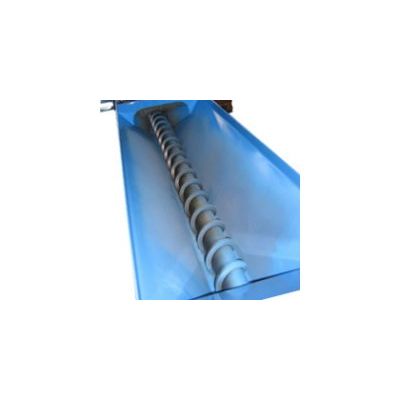
Thanks to the rotating movement of the screws inside the horizontal and vertical manifolds, the swarf produced by each machine tool is lifted to the main overhead line which carries it to the centralized collection station possibly consisting of an "A1" container or an "A2" wall silo.
The figures "B1" and "B2" represent sections of manifolds in the pit where the traditional extractors "C1" and "C2"discharge the swarf using special loading hoppers. The figures "D1" and "D2" show a Govoni screw conveyor application in a work centre that discharges the swarf generated from processing directly into the horizontal manifold. Between the machine and the manifold, a pre-filtration system can be installed in the machine that receives the coolant whose particles are retained and separated from the liquid which is sent under pressure back in the machine tool for recovery.
In case it is necessary to improve the pre-filtration result and the fluid still appears to be too polluted by the presence of solids, it is sent to the centralised filtration unit in order to separate smaller particles.

MULTI-DIRECTIONALITY OF MANIFOLDS: the screw conveyor can move the swarf horizontally, vertically and overhead and is patented worldwide.
UNIVERSALITY OF THE CONVEYOR: thanks to a suitable screw-trough combination, the screw system can carry any metallic chip morphology (powdery, short, medium-long, flowing, tangled and bundled) and all types of metal (aluminium, brass, bronze, copper, various types of steel, cast iron, various alloys).
ABSENCE OF MAINTENANCE AND SPARE PARTS: maintenance is not necessary because conditions of wear and tear are almost non-existent thanks to thermal treatment for surface hardening undergone by the screws and all components in contact with them, while the absence of other moving parts apart from the screws eliminates the need for spare parts to replace.
SWARF VOLUME REDUCTION: the rotation of the screws result in, depending on the type of material, either a crushing or compaction of the swarf, with a consequent increase in the quantity added to the centralized vessel and therefore less frequent collections by the scrapper.
OBSTACLE REDUCTION: reduction of the swarf volume allows for the use of transport manifolds with extremely small cross-sections, while vertical transport allows for the use of limited space for the installation of the entire system which turns out to be non-invasive and elegantly integrated to the internal architecture of the plant.
MAXIMUM FLEXIBILITY AND MODULARITY OF THE OVERHEAD SYSTEM: the network of manifolds composing the system can be created by step and is adaptable to all layout variations: it can be expanded with subsequent enlargements or moved to another location together with the whole production apparatus.
EASY AND ECONOMICAL SYSTEM IMPLEMENTATION: the development of the entire overground system eliminates the costs of creating pits and does not require costly production interruptions but can be implemented with the machines working at full capacity.
DRYING THE SWARF: the vertical transport of the wet swarf facilitates its drying due to gravity, improving the performance of any de-oiling systems.
RATIONALIZATION OF LAYOUT: best use of available space due to the possibility of eliminating the swarf containers in the machine and the space necessary for handling carriages; the centralized container can also be placed in a suitable position for easy unloading by the scrapper.
COMPLETE AUTOMATION: the centralized screw systems are designed to transport swarf 24 hours a day with maximum efficiency and reliability, without any human supervision.
LABOUR SAVING: the time saved in labour in terms of swarf collection and system maintenancecan be fully dedicated to the production.
ENERGY SAVINGS: transport by simple rotation of the screw requires significantly lower power and operating costs compared to other technologies.
ECOLOGY AND IMPROVEMENT OF WORK ENVIRONMENT: the swarf is channelled in structurally closed manifolds that allow for the elimination of oil spills, fumes, odour and noise.
WORK SAFETY: the risks of cutting swarf operators is eliminated and those related to the handling of forklifts at the workshop are reduced; the operational characteristics of the system fully meet the requirements of laws on health, hygiene and safety at work (OSH Directives as 89/391 or 98/37, CEI and UNI regulations).