


- Home
- Companies
- JASCO Applied Sciences (Canada) Ltd.
- Products
- Model AMAR - Compact Ocean Observatory
Model AMAR -Compact Ocean Observatory
Capture both acoustic and oceanographic data in real-time, be it for scientific research or environmental monitoring. The Observer is an underwater observatory combining superior acoustic data quality and multi-sensor data streaming: Acoustic and oceanographic sensors in one compact system. Real-time data streaming via cabled or wireless telemetry. Versatile and configurable to meet your data collection needs. Standard (250 m) and Deep (2500 m) models.
Multi-sensor data in one manageable data stream
The data from multiple sensors is digitized and combined into a single manageable data stream:
- Up to 4 hydrophones sampled at 24-bit resolution at rates up to 128 ksps, or 8 hydrophones up to 64 ksps
- One ultra-high speed, 16-bit acoustic channel sampled at up to 687.5 ksps
- Your choices of analog and digital sensors: dissolved oxygen, salinity, acidity/pH, temperature, depth, turbidity, orientation (roll-pitch-yaw), or others upon request
The Observer collects and delivers precisely calibrated acoustic and oceanographic data for ocean monitoring. It supports analog sensors with voltage or current inputs as well as digital sensors via RS-232, RS‑485, USB, and Ethernet.
The open-format data stream from the Observer can be received, processed, and logged by your own software, custom-developed applications, or JASCO’s existing suite of monitoring solutions.
Continuous real-time ocean monitoring
Built on the proven AMAR G3 technology of JASCO’s autonomous recorders, the Observer is the one-stop solution for your data gathering, assimilation, and streaming requirements in all types of underwater environments. Gather and stream observations from both acoustic and oceanographic instruments for continuous monitoring of:
- Ambient noise
- Water conditions, sediments, and pollution
- Industrial noise sources
- Seismic activity and geological processes
- Marine animal presence, abundance, and behaviour
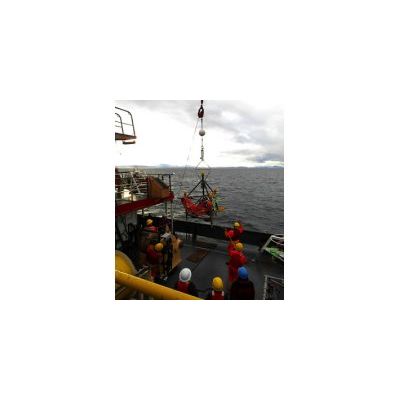
Two Observers have been integrated into ONC’s VENUS (Victoria Experimental Network Under the Sea) in the Strait of Georgia, capitalizing on their multi-sensor data collection and streaming capabilities.
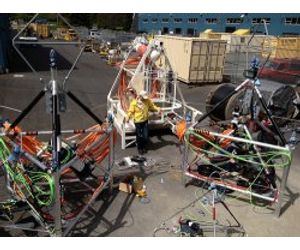
The Observers were equipped with a tetrahedral array of four hydrophones as well as orientation, oxygen, and turbidity sensors. Once deployed, ROVs connected the Observers by pressure balanced oil filled cable to the VENUS nodes. The nodes are cabled to shore via fiber optic telecom cable, allowing the Observers to stream their data to the ONC Operations Centre at theUniversity of Victoria.
Environmental
Max. depth: Standard (250 m), Deep (2500 m), or custom
Operating temperature: −5 to 50 °C
Shock tested: 3 m drop into water
1 m drop onto concrete
Vibration tested: Transport by air, truck, or vessel
Physical (Standard model)
Dimensions: Ø 16.5 cm D × 57.2 cm L
Material: PVC, anodized aluminum, 316 stainless steel, Type 2 titanium
Weight in air: 10 kg
Weight in seawater: 1 kg
Custom housings are available upon request.
Hydrophone
Sensitivities and frequencies tailored to your needs.
Nominal sensitivity: −164 dBV re 1 μPa @ 1 kHz
Frequency response: 1 Hz to 150 kHz
Power
Typical power use: 600 mW
Power input: 7–16 Vdc
Software options
The open-format data stream from the Observer can be received, processed, and logged by your own software,
custom-developed applications, or JASCO’s existing suite of monitoring solutions:
SpectroPlotter: displays data stream for viewing, analysis, and archiving
Stream Converter: converts data stream to WAV and CSV files
Stream Server: converts data stream to WAV and CSV files across multiple host computers
Custom software applications are available upon request.
Eight 24-bit acoustic channels
Two banks of 4 channels: Each bank has independently-selectable sample rates
Sample rates: 2–128 ksps
Spectral noise floor: Better than −150 dB re FS at 128 ksps
Gain settings: 0–42 dB
Data format: WAV
Max. combined throughput: 1476 MB/s
High speed, 16-bit acoustic channel
Sample rates: 125–687.5 ksps
Dynamic range: 14.5 effective bits
Voltage: 0–4.5 V peak-to-peak
Data format: WAV
Max. combined throughput: 1476 MB/s
Oceanographic sensor channels
Sensors available: Dissolved oxygen, salinity, acidity/pH, temperature, depth,
turbidity, orientation (roll-pitch-yaw), others upon request
Eight analog channels:
Sample rate: 1 Hz
Dynamic range: 10.5 bits
Voltage: −10 to +10 V
Digital inputs: RS-232, RS-485, USB, Ethernet
Non-acoustic data format: CSV
Data output
The open-format data stream sends acoustic and oceanographic
data over Ethernet via: Copper, fiber optic, Wi-Fi, VHF, UHF, Iridium, RUDICS