

IS-Instruments - Model HES -Compact Spectrometers
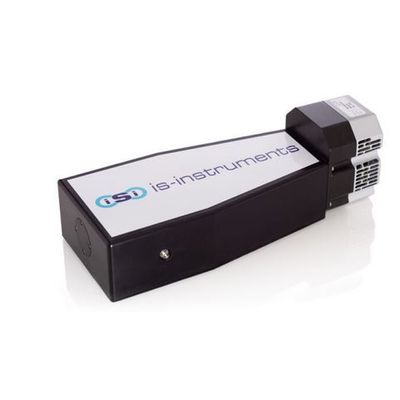
High throughput/etendue spectrometers. Traditional spectrometers use a slit to allow light to pass into the instrument and focus on the target substance. Our spectrometers are different: we use optical fibres at a size of 1 mm - 3 mm, although a 5 mm is possible.
The Benefits of Our HES Spectrometers
Using a fibre rather than a slit aids transmission; where light would normally be lost it is retained and therefore can be focused on the target. More light on the target delivers a stronger signal, particularly helpful when measuringsubstances with weak Raman signals.
ISI`s standard HES spectrometer offers a 100-fold increase in throughput over conventional systems currently available. This increased throughput can lead to a superior signal-to-noise ratio (SNR) for a given observation over a Czerny Turner instrument. The HES spectrometer contains no moving parts and yet offers the advantages of a Michelson Interferometer with the spectral properties of a traditional diffraction grating-based device, such as a Czerny Turner spectrometer.
The high throughput/etendue of our HES spectrometers results in the instruments being ideal for low light applications and makes it possible to couple the devices via a large multimode optical fibre. They are, therefore, easy to use with a large optical telescope, unlike Czerny Turner systems with comparable resolution. Our HES spectrometers are capable of stand-off measurements at a range of 2-3 meters.
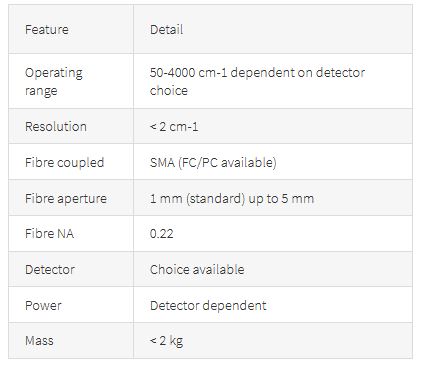
The spectrometer is available as a stand-alone instrument or a fibred-coupled Raman spectrometer, typically with a 500 mW785 nm laser.
A choice of detectors is also available according to the end-user requirements, from ultra low light, cooled CCD through to simple CMOS devices.
- Raman spectroscopy
- Transmission Raman spectroscopy
- EnVss`onspect`oscopy
- Fluorescence spect`ometry
- Reflectance spectrometry
- Astronomical applications