


- Home
- Companies
- Evident Inspection Technologies, part ...
- Products
- Evident - Model OmniScan MX - Eddy ...
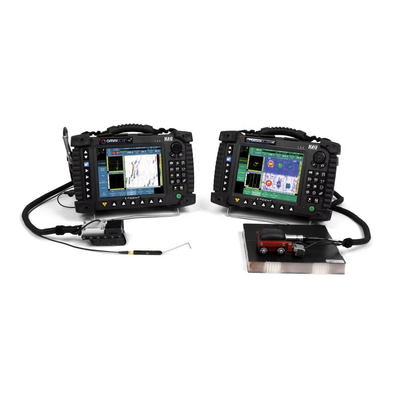
Evident - Model OmniScan MX -Eddy Current Array Flaw Detector
With thousands of units being used throughout the world, the OmniScan MX is a field-proven, reliable instrument that is built to withstand harsh and demanding inspection conditions. Compact and lightweight, its two Li-ion batteries provide up to 6 hours of manual or semi-automated inspection time.
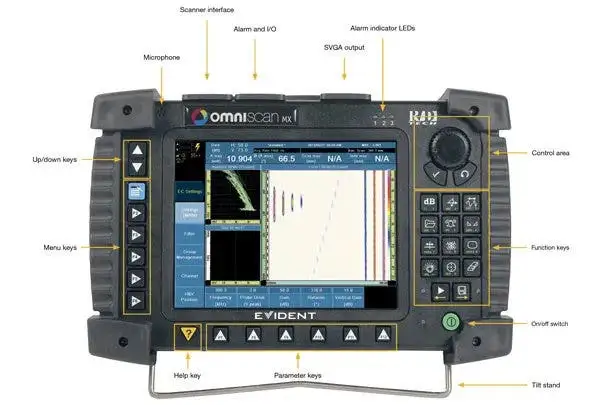
One Platform, Two Modules, Three Technologies: More Flexibility
To meet the requirements of a broader range of applications, eddy current testing (ECT), eddy current array (ECA) and the new bond testing (BT) C-scan technology are available in two module versions. Both of these modules are compatible with the MXE (ECT/ECA) and MXB (BT C-scan) software, providing easy transition between technologies and a very short learning curve.
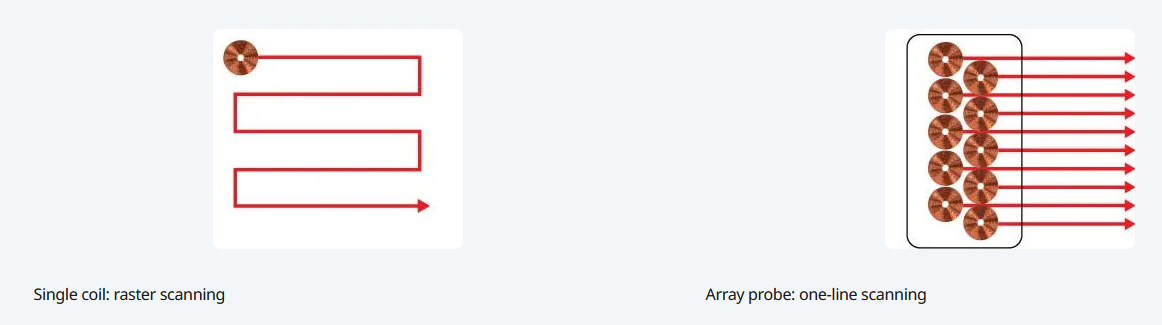
Eddy current array (ECA) technology incorporates several traditional bridge or reflection (driver-pickup) probe coils in order to achieve a much larger coverage in a single inspection pass. Additionally, each ECA probe model is carefully designed to maintain a high probability of detection of a targeted defect range, all along the probe length. With the OmniScan® MX ECA, you can use ECA probes at fast manual-inspection speeds, offering a powerful and productive inspection with color representation and archiving capability.
Inspection through Thin Coatings
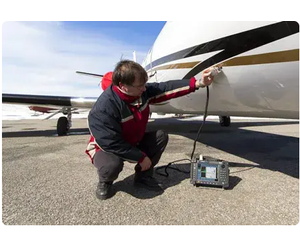
Eddy current testing (ECT) technology works on the principle of magnetic coupling of a probe sensor (coil) close to a test specimen (conductive material, ferromagnetic or non-ferromagnetic), generating eddy currents inside the test specimen, and displaying signals on the instrument’s impedance plane. With eddy current technology, you can detect defects through thin coatings (such as paint), as long as the distance from the probe to the metal is kept reasonably low—typically in the order of 0.5 mm to 2.0 mm.
As eddy current array and ECT technology share the same basic principles (and physics), it can also perform inspections through paint while offering all advantages of ECA, including large coverage, fast scanning, high probability of detection and color imaging.
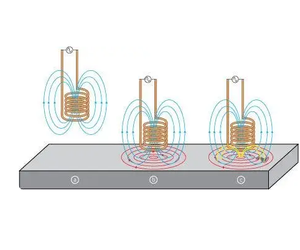
Probes used to perform eddy current inspections are made with a copper wire wound to form a coil. The coil shape can vary to better suit specific applications.
- The alternating current flowing through the coil at a chosen frequency generates a magnetic field around the coil.
- When the coil is placed close to an electrically conductive material, an eddy current is induced in the material.
- If a flaw in the conductive material disturbs the eddy current circulation, the magnetic coupling with the probe is changed and a defect signal can be read by measuring the coil impedance variation.
Increased Power, Decreased ComplexityMXE 3.0 Software
With the exception of the added capacity to electronically switch between elements, eddy current array (ECA) technology is essentially the same as ECT technology. Eddy current array is easy to operate and calibrate. The new OmniScan MXE 3.0 ECA software has been redesigned to facilitate the transition from a conventional ECT instrument (such as the Evident Nortec® 500) and to offer the power of ECA in a much more accessible way.
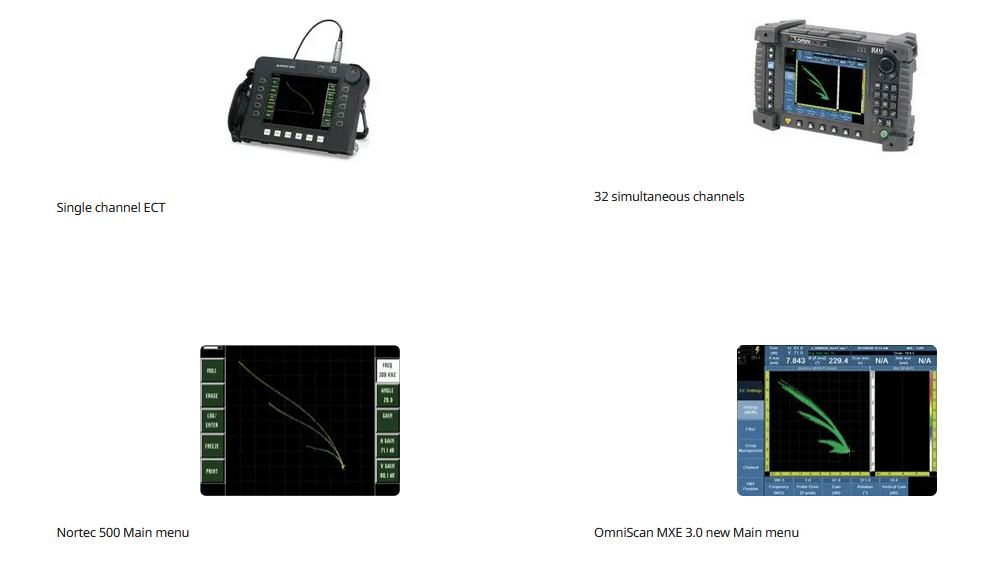
Calibration of ECA is done in a nearly identical fashion as conventional ECT. The principles of lift-off, gain and null adjustments are maintained so calibration is no more complex or time-consuming than usual.
Generate live lift-Off signals with ECA probe – just like with a conventional ECT probe.
Adjust the phase angle in real time with the OmniScan knob. Gain, Vertical Gain and Null Point (H/V) can also be adjusted the same way.
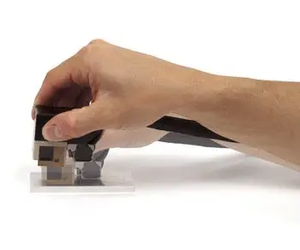
Replacement of Traditional NDT methodsPaint Removal is Obsolete
Eddy current array has a unique ability to perform inspections through thin coatings on conductive material. This capability provides a tremendous advantage over existing methods, such as penetrant testing, magnetic particle or magneto-optical imaging (MOI), as the need to remove and then reapply paint or coating is eliminated completely. Over time, this provides you with enormous cost-savings, and most importantly, your inspections will be chemical-free.
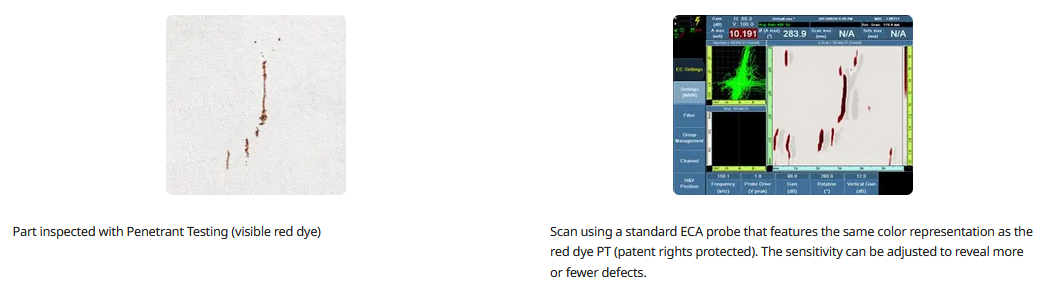
- No need for paint removal.
- Imaging and archiving.
- One-step inspection, high scan speed, and instant results.
- Major time-savings (typically 10:1 and over).
- Drastically reduced turnaround time.
- Defect depth evaluation capability.
- Adjustable sensitivity and post-process analysis.
- Environment-friendly method (no chemicals involved).