


- Home
- Companies
- Norchem Industries
- Products
- Norchem - Model ASA - Emulsifiers
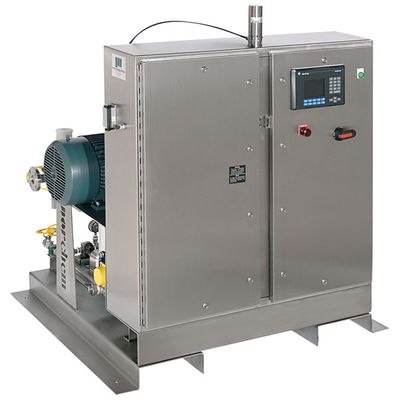
Norchem - Model ASA -Emulsifiers
NORCHEM advances the science of ASA internal sizing with its most recent innovations in ASA emulsification equipment. Designed for reliable, efficient operation, Norchem takes turbine emulsifier technology to the next level. The product of a rigorous 10-year developmental and field-testing program, Norchem ASA emulsifiers deliver consistently higher quality emulsions with all types of emulsifier chemistries.
- Variable speed stainless steel turbine for optimization of emulsion quality and sizing response
- Unique turbine seal design for extended service in ASA emulsification applications
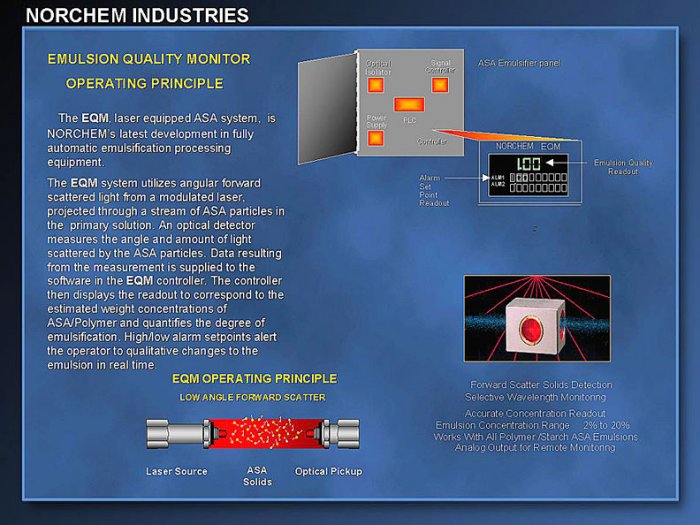
- Real time laser emulsion quality monitor (EQM) for instant verification of emulsion quality
- Emulsifier manifold block eliminates pre-dilution with high solids emulsifier formulations
- Works with all polymers, modified starches, and cooked starch chemistries
- 30-50% reduction in particle size when measured next to conventional turbine emulsifiers
- Improved particle size distribution characteristics achieving standard deviations in the 0.130-0.300 range
- 3 times the ASA processing capacity of conventional turbine emulsifiers
Because of its importance in the papermaking process, sizing has become the focus of modern wet end chemistry in alkaline papermaking. Alkenyl succinic anhydride (ASA) is one of the most frequently used alkaline sizes, as well as one of the most complex wet end additive applications. ASA is insoluble in water and, like other internal sizing agents, must be added to the furnish as an emulsion. One of the most distinct features of internal sizing with ASA is that emulsification must be performed on site. This is due to the instability of the anhydride moiety after the ASA is emulsified with water. To ensure the success of an ASA sizing process, NORCHEM has developed a series of ASA emulsifiers with unique particle size and distribution adjustability functions that can be fine-tuned, on-site, for optimization of the emulsification process. The production of a quality ASA emulsion is critical to the success of an ASA sizing process.
Low quality ASA emulsions are not only less efficient, but also cause many paper machine operational problems. The performance of ASA size is directly related to the qualities of the ASA emulsion as it is applied to the paper furnish. ASA emulsion quality is affected by many variables. A primary dependency exists as a relation to the particle size of the colloidal ASA droplets. Particle size analyzers, using forward scattered laser light, reveal analytical details for emulsion particle size with its associated profile of the emulsion particle distribution. An emulsion with a mean volume (particle diameter) in the range of 0.5 -1.0 micron has been a widely desired target for the ASA emulsions. Measurably important is the shape (profile) of the emulsion particle distribution curve. Finer particle sizes with a narrow distribution profile are retained more efficiently and thus an emulsion with 99-100% of its colloidal ASA below 2 microns and a standard deviation less than 0.500 is the most effective.
The graph on top illustrates an ASA emulsion processed through a conventional turbine emulsifier. The second graph illustrates the same emulsion chemistry processed through the NORCHEM AP series emulsifier adjusted for optimum size and distribution qualities.
The NORCHEM ASA emulsifiers use a combination of a proprietary emulsifier pre-conditioning manifold, low volume recycle loop and high-speed turbine rotors to create an emulsion with the proper particle size and distribution to improve sizing response. Unlike conventional ASA emulsifiers, which are normally limited to two adjustments, (recycle rate and turbine pressure), the NORCHEM systems add a third proprietary dimension, adjustable turbine shear events. This patented feature found exclusively on NORCHEM ASA emulsifier systems, improves the emulsion particle size and narrows the overall emulsion distribution characteristics to promote better sizing response, enhance emulsion stability, and reduce dosage requirements.
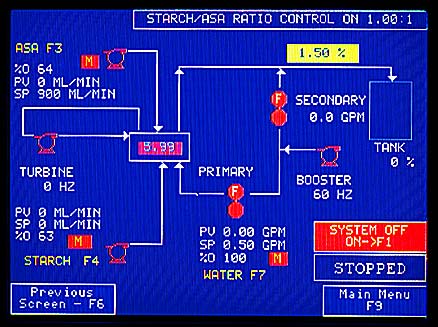
The ability to adjust particle size and distribution through the emulsifier loop can be illustrated by using these particle analyzer graphs. A baseline operating condition is established through the emulsifier and a particle size test is run. The adjusted parameters (independently controlled) are ASA to emulsifier ratio, primary turbine flow, turbine pressure, recycle pressure, turbine inlet pressure and turbine rotor speed (expressed in Hz). The emulsion sample is evaluated for overall mean particle diameter and particle size distribution. (standard deviation)
First Sample Run
The initial run through the emulsifier produced an emulsion with a 1.1 micron median particle size. To improve sizing response and lower the dosage demand, optimization to the emulsifier was initiated.
In this instance, the overall improvement to the emulsion quality is in the particle size and uniformity. (compare the standard deviation values among the three samples) While the first sample is a good emulsion in terms of particle size and distribution, the second and third samples are better emulsions with regard to sizing response. In the actual sizing application using the optimized emulsion, the paper machine production rate improved in a predictable manner without the penalty of higher chemical costs associated with increased dosages.