Solartex - Expanded Polystyrene (EPS)
EPS is a closed cell lightweight cellular plastics material produced from polystyrene. The material has been modified by the addition of flame retardant additives. Polystyrene literally translated is ?polymerised styrene?. That is, the single styrene molecules are chemically joined together to form a large molecule which is called the polymer. Styrene is produced from benzene and ethylene, and polymerisation is accomplished in the presence of catalysts, usually organic peroxides. The expandable form is produced as small beads containing a blowing agent.
The Manufacturing Process
Pre Expansion
The small expandable beads are subjected to steam, which causes the thermoplastic polystyrene to soften. Increasing vapour pressure caused by the blowing agent causes the beads to expand to up to 40 times their original volume. It is this prefoam stage which determines the final density of the expanded polystyrene block.
Aging
After pre-expansion the prefoam is transferred via to fluidised drying bed to large silos for aging. This process is designed to allow for the replacement of expanding agent by air in the cells of the bead. Aging also allows for stabilisation and cooling of the prefoam.
Moulding
Once conditioned by aging, the prefoam is blown into a mould where further steaming causes the expanded beads to fuse into a block.
Drying
To provide dimensionally stable dry blocks it is necessary to pass them through a temperature controlled oven. This process also ensures that any residual blowing agent has been removed.
Finishing
For most customers the manufacturing process is not complete until the EPS blocks have been cut into various shapes. This process is mainly carried out using a hot wire cutting machine that gives a fine finish to the product and enables very fine cutting tolerances to be achieved.
Australian Standard
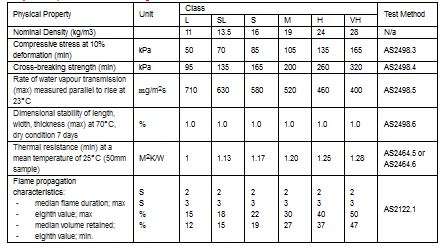
Australian Standard 1366, Part 3 ? 1992 Physical Properties of Rigid Cellular Polystyrene ? sets out minimum properties for six classes (see table 1) and methods for determination and compliance. Flexibility in production allows EPS to be produced to this standard or to other requirements that specialized applications may demand.
Quality Control
To ensure compliance with customer requirements our Quality Assurance process monitors and tests various key properties.
Acoustic Properties
As EPS has a closed cell structure it offers only a limited absorption of airborne sound. Structure borne sound, transmitted though such structures as walls, may be effectively isolated by the use of floating floor systems. For this type of insulation EPS with the required dynamic stiffness can be obtained by compressing the sheets by 50 to 60 percent and then allowing them to recover to 80 or 90 percent of their original thickness.
Thermal Properties
EPS gains its exceptional insulating properties from the stabilised air trapped within its cellular structure. Since it contains no CFCs or any other gas that may leak out, it will not harm the ozone layer or decrease its insulation properties.
As Australian Standard 1366 Part 3 is a minimum conformance standard the thermal resistances quoted will be achieved as a minimum in 97.5% of cases in a statistical sample, when tested at a mean sample temperature of 25°C.
For design purposes the average thermal resistance is a better guide than the minimum thermal resistance (refer table 3).
Moisture Resistance
Of all the materials used for insulation applications, EPS is one of the most resistant to the adverse effects of moisture content. At ten times its dry weight, EPS has been found to maintain 80% of its R value.
Flotation Properties
The density of EPS is low compared to water, with a normal density range of 11 to 32 kg/m3 compared to water at 100 kg/m3. The water buoyancy per cubic metre of EPS is determined by subtracting its kg/m3 density from 1000. The result is the weight in kilograms that a cubic metre of EPS can support when fully submerged in water.
Temperature Cycling
EPS is able to withstand the effects of temperature cycling thereby providing long term performance in low temperature applications.
Core specimens of EPS removed from freezer walls in place for twenty years have demonstrated no deterioration in the structural integrity or physical properties.
The K Value of EPS decreases at lower average mean temperatures, hence its popularity and success in sub-zero applications.
Toxicity
Extensive research programs have been conducted overseas (i) to determine if thermal decomposition products of EPS present a toxicity hazard. The test results have revealed that these decomposition products are less harmful than those of burning wood.
Gases released during combustion are predominantly carbon monoxide and, to a lesser extent, carbon dioxide. A CSIRO report (ii)comments that the toxicity of the gases associated with the burning of EPS is no greater than that associated with timber.
Combustibility
As with all other organic material, EPS insulation products must be considered combustible and to constitute a fire hazard if improperly used or installed.
EPS products should not be exposed to open flames or other ignition sources.
The material contains a flame retardant additive to inhibit accidental ignition from small fire sources. Table 2 shows test results for ES and other common building materials to provide a good guide as to how these products compare.