


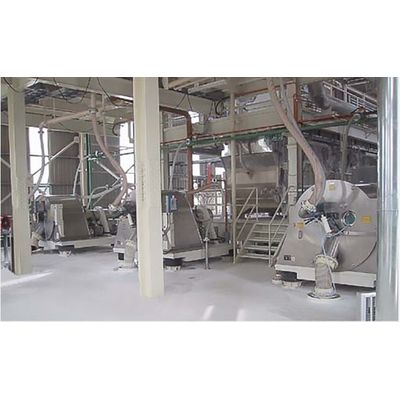
Filtration
Core competence: In all areas of the mechanical separation technology a run to ultra-fine materials can be noticed. These particles, to be separated out of a slurry, will be produced among other things by a crystallization resp. precipitating process. Nano-/ Micro-technology is not only a keyword but will be playing a decisive role in the future for the development of new products in all areas like the filler industry as well as the chemistry and pharmacy. The basis for advanced product development is only given if the manufacture of very fine, uniform distributed particles contained with defined characteristics in constant configuration is successful.
On basis of the real existing situation, the Krettek Separation GmbH developed the horizontal peeler centrifuge series ProCent®. This centrifuge generation is excellently suitable for the dewatering of fine materials because of extremely high g-force factors, which are regularly 50 %, in some cases even up to 100 % higher than these of our worldwide competitors. Particularly when the use of conventional technology, as for example low speed centrifuges, vacuum drum filters as well as vacuum belt filters seems to be problematical resp. impossible for the dewatering of a filter cake (thixotropic or dilatant behaviour) our dewatering system shows its strength.
These machines process fine materials with a dp50 of ≥ 1,0 µm. The rotor diameters vary between 400 and 1900 mm. The complete production line will be quoted as a closed and gas-tight system, of course. Tests have shown, that with the processing in the ProCent® there are no significant changes of particle shape resp. particle break.
A great number of grained products from processing technology, the chemical industry and the pharmaceutical industry have to be dewatered with regards to its usability resp. further processibility. Examples for this are:
- the starch drying
- the dewatering of FGD-gypsum in power plants as well as
- the dewatering of calcium carbonate
This separation can be made thermal or also mechanically. In both kinds of dewatering it has to be distinguished between various parts of liquid in the aggregate material, whose bond forces are differing for orders of magnitudes from each other. According to their removability and their local appearance parts of liquid remain in a complete or only partly saturated package as shown in the following picture:
Therefore the drying process is made for the thermical as well as also for the mechanical drying in several phases.
With the thermical drying the adhesive liquid evaporates and steams in the first drying phase, then the drying of the coarse capillaries starts and when also this liquid has been driven out the drying of the pores start. In a final phase the internal capillary liquid which is bound in the crystallin structure will be driven out. Although with the thermical drying the product can be fully dehydrated, but this kind of dehydration is very energy-intensive, so that it is more economical to deposit the liquid out of the solid in a first step. Furthermore with the thermical drying of sensitive materials there is a danger that the solids will be damaged by boiling und steaming in the pores.
With the mechanical drying the humidity will be displaced by a porous filter medium with the effect of a driving potential. The last one either can be realized by a pressure difference or a centrifugal field of force. For example, the following aggregates are suitable for drying:
- the vacuum basket filter
- the vacuum belt filter
- pressure belt filter or centrifuge
With the dewatering with pressure belt filters or chamber filter presses higher pressures can be realized, but also these processes have their limits. Their decisive disadvantage is that the cakes to be dewatered are strongly compacting and they can only be discharged in larger connecting solids packages. Before its further use the drying goods have to be finely distributed by striking works, so that a further aggregate has to be integrated into the process in addition to the pressure belt filter resp. to the chamber filter press. Furthermore a closed, i.e. gasproofed production by such plants can only be realized by a very constructive expenditure. In spite of the high pressures the degrees of drying normally cannot be reached in technically optimized centrifuges by the already mentioned tendency of the dried goods to compact. You get an impression of the achievable g-force factors of the Krettek-centrifuges by recalling the respective centrifuge specific diagramme. It shows the centrifugal factors realized in Krettek-centrifuges in comparison with these of vertical peeler centrifuges according to DIN 24400-2.
All these disadvantages attached to the vacuum and pressure filtration do not occure with the centrifugal dewatering with the high g-force factors, which can be realized by Krettek. With these high g-force factors of this centrifuge technology the previous process limits, given by the products of competitors, could be overcome. By the far higher g-force factor of the Krettek-centrifuge the capillary rise of adhesive liquid as well as a part of the pore liquid could be overcome and also great parts of the liquid, which are containing in the large capillary system, could be driven out of the cake. The residual moisture of the cake will be reduced so much, that even products with thixotrope or dilatant behaviour can be treated without problems in many cases.
Furthermore the demand for washing water can be strongly reduced by this high realized g-force factor and the excellent driving out of the mother liquor. Often the washing which is necessary with vacuum belt filters and vacuum basket filters is even completely unnecessary.
A historical retrospect shows, that already mid of the 18th century vertical basket design of centrifuges were standard. At that time sugar massecuites from sugar beet production was centrifuged on a large-scale. Also chemical products would be processed with such centrifuges. With an increasing industrialization a variety of centrifuge versions with vertical positioned baskets came into the market.
So among others, star buffer centrifuges, one-buffer centrifuges, free-running centrifuges, pendulum suspended centrifuges as well as three column centrifuges are known. Finally the last-named have been established in the 20th century. This is to be explained with the possibility of a realisable gas-tight centrifuge construction without great effort. In all fairness it has to be mentioned that the pendulum design could stand it’s ground for the processing of sugar and dextrose massecuite up to today.
The 3-column-design had been launched with a variety of different rotor types. So as classic top discharge centrifuge but also with loosening scrapers or also in construction with detachable top of basket with below hanging filter bag used world-wide.
This machine design was substituted by the so-called vertical peeler centrifuge in the eighties and nineties of the last millennium. Here the rough design framework remains unchanged beside the real pendulum suspension.
This machine type was made fit for the next millennium by bolting beneath resp. welding on a vibration plate with below installed vibration dampers. This at least was the opinion of many world-famous centrifuge manufacturers.
The horizontal basket position was marketable with the beginning of the 20th century, characterized by very solid centrifuge designs, which rigidly mounted were based on heavy concrete foundations with a substructure in deep natural ground. In the course of the century the continuous development implicates to assemble these centrifuges on separate based and vibration-absorbed installed massive vibration blocks. Due to this, the planning for a new building or rebuilding of a production plant was essentially more complicated resp. more extensive than for the planning of three column centrifuges, which do not need a separate, heavy vibration basement.
For the modern plant design this cannot be used as a real criterion, because innovative horizontal peeler centrifuge designs safely compensate to a great extend the possible occurred unbalances in combination with the vibration table and the underneath installed vibration dampers.
Another important decision criterion is the available g-force factor, which is defined depending on the basket diameter and the speed. In the context of a standardization peripheral speeds of 63 m/s at the basket shell according to DIN24400 were predefined for three column centrifuges in Germany. For horizontal peeler centrifuges this almost universally valid value is 80 m/s. The main part of world wide centrifuge manufacturer orient themselves towards this value. We believe and we have demonstrated this again and again in production scale, that for the process of fine resp. ultra-fine materials essentially higher g-force-factors and therefore necessarily higher peripheral speed are much more useful, if not in many cases absolutely indispensable for a trouble free and low-staff production.
Therefore Krettek horizontal peeler centrifuges are designed for a peripheral speed of approx. 100 – 110 m/s, depending on rotor diameter. So the realized g-force factors of the horizontal peeler centrifuges of Krettek are normally approx. 50 % higher than these of the competitors. Referred to vertical peeler centrifuges with a peripheral speed according to DIN 24400-2 more than twice as high, always with regard to comparable rotor diameter.
Following a comparison of horizontal and vertical rotor position using the example of the Krettek horizontal peeler centrifuge series type ProCent and the vertical peeler centrifuge according to DIN 24400-2, referring to a comparing roto diameter of 1.250 mm.
Designed with the demand of highest space and time yield, this horizontal peeler centrifuge generation is distinguished by unusual high g-force factors with a very slim rotor design at the same time. In order to obtain almost constant filtration properties during longer time periods the heart of the machine is equipped with a backflushing rotor.
For discharging the filtrate the long-standing tried and tested sandwich filtration element will be used. A further design feature is the combined function unit, which combine the process steps feeding, washing and peeling in one device. The oversized centrifuge shaft will be fixed in a solid cartridge bearing, made in stainless steel. The centrifuge housing is made of primary plates in a welded construction; all parts of the processing room are in stainless steel.
It is characterized by the requirements of maximum cleanability while minimizing the contact surfaces inside the process room. Thus the design, characterized by the 3-room-concept calls its own a conical hinged housing. This machine type is equipped with a sieve basket as standard.
The system design enables a quick replacement of the filter cloth, which is necessary for multi-purpose-plants. A pneumatic operating working system realizes an automatic removal of the heel cake. To reduce contaminations of any product exclusively only mechatronic actuators will be used, which are based on long experiences of centrifuges for more than a decade.
Design-related gaps as well as screw connections are reduced to a minimum. During the processing of adhesive solids a chute screw can be adapted with low personnel effort.