


- Home
- Companies
- MusterFire International Pty Ltd
- Products
- MusterFire - Foam Based Fire ...
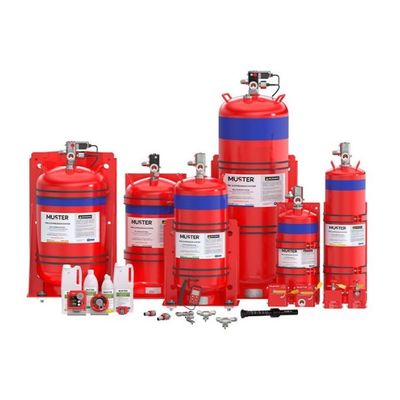
MusterFire - Foam Based Fire Suppression System
Muster Foam based Fire Suppression Systems are the most suitable solution for the protection of assets where liquid hydrocarbon fuels pose a high fire risk. Water alone is ineffective and can even be dangerous. The introduction of foam amplifies the effectiveness of water by breaking down the surface tension, making the droplets smaller, and enhancing the cooling effect
The role of the foam in the solution is to create a blanket sealing the vapours preventing ignition. The role of the water in the solution is to provide cooling. Foams are supplied in concentrates that are appropriately proportioned with water. They are then aspirated with nitrogen gas to produce the foam bubbles and discharged through a pre-engineered Fire Suppression System specifically designed to protect the risk areas. A Muster Foam System can be used as a standalone Fire Suppression system or in conjunction with IPS or SAG as a dual agent system.
- Solution-based agents suitable for mobile vehicles & fixed plant
- Environmentally responsible Fluorine Free options available
- Direct application with superior cooling effects
- Operating range from -40°C to +60°C
- Cylinder sizes from 15 litres to 110 litres
Using a foam fire suppression system has many advantages.
Foam fire suppression systems are quite efficient in putting out fires. In order to put out a fire, foam agents produce a thick, insulating blanket that covers the burning fuel.
Fires of all classes (Class A, B, and C) can be put out with foam fire suppression systems, proving their adaptability. They have many potential applications, from commercial and industrial buildings to storage facilities and even private homes.
Foam fire suppression systems use a foam agent that requires less water to be effective than traditional water-based fire suppression systems. This can lessen the extent of water damage to the property and lessen the likelihood of further water damage.
Quick action is possible because foam fire suppression systems can be set up to automatically respond to fires or to require manual activation in the event of an emergency. A quicker response time increases the likelihood that the fire can be contained and that the fire won’t spread to other parts of the structure.
When compared to alternative fire prevention systems, such as sprinklers or clean agent systems, foam fire suppression systems may be the most cost-effective option. Because they use less water and can be tailored to protect individual sections of a structure, their installation and upkeep costs can be kept to a minimum.
Fires may be put out with minimal water damage, response times can be improved, and costs can be kept to a minimum with the help of a foam fire suppression system.