


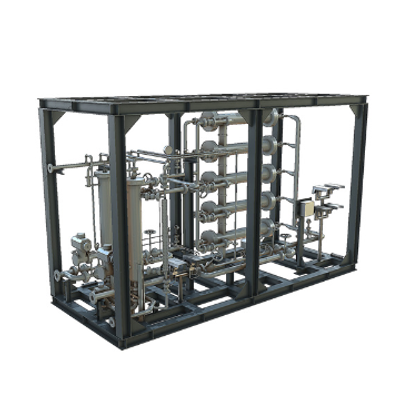
Garo - Gas Membrane Separation Unit
In general, gas membranes are polymer sheets are used to recover, purify or just separate gases.
Polymers can beare cross-linked in different ways to allow mechanical stability for various molecular cuts and the material they are made from can be blended depending on the gas being treated.
In oil and gas, petrochemical and chemical application often it is often required to recover part of the gas coming from a mixture of components with consequent economic benefit or to reduce the presence of some components that may effect affecton healthy if released in the atmosphere.
The membrane limits the motion of gas molecules passing through it so that some gases move more slowly than others or are completely excluded.
When a gas passes through the membrane, it is separated into both permeate and etentate streams. The permeated gas is the portion of the gas that thepermeates through the surface of the membrane whereas the retentate is the residual portion that does not permeate the membrane.
Gas separation using membranes is a potential alternative to conventional gas separation processes (such as absorption, adsorption, and distillation). Gas separation is a pressure-driven procedure in which the difference in pressure between the gas inlet of and the gas outlet of the product is used to.
Here’s a step-by-step explanation on how a gas separation process works to bring about gas purification:
1) The gas enters the liquid ring compressor.
2) The gas is compressed at the required pressure to get the best separation performance.
3) After the compression, the gas and liquid mix reaches the scrubber/separator that divides them.
4) The liquid comes back to the compressor, while the gas enters the membrane separator unit.
5) At the membrane stage, the required components are recovered