


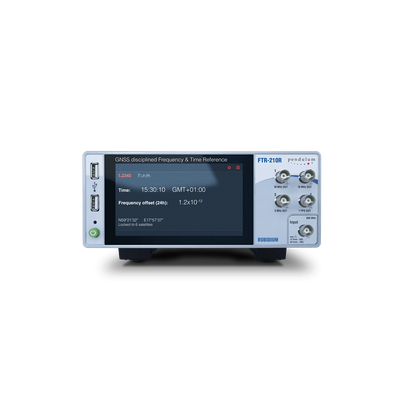
Pendulum - Model FTR-210R -GNSS-d. Rubidium Frequency & Time Reference
The Pendulum FTR-210R GNSS disciplined Rubidium Frequency & Time Reference provides near Cesium-level stability through GNSS-based disciplining. There are 7 standard outputs (5×10 MHz, 1×5 MHz and 1×1 pps) that can be expanded with up to 4 extra outputs, plus a programmable 100 MHz pulse output option.
The optional integrated independent frequency calibrator guarantees true traceability to the GPS time scale and NIST. Traceable calibration reports are easily generated. With Pendulum FTR-210R Rubidium Frequency and Time Reference, there is no need for yearly expensive calibration services from metrology labs.
An optional input for frequency measurements to 400 MHz turns the FTR-210R into a one-box ultra-high performance frequency calibrator with up to 13-digit resolution in a second.
When used as a GNSS disciplined Frequency standard, the short-term stability is very high, and ageing is virtually zero.
When used as a stand-alone Frequency standard, in manual hold-over mode, the stability is ultra-high. Ageing is less than 5х10-11/month.
When used as a GNSS disciplined Time standard, the 1 pps time reference output differs less than 10 ns rms from UTC. When GNSS disciplining is removed, the hold-over drift is very low; typical 1 µs/24 h.
The basic configuration contains 5×10 MHz, 1×5 MHz, and 1×1 pps outputs, to support other instruments, testers, or test objects. If that is not sufficient, 4 additional outputs can be fitted on the rear panel. These outputs are either
- 4×10 MHz
- 4×1 pps
- 0.1, 1, 5, and 10 MHz
Additionally, you can enable an optional programmable pulse output, 0.5 Hz to 100 MHz, via a SW license, at any time.