


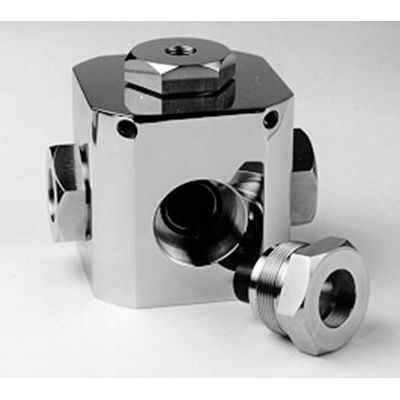
High-Pressure Cell System
The ISS High Pressure Cell System (HP Cell) has been designed for Absorption, Fluorescence, Raman spectroscopy and polarimetry studies of solid and liquid samples. The cell, built in a stainless-steel alloy, reaches pressures up to 400 MPa (4,000 bar) using a hydrostatic pump. The HP Cell can be mounted directly into ISS spectrofluorometers and several commercial instruments; also, it can be used as a stand-alone unit. The HP Cell comes either in a 3- or 4-windows version; the windows are located at 90 degrees from each other. Quartz and sapphire windows feature a 10mm aperture; MgF2 windows (used for polarimetry studies) feature a 3mm aperture. The high aperture 10mm-diameter windows allow for using as an excitation light source either a laser, a light emitting diode (LED) or a collimated beam from a xenon arc lamp. The unusually high numerical aperture (NA = 0.18) for a cell makes it unique for high sensitivity fluorescence studies.
A plug is available for the HP Cell whenever a voltage needs to be applied to a sample. The plug is mounted on top of the HP Cell; the pressure is applied by connecting the flexible tubing from the pump horizontally onto the plug. Pressures up to 300 MPa can be reached with the plug.
HP Cell with the plug for electrical feedthrough. The pressure is applied through the tubing connected horizontally to the plug. The voltage is applied on the electrodes.
Optical windows are made out of quartz [SiO2], sapphire [single-crystal aluminum oxide Al2O3] or MgF2. The windows are mounted onto polished plugs and held in place by precise mechanical holders.
| Material | Max pressure (MPa) | Aperture (mm) | Birifringence(Δn) | Transmission range (nm) |
| Quartz [SiO2] | 300 | 10 | +0.009 | 180 - 2,000 |
| Sapphire [Al2O3] | 400 | 10 | -0.008 | 250 - 5,000 |
| MgF2 | 250 | 5 | +0.006 | 150 - 6,500 |
The choice of the windows material is dictated by the specific application and measurement to be acquired. Quartz windows, constructed of UV grade fused silica, withstand pressures up to 300 MPa. Fused silica is a polycrystalline, isotropic material with no crystal orientation; these windows are suitable for polarization measurements. Sapphire windows withstand pressures up to 400 MPa. Yet, sapphire is a synthetic, hexagonal single crystal anisotropic material, which displays substantially different optical characteristics when measured along different axes; sapphire if birefringent, that is a light beam propagating along the optical axis experiences two different values of the index of refraction. These windows are less suitable for polarization measurements. MgF2 windows feature the lowest birefringence; moreover, their transmission extends to 150 nm making them suitable for circular dichroism studies.
The HP Cell body includes a built-in path for circulating the temperature control liquid from an external bath circulator directly attached to it. As the cell is made of a stainless-steel alloy with excellent thermal conductivity, temperature stabilization is rapid. The HP Cell is designed for operating in the temperature range from -20°C to +60°C.