


Regenesis HRC - Hydrogen Release Compound
HRC is an engineered, hydrogen release compound designed specifically for enhanced, in situ anaerobic bioremediation of chlorinated compounds in groundwater or highly saturated soils. Upon contact with groundwater, this viscous, poly-lactate ester material becomes hydrated and subject to microbial breakdown producing a controlled-release of hydrogen for periods of up to 18-24 months on a single application. HRC enables enhanced anaerobic biodegradation by adding hydrogen (an electron donor) to groundwater and/or soil to increase the number and vitality of indigenous microorganisms able to perform the naturally occurring process of enhanced reductive dechlorination. During this process, certain naturally occurring microorganisms replace chlorine atoms on chlorinated contaminants with the newly available hydrogen effectively reducing the contaminant to a less harmful substance with the preferred and innocuous endpoints of ethane or ethane.
To make available time release lactic acid for fermentation by subsurface microbes that in turn generates hydrogen. Hydrogen is the key ingredient in the anaerobic contaminant degrading process known as reductive dechlorination. Reductive dechlorination is the mechanism by which chlorinated compounds are biodegraded into less harmful constituents such as ethene and ethane.
HRC is typically applied using direct-injection techniques. This process enables the viscous HRC material to be pressure injected into the zone of contamination and moved out into the aquifer media. Once in the subsurface, HRC can reside within the soil matrix fueling reductive dechlorination and promoting reducing aquifer conditions for periods of up to 24 months or longer through the controlled release of lactic acid and subsequent hydrogen production.
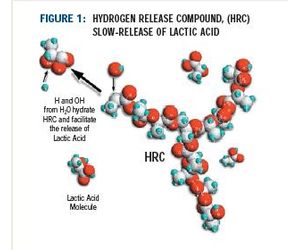
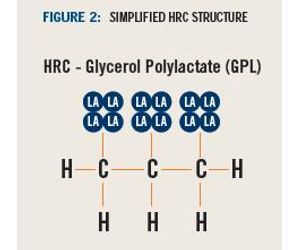
HRC is supplied as a viscous liquid for direct injection into contaminated groundwater and saturated soils. This specially formulated product produces a controlled release of lactic acid upon contact with water (Figure 1). This newly available source of lactic acid is then metabolized by microbes to produce hydrogen which is then used in a naturally occurring process known as anaerobic reductive dechlorination (Figure 2). The reductive dechlorination process results in the step-by-step biological degradation of chlorinated contaminants. HRC can be used to degrade a range of chlorinated compounds including: degreasing agents (PCE, TCE, TCA and their breakdown products), carbon tetrachloride, chloroform, methylene chloride, certain pesticides/herbicides, perchlorate, nitrate, nitroaromatic explosives and dyes, chlorofluorocarbons, certain metals and radionuclides.
As discussed, reductive dechlorination is a term used to describe the mechanism by which chlorinated hydrocarbons are biologically degraded under anaerobic conditions. In this natural process, anaerobic microbes substitute hydrogen (H) for chlorine (Cl) on chlorinated contaminant molecules, thus dechlorinating the compound. Being a natural process, reductive dechlorination usually proceeds at very slow, unsustainable rates. HRC increases the rate of dechlorination up to several orders of magnitude, rapidly taking the contaminant through a step-wise dechlorination process that ultimately results in the production of non-toxic compounds such as ethene and ethane. Under the influence of HRC, this process may continue.

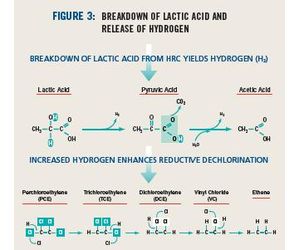
HRC is supplied as a viscous liquid for direct injection into contaminated groundwater and saturated soils. This specially formulated product slowly releases lactic acid upon contact with water (Figures 1 & 2). This source of lactic acid is then metabolized by microbes to produce hydrogen which is then used in a natural process known as reductive dechlorination (Figure 3). Reductive dechlorination results in the stepby-step biological degradation of chlorinated contaminants. HRC can be used to degrade a range of chlorinated compounds including: degreasing agents (PCE, TCE, TCA and their breakdown products), carbon tetrachloride, chloroform, methylene chloride, certain pesticides/ herbicides, perchlorate, nitrate, nitroaromatic explosives and dyes, chlorofluorocarbons, certain metals and radionuclides.
More on Reductive Dechlorination
As discussed, reductive dechlorination is a term used to describe the mechanism by which chlorinated hydrocarbons are biologically degraded under anaerobic conditions. In this natural process, anaerobic microbes substitute hydrogen (H) for chlorine (Cl) on chlorinated contaminant molecules, thus dechlorinating the compound. Being a natural process, reductive dechlorination usually proceeds at very slow, unsustainable rates. HRC increases the rate of dechlorination up to several orders of magnitude, rapidly taking the contaminant through a step-wise dechlorination process that ultimately results in the production of non-toxic compounds such as ethene and ethane. Under the influence of HRC, this process may continue at an accelerated rate for up to 18 months.
HRC May Favor Reductive Dechlorination Over Competing Methanogenic Activity
Within the subsurface anaerobic microbial consortium, there exist microbes that use hydrogen primarily for the production of methane (methanogens), and also present are microbes that use hydrogen primarily for dechlorination (reductive dechlorinators). Results from university studies suggest that there is competition for hydrogen between the reductive dechlorinators and methanogens. High concentrations of hydrogen favor methanogenic activity, whereas reductive dechlorinators are best supported in conditions of low hydrogen concentrations (2-10 nM). With HRC’s long-lasting, timerelease feature, a more steady and low hydrogen concentration is possible which can optimize reductive dechlorination over competing methanogenic activity.
- A viscous, honey-like material rated at 20,000 centipoise
- Composition: Glycerol Tripolylactate
- Non-hazardous, food grade product
- Packaged and delivered in 30 lb. PVC buckets
- Expected shelf-life of material = 3 years
- Controlled release of lactic acid to promote reducing conditions and produce hydrogen in 8 to 10 nM range which is optimal for anaerobic reductive dechlorination
- Long-term source of lactic acid/hydrogen to the subsurface (up to 24 months or longer)
- Single product application (for majority of sites)
- Clean, low-cost, non-disruptive application
- Not limited by presence of surface structures
- No Operations and Maintenance
- Faster and often lower cost than drawn out monitored natural attenuation (MNA)
- Complimentary product application design and site analysis from Regenesis
- Direct-injection (most common) for source area and permeable reactive barrier applications
- Re-circulation wells
- Straight HRC application in excavations
- Straight HRC application in ex-situ soil mixing
- Hydraulic fracturing of tight soil media
- Fractured bedrock injection using straddle packers
- Direct application into wells via gravity feed
- Existing aerobic or anaerobic conditions
- Contaminant type and mass
- Subsurface geology (distribution)
- Depth to groundwater
- Groundwater flow rates
- Viscosity/Pumping (heating of material sometimes required for ease of application)
- Free product (if present call Regenesis tech services to discuss options)