


- Home
- Companies
- Optikos Corporation
- Products
- Optikos - Model LensCheck - Instruments ...
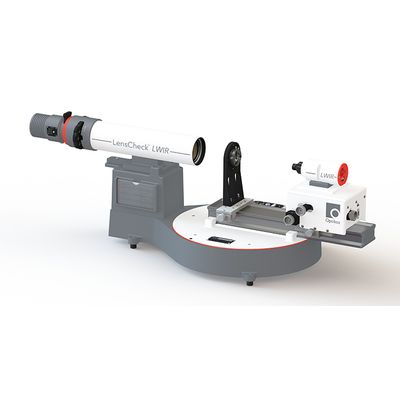
Optikos - Model LensCheck -Instruments for Small Optics
LensCheck™ Systems are a cost-effective solution to your production and prototype lens qualification needs. Optikos, the leader in image quality test equipment, is pleased to offer this compact, efficient, easy-to-use quality control tool. LensCheck™, with patented Optikos® VideoMTF® image analysis software, features realtime MTF testing and analysis enabling manufacturers to qualify incoming products quickly and reliably and minimize the risk of sub-standard complete assemblies.
| Specification | VIS | SWIR | LWIR |
| Entrance Pupil Diameter | Up to 50mm | Up to 50mm | Up to 50mm |
| Focal Length | ≤100mm (with appropriate image analyzer objective lens) | 5-50mm | 5-50mm |
| f-number of the lens | f/20 to f/1 (with appropriate image analyzer objective) The suitability of fast, non-telecentric lenses at off-axis field angles is determined by whether the image cone falls within the acceptance cone of the image analyzer objective. | f/20 – f/1 | f/20 – f/1 |
| Image Format Size | Up to 25mm diagonal | Up to 25mm diagonal | Up to 25mm diagonal |
| Max Spatial Frequency | Up to 500 lp/mm(assumes standard objective relay lens. Other relays available for higher spatial frequencies.) | Up to 120 lp/mm (assumes standard objective relay lens. Other relays available for higher spatial frequencies.) | Up to |
| 60 lp/mm |
Other characteristics that factor into the determination include spatial frequency of interest, chromatic performance of the lens, and departure from telecentricity at off-axis angles. These parameters are seldom independent, making it difficult to place rigid bounds on the space of the lenses that may be tested on LensCheck instruments. However, it is generally true that lenses that fall within the bounds described above are usually good candidates for testing with this instrument. There may be special cases in which lenses within these bounds may not be suitable for testing, and there are certainly cases in which lenses outside of these bounds may be tested. When in doubt, consult an Optikos engineer for advice.
- MTF – On/Off Axis
- EFL and f-number
- Back Focal Length
- Astigmatism
- Field Curvature
- Distortion
- Chief Ray Angle
- Transmission (VIS option – requires optional Transmission Kit)
- Stray Light (VIS option – requires optional Stray Light Kit)
- Axial Chromatic (VIS option – requires optional Reflective Collimator and Apochromatic Objective Relay Lens)
- Lateral Chromatic (VIS option – requires optional Reflective Collimator and Apochromatic Objective Relay Lens)
- Patented VideoMTF® technology enables real time MTF measurements
- Flexible platform allows a wide range of measurements (e.g. MTF, EFL, Distortion)
- VIS – Industry leading measurement accuracy better than 2 MTF (1 MTF typical); and better than 1 MTF repeatability (0.5 MTF typical)—validated with a diffraction-limited audit lens
- LWIR – Industry leading measurement accuracy better than 3 MTF (2 MTF typical); and better than 2 MTF repeatability (1 MTF typical)—validated with a diffraction-limited audit lens
- Configurable automated measurement routines
- Easily switch between wavebands (VIS/NIR, SWIR, or LWIR)
- Installed in production and R&D facilities around the world
| Measurement Accuracy: | VIS – Industry leading measurement accuracy better than 2 MTF (1 MTF typical) validated with a diffraction-limited audit lens. |
| LWIR – Industry leading measurement accuracy better than 3 MTF (2 MTF typical) validated with a diffraction-limited audit lens. | |
| Repeatability: | VIS – Better than 1 MTF (0.5 MTF typical) repeatability—validated with a diffraction-limited audit lens. |
| LWIR – Better than 2 MTF (1 MTF typical) repeatability—validated with a diffraction-limited audit lens. | |
| Physical Size: | 15″ (355mm) H |
| 30″ (762mm) W | |
| 48″ (1219mm) L | |
| Power Requirements: | 100 ~ 240 VAC 60/50 Hz |
| Computer 8/5A, monitors 0.6A each, DC power supply 1.6A, light source 2/1A | |
| Environmental: | Optimal performance is achieved in a dark room |
| Refractive Collimator: | 355mm EFL, 50mm clear aperture; shorter EFL collimators available upon request |
| Source Module: | VIS – Fiber-optic light source: 400-1000 nm |
| Electronic shutter enables automatic background corrections | |
| 8-position manual target and filter wheels | |
| Target set: pinholes, USAF 1951, and alignment target | |
| Filter set: photopic, 546 nm bandpass, infrared cutoff, and RGB set | |
| SWIR – Fiber optic light source, 400-2000nm | |
| Light guide with enhanced transmission in the SWIR spectrum | |
| Electronic shutter enables automatic background corrections | |
| 12-position motorized target wheel | |
| Target set: slits, pinholes, and alignment targer | |
| Filter: 0.9-1.7μm bandpass | |
| LWIR – Broadband emitter: 7-15 microns | |
| 12-position high-speed motorized target wheel | |
| Target set: slits, pinholes, crosshairs, and alignment target | |
| Filter: 8-12 micron bandpass | |
| Image Analyzer: | VIS – Sony EXview HAD CCD II offers improved sensitivity, dynamic range and noise characteristics: |
| 2736 x 2192 pixels | |
| Calibrated 40x 0.65 NA achromatic objective | |
| 14-bit video output | |
| SWIR – InGaAs camera | |
| 640×512 format | |
| Spectral responsivity 0.9-1.7μm | |
| NIR apochromatic tube lens | |
| Calibrated 20x 0.40NA NIR Apochromatic objective | |
| LWIR – Uncooled microbolometer | |
| 324 x 256 format | |
| Spectral sensitivity 7.5-15 microns | |
| Calibrated 7.5x 0.70NA relay lens | |
| 14-bit video output | |
| Motorized Z-axis: | 25mm travel 0.1 μm resolution |
| Motorized X-axis: | 25mm travel with 0.05 μm resolution glass scale encoder |
| Manual Y-axis: | 12.5mm travel |
| Motorized Lens Platform: | +/- 105° off-axis rotation |
| 0.0001° resolution glass scale encoder | |
| 0.5m optical rail | |
| Self-centering lens mount |