


HVR Internationals - Linear Disc Resistor
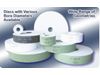
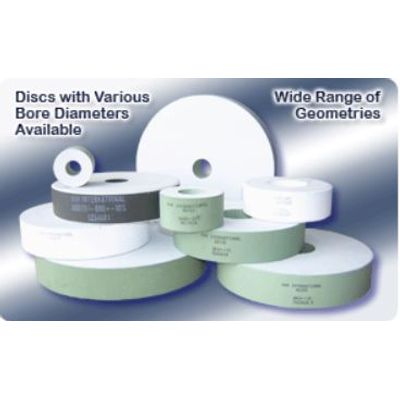
HVR Linear Disc Resistors are manufactured from a carefully blended mixture of clays, alumina and carbon. After blending, the material is pressed to the required shape, with diameters ranging from 0.3 to 15.1cm. The resistors are then fired at high temperature in a tunnel kiln with controlled atmosphere. This produces a Ceramic Carbon Resistor which is 100% active material and therefore of minimum size. Aluminium is then flame-sprayed onto the flat surfaces of the resistor to provide electrical contact, and an anti-track coating is applied to the periphery to improve dielectric withstand. With the capability of sustaining energies ranging from Joules to Mega-Joules, at frequencies up to Mega-Hz, HVR Linear Disc Resistors can be used in even the most demanding applications such as electrical transmission, traction, AC/DC drives, pulse power, dummy loads, induction heating and pulse forming networks.
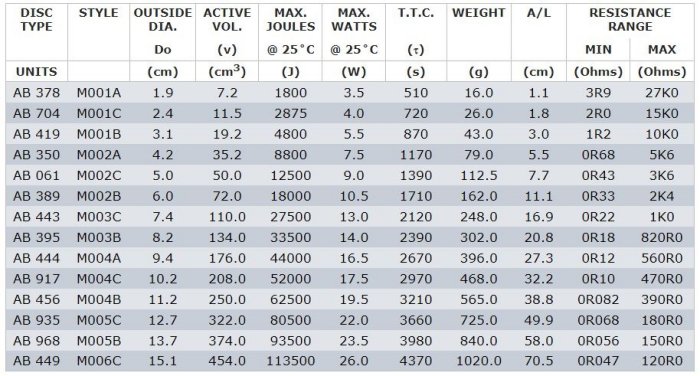
Dimension Range
- Outside Diameter (Do) 0.3 to 15.1 cm
- Standard Length (L) 2.54 cm
- Length (L) 1 to 5 cm
Density
- Nominally 2.25 g / cm3
Shock and Vibration
- Linear Disc Resistors are robust and capable of absorbing transmitted mechanical shock provided direct impact is avoided.
Coefficient of Linear Expansion
- + 4 x 10 -6 to + 10 x 10 -6 per °C
Youngs Modulus
- 3 x 10 6 N cm -2
Crushing Strength
- Average value 12000 N cm -2
Assembly Mounting Force
- Linear Disc Resistors may be assembled directly to the busbar or assembled into stacks by mounting on an appropriate tie rod. Sufficient assembly force must be maintained to provide good electrical interdisc contact over long periods of time. HVR recommend the use of several disc spring washers in series (reduces stiffness ratio) to provide the reliable mounting force described below:
- Force (kg) = 120 x (Do - Di) 0.7 (±50%)
- As a guide the total compression (deflection), from `just nip` condition should be:
- Total Compression = 2 + (Number of Discs x 0.1) mm
- Greater compressive forces are permissible provided the disc contact surfaces are ground flat and are free from foreign bodies, thereby minimising the risk of destructive induced bending moments.
Disc Terminations
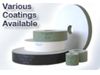
- Metallised contacts are flame sprayed onto the opposing flat surfaces of the Resistor Discs. Standard metallised contacts include Aluminium, Copper , Brass, Nickel and Silver.
Anti-Track Coating
- Epoxy and Silicone based anti-track coatings are utilised for improvement of dielectric withstand in Air and SF6 gas.
Environmental Protection
- Resistor Discs can be impregnated with Silicone Varnish to reduce moisture ingress and terminals Electroless Nickel Plated to minimise corrosion.
Resistor Drying
- Ceramic Resistors are porous and absorb moisture, this should be removed from the disc prior to use. Dry the discs in an oven at 110 - 120 °C for 24 hours. Place discs in a sealed container with silica gel.