


- Home
- Companies
- EconoPure Water Systems, LLC
- Products
- LFNano - Membrane System
LFNano - Membrane System
The LFNano™ membrane system is a nanofiltration system providing osmotic water quality with a simple, unique system to mitigate the effects of membrane fouling.
The system combines three features:
- Proprietary open architecture NF membrane element
- Anti-fouling particulate coating/injection
- Feedwater circulation
This system drastically reduces the impacts of membrane fouling. Fouling is where the contaminants in the water plug up the ‘pores’ in the membrane. Fouling is the limiting factor to the adoption of membranes today as most methods of dealing with it are mechanically complex and expensive. The membrane cartridge uses thin film composite (TFC) nanofiltration membrane in an open configuration, eliminating the dead spots common to standard elements today. The system is designed to circulate the feedwater continuously in order to eliminate the velocity/recovery relationship (limitation) while maintaining a high velocity. This maintains a consistent feed concentration which gives consistent performance or removal (avoids concentration polarization) and limits the buildup of foulants on the membrane surface.
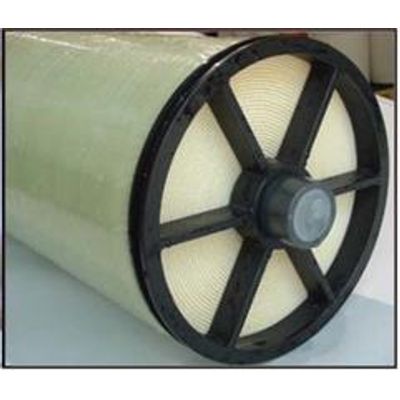
The LFNano™ membrane element has an open configuration that imparts an extremely low headloss allowing a low energy circulation of the feed water. The photos below show a close up of a cross section of the LFNano™ membrane element with the unique feed spacer along with a photo of the element that looks almost identical to traditional spiral elements today.
The system also uses anti-fouling particles that protect the membrane from organic fouling and inorganic scaling. These anti-fouling particles can be based on standard high surface area particles like diatomaceous earth or activated carbon. The particulate feed stock is modified for use in the LFNano™ and is injected into the feed stream to bind up the very fine particles that would otherwise imbed into the membrane. These injected particles can be easily removed when they accumulate in the vessel or on the membrane surface. Below are microscopic views of some possible particulate stocks that can be used in the LFNano™ (diatomaceous earth, granular activated carbon and bentonite).
The use of these particles greatly extends the fouling intervals and protects the membranes from the smallest of the foulants which can imbed into the membrane and impede the flow of water through it. The coating of these particles on the membrane also allows for an online flux reset by the DXV ‘rest cycle’ whereby the membrane is rested between one (1) and five (5) times per day. The rest lets the system restore most of the flux lost in the treatment process.
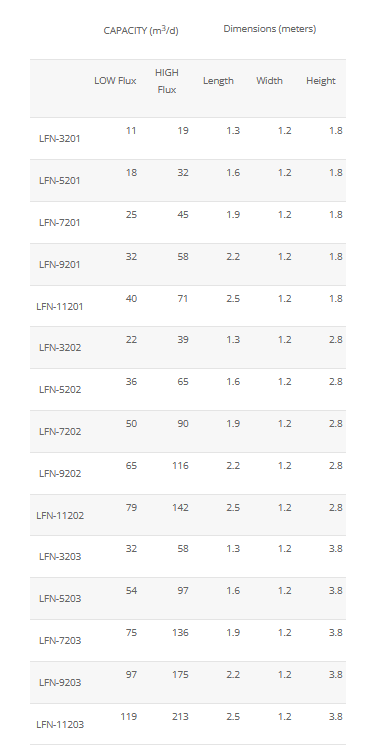
The LFNano™ comes in several standard systems and multiples of these systems can be run in parallel to achieve larger capacities. The LFNano™ systems come in 20 centimeter (8 inch) diameter vessels currently with larger (and smaller diameters available on custom orders). The standard LFNano™ system come in odd numbers of pressure vessels from 3 to 11 and from 1 to 3 elements tall. The part number nomenclature is as follows:
LFN-[# vessels]20[elements tall]
So LFN-7202 is seven (7) vessels, each of 20 centimeters in diameter (8 inch) and two elements per vessel. The following table shows the dimensions and capacity of each standard system as well as the range of capacities from low to high flux applications.
Membrane Selection
The LFNano™ has six different nanofiltration (NF) membranes from which to choose. They are described by their rejection of magnesium sulfate (MgSO4) and sodium chloride (NaCl) under certain test conditions. The range of NF membranes available on the LFNano™ are shown in the table below.
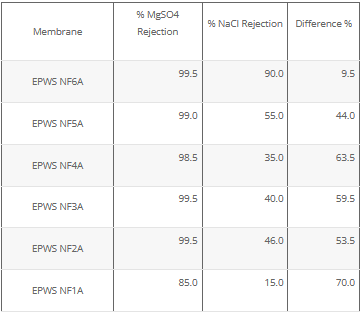
The test conditions for the standard membrane performance tests rarely approximate real world conditions but are used to give people an indication of a membrane’s performance. The difference between the rejection of magnesium sulfate and sodium chloride is important because the monovalent ions like sodium and chloride will exert far more osmotic pressure on a membrane system than the polyvalent ions like magnesium and sulfate. Thus the lower rejection of the monovalent ions is important for a low cost simple system. As a comparison, most reverse osmosis (RO) membranes reject over 95% monovalent ions and over 99% of polyvalent ions.