


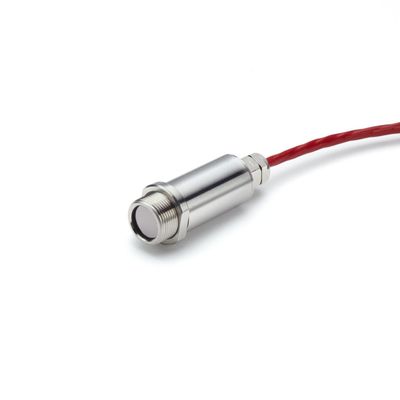
- Miniature non-contact temperature sensor
- RS-485 Modbus interface
- Measures temperatures from -20°C to 1000°C
- For use in ambient temperatures of up to 120°C without cooling
- Compatible with third-party RS-485 Modbus Master devices, or Calex touch screen interface
- Not designed or approved for fever detection
- 6-channel temperature display with configuration, alarms and data logging
- Analogue and alarm relay outputs via optional modules
- Low-cost standalone 6-channel temperature measurement system
- Build larger systems using the PM180’s separate Modbus Master and Slave interfaces
- Connect PyroMiniBus sensors directly to third-party RS-485 Modbus systems
Temperature Range
-20°C to 1000°C
Interface
RS-485 Modbus RTU
Accuracy
±1% of reading or ±1ºC whichever is greater
Repeatability
± 0.5% of reading or ± 0.5°C whichever is greater
Emissivity
0.2 to 1.0
Response Time, t90
125 ms (90% response)
Spectral Range
8 to 14 μm
Supply Voltage
6 to 28 V DC
Supply Current
50 mA max.
Baud Rate
9600 baud (other configurations available upon request)
Modbus Data Format
8 data bits, no parity, 1 stop bit (other configurations available upon request)
Configuration Method
Via PM180 touch screen, or directly via RS-485 Modbus
Configurable Parameters
Emissivity Setting, Averaging, Peak/Valley Hold Processing, Reflected Energy Compensation
Construction
Stainless Steel
Dimensions
18 mm diameter x 45 mm long (excluding cable gland)
Thread Mounting
M16 x 1 mm pitch
Cable Length
1m (longer lengths available to order)
Weight with Cable
85 g
Environmental Rating
IP65
Ambient Temperature Range
PyroMiniBus sensor: 0°C to 120°C including cable
PMBHUB junction box: 0°C to 80°C
Relative Humidity
95% max. non-condensing
EN61326-1, EN61326-2-3 (Electrical Equipment for Measurement, Control and Laboratory Use – EMC Requirements – Industrial)
The PyroMiniBus may be installed as a new temperature monitoring system, or integrated into an existing Modbus network with third-party hardware.
With two Modbus interfaces, the PM180 touch screen module makes an ideal local display for a group of sensors as part of a larger system.
The PMBHUB junction box makes it easy to connect the system together.
Never miss a critical temperature event. In condition monitoring applications, the PyroMiniBus system is an always-on solution that can replace manual checks with a handheld thermometer or expensive thermal imager.
For example, some typical uses include:
Typical Applications
Power distribution
Monitor the temperature of busbar joints in switchgear cabinets. Hundreds or even thousands of points can be monitored on the same network using PyroMiniBus sensors.
Curing ovens
Fibreglass impregnated with epoxy is cured in an oven to increase strength. PyroMiniBus sensors are placed inside the oven at up to 120°C, to build up a temperature profile at many points on the entire surface of the workpiece, and to communicate the measured temperature to the heating system that controls the hot air blowers in the oven. Industries include boatbuilding and aerospace as well as many others.
Industrial bakery
Check the temperature profile of bakery products at multiple points along a conveyor oven.
Corrugated board manufacturing
Monitor the web temperature along an entire corrugator, with local displays for each section of the production line, and centralised monitoring in the control room. Sensors withstand 120°C, and can be used in high-temperature areas such as single facers without cooling.
Automotive
A large system of PyroMiniBus sensors can monitor the paint curing process at several points.
Monitor temperatures around the entire vehicle in environmental test chambers.
Condition monitoring
A network of PyroMiniBus sensors can monitor all the bearing temperatures on a machine, a runout table, or the whole factory. The PyroMiniBus is ideal for measuring the temperature of all painted metal surfaces.
Infrared curing
Arrays of sensors fitted on a rig of infrared curing lamps ensure an even temperature profile along the part being cured. Surface coatings, paint and epoxy are ideal target materials, among many others.
Gas cylinder filling
Monitor temperatures to improve repeatability in the filled volume and improve filling efficiency. The temperature of every cylinder on a filling rig is easily monitored with no need to manually move contact probes.