


LightForm, Inc.
- Home
- Companies
- LightForm, Inc.
- Products
- Pariss - Modular Imaging Spectrometer ...
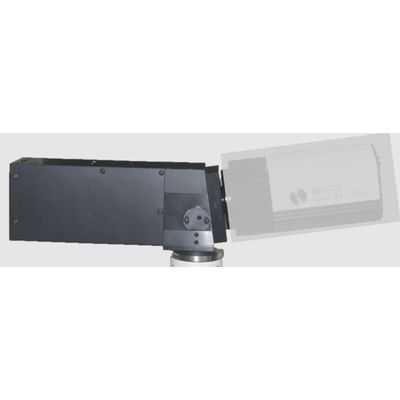
Pariss - Modular Imaging Spectrometer and Spectrograph
FromLightForm, Inc.
The PARISS Imaging Spectrometer is prism-based for the highest possible spectral sensitivity. A modular prism based imaging spectrometer and spectrograph captures low signal- to-noise, spatially resolved spectra, at all wavelengths from 365-nm – 920-nm simultaneously.When used with a CCD or CMOS camera spectrum detector it becomes an imaging spectrometer. Enables point-to point spectral imaging in a variety of configurations.
Most popular related searches
microscope objective
spectrometer
CMOS camera
spectral imaging
wavelength calibration
spectral analysis
petri dish
microscope slide
calibration standard
remote sensing
A modular prism based imaging spectrometer and spectrograph captures low signal- to-noise, spatially resolved spectra, at all wavelengths from 365-nm – 920-nm simultaneously.
When used with a CCD or CMOS camera spectrum detector it becomes an imaging spectrometer. Enables point-to point spectral imaging in a variety of configurations.
Design: The PARISS imaging spectrograph and spectrometer uses a prism with curved sides to deliver state of the art light throughput efficiency. This enables highest sensitivity and very fast acquisition times, even with low signal to noise spectra.
Zoom magnification is available from less than 1x (de-magnification) to 40x, or higher with microscope objectives.
Most PARISS modules are available separately. Our goal is to enable any researcher to mix-and-match and buy only what is needed. When budgets are squeezed this is a great way to save money.
Upgrade any time as funds become available.
Mounting: PARISS imaging spectrograph can be column mounted on a bench, a tripod, or interface with a microscope or telescope video port.
Light collection optics can include a c-mount macro lens, with or without zoom capabilities, a microscope objective or telescope optics.
Spectral object characterization in %reflection, absorption, or luminescence
Spectral cameras: can be user-supplied or select from a range of options available through LightForm.
Software: Written in Python, various options are available, including:
Basic spectral analysis %Refection, absorption, emission, Spectral classification, Create spectral libraries, Perform spectral recognition.
Zoom magnification: From less than 1x to greater than 40x. Eliminates the need for multiple objectives
Samples and specimens: Designed to work with heterogeneous samples in air, a petri dish, microscope slide, in water or in-situ
Optics and objectives: Accommodates high numerical aperture (NA) long working distance objectives, commercial microscope objectives, camera, and long focal length telescope lenses for remote sensing.
Spectroscopy modes: %reflection, %transmission, absorption fluorescence, luminescence…
Wavelength range: prism-based imaging spectrograph. Operates from 360 – 920-nm depending on the spectrum camera and application optics
Mounts: Can be mounted on a column, microscope C-mount video port, a cart, tripod, or mast
Illumination: LED brightfield, darkfield, refection, transmission, monochromatic fluorescence excitation
Observed field-of-view: Coaxial side camera records the FOV live. Great for object targeting and documentation
Weight: 1,250 g (Excluding a camera)
Moving parts: None. Optimizes stability and reproducibility.
Dimensions: 210 x 55 x 85 mm
Wavelength dispersive element: The wavelength dispersive element is a prism with optical `power." Concave and convex surfaces on the front and rear surfaces correct astigmatism, coma, and spherical aberration. (See Figure 2)
Spectral range: 365 to -920 nm or 400 to -920 nm, depending on choice of camera. All spectra acquired simultaneously without order sorting filters
Light throughput efficiency: Internal transmission -90% from 450 to -920 nm.
Entrance slit dimensions: Standard 5 mm by 25-micron, widths of 50 and 100-micron are available in pre-aligned mounting assemblies.
Spatial resolution at the sample: Depends on slit width and camera pixel size - 0.6 micron by -0.6 micron
with 40x magnification typical. Nanoparticles may be detected but not resolved
Spectral resolution: -1 nm measured at the full width at half maximum of the 436 nm Hg line, depends on slit width and camera pixel size.
Optional calibration standards: Available MIDL wavelength calibration lamp and a "SYLPH" NIST certified
radiometric light source.