


Mick Moor

HarvestStore - Moist Grain Silo
FromMick Moor
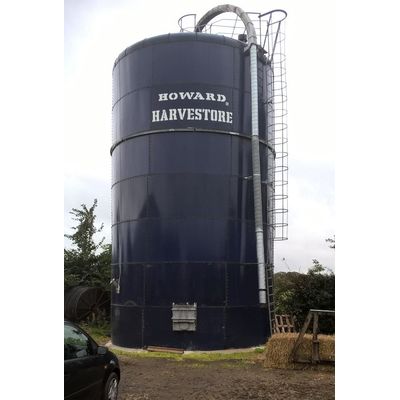
Sealed grain towers were first introduced to farms in the 1960’s. They are an under-rated, sustainable way to store grain for animal feed, with minimal CO2 produced during the process. Originally made by A O Smith, Howard, Harvestore, Simplex and Boythorpe, after the initial expense they were an almost cost-free way of storing barley or wheat, to be fed to the farm’s livestock. The tower silo is a sealed structure; once filled, all hatches are closed, and the living crop uses up the oxygen in the atmosphere by respiration. Moulds, insect pests and even rodents cannot survive, so the crop is preserved.
Most popular related searches
grain silo
sweep auger
crop storage
animal feed
grain storage
animal feeding
barley
barley wheat
grain testing
crop testing
Because there is no oxygen, it is extremely dangerous to enter a sealed silo without ventilating it well and testing the air inside for oxygen content.
The advantages are however considerable; virtually no wastage, vermin-proof storage, highly palatable (with a slight ‘beery’ smell), less dusty feed, no on-going costs for drying, ‘Propcorn’, or chilling. To a certain extent, the crop can be harvested when it is ready, without waiting for a sustained period of dry weather. The silo can be automatically emptied at a speed which matches a roller mill, and the whole process can be automated. If you wish to re-commission a sealed silo, at the same time reducing your carbon footprint, please give me a call. I can also fit a sweep auger to an existing silo to improve the safety for operators.
This silo will hold approximately 200t barley. According to a price list, back in 1965 it would have cost £2,500. With a sweep auger adding a further £380. Handrails on the roof ladder, though, were extra! However, no VAT in those days!
Unfortunately, like machinery, moist grain silos do require maintenance, which will prevent a gradual deterioration in the quality of the stored crop. As the silo is filled it stretches, and when emptied relaxes again. This constant movement, combined with expansion and contraction due to temperature variations, and strong winds, gradually wears the mastic sealing the joints between the sheets, letting out carbon dioxide and letting in fresh air and moisture. The rubber seals on the hatches lose their elasticity and deteriorate due to sunlight. Often the valve controlling pressure inside the silo can become blocked. The adjusters for door, filler and emptying hatches often seize up.
Unfortunately, like machinery, moist grain silos do require maintenance, which will prevent a gradual deterioration in the quality of the stored crop. As the silo is filled it stretches, and when emptied relaxes again. This constant movement, combined with expansion and contraction due to temperature variations, and strong winds, gradually wears the mastic sealing the joints between the sheets, letting out carbon dioxide and letting in fresh air and moisture. The rubber seals on the hatches lose their elasticity and deteriorate due to sunlight. Often the valve controlling pressure inside the silo can become blocked. The adjusters for door, filler and emptying hatches often seize up.
A cutaway drawing of a Harvestore grain silo from an old brochure, showing the sweep auger unloading system.
I am probably the only person in the country offering a full test and repair service for all makes of moist grain silos.
Testing involves shutting the silo up, and then blowing air in until the pressure release valve is triggered. This must be checked first, to avoid excessive pressure damaging the silo. All seals on hatches and doors, are them checked by spraying soapy water on them, and looking for bubbles. Finally, the whole structure is tested, including the joint between the silo and base, a common source of trouble. It is surprising how often I find a nut that has never been tightened up! Any leaks are marked with chalk, for appropriate treatment once the silo is no longer pressurised. Occasionally it is cheaper to just apply fresh mastic to every seam, regardless of whether it is leaking or not.
Leakage under the bottom edge of the silo easily detected with soapy water!
This open seam was leaking so much that it would not have been possible to pressurise the silo to test. The size of the gap can be checked by comparing the number of threads showing beyond the nuts. The seam has been cleaned up ready for fresh Sikaflex mastic to be applied before the bolts are tightened again. Three horizontal seams on the South side of this silo were like this!
Sometimes the original erectors missed tightening a nut, or where the glass has been chipped under the washer, overtightened it.
Good for another few years now!
Pressure release valves can be blocked with corrosion and dust. Cleaned up and re-fitted the storage problem was solved.
Boythorpe valves are particularly prone to blockage! They can only be cleaned by removal followed by dismantling.
The ¼” BSW slot head screws holding them together are often corroded and shear off in the housing! I replace them with stainless hexagon head set screws, BSW thread of course, with plenty of copper grease, to make future dismantling easier without removing the assembly from the silo roof. It is a good idea to replace the gauze to keep flies out.
Seals often need replacing, and the clamps freeing and adjusting. Occasionally the hatch gets buckled, (usually by being dropped) in which case a replacement is the only answer. The slats behind the bottom rectangular hatches keep the pressure of grain off the hatch. Without them, the door will become bowed.
The outlet seal on Harvestore sweep augers wears as grain passes over it. The catch also needs periodic adjustment.
I stock spare most seals including circular hatch seals and rectangular access door seals for any make; Simplex, Boythorpe, Harvestore, Howard, and A O Smith, along with replacement door slats.
Testing and necessary repairs can restore the performance of a sealed silo to ‘as new’ or sometimes even better!
Testing and necessary repairs can restore the performance of a sealed silo to ‘as new’ or sometimes even better!