

- Home
- Companies
- Nakkilan Metalli Oy
- Products
- Nakkilan Metalli - Model Mint F-L ...
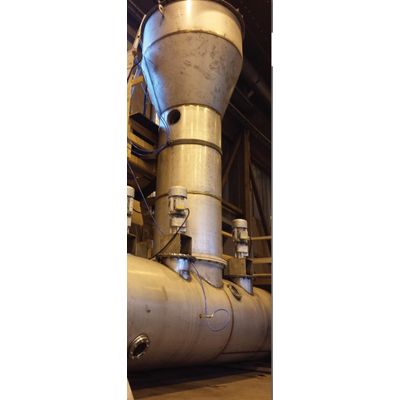
Nakkilan Metalli - Model Mint F-L Cascade -Multi-Interactive Flow-Loop Reactor Technology
The MInt F-L reactor is an example of a stepwise, during several decades minted technology. The Driving force for this technological development has been the hydrometallurgical need for even larger reactors capable to an economical treatment of vast amounts of metal containing slurries, for example such dumped at both old and new mine sites. A typical MInt F-L reactor is implemented as a cascade consisting of three to five separate flow loops, each divided into separate vertical and horizontal parts. Marine type high flow propellers are used to generate a master flow loop throughout each cascade, which are joined together by short overflow channels. The propellers arrangement allows a massive down flow in the vertical section, which in turn allows a design, according to which a diameter 2..6m flow enters the horizontal section at a speed of 1,0..2,0 m/s.
According to preferred design, the vertical flow is split into two horizontal parts using symmetrical steep profile bottom slopes in the middle of the horizontal loop section, the volume of which can exceed that of the vertical section by more than 50 percent. Preferably, a case specific “marine type propeller mixing” is used to enhance both the general processing performance as well as the flow speed of both the horizontal and the vertical cascade sections. A successful marine type propeller approach has in this case required some guiding flow arrangements for the propellers of both the vertical and the horizontal flow sections.
As the process economics of a MInt F-L plant, the very size of a reactor cascade greatly decreases the volume wise investment costs as well as the operating costs. The reactor cascade volume, typically 5000…15000m3, can be designed to exceed 20000m3. The main explanation for good process economics is an advanced use of high performance marine type propellers, a development, which has required several technical pilot installations based on serious flow laboratory test efforts.
- Suitable for oxidative leaching treating large slurry flows
- Increasing manageable flow capacities
- Alternative for conventional autoclave treatment
- Increasing manageable slurry densities
- Autogenous heat generation when treating sulphide slurries facilitating energy recovery
- Facilitating process economy improvements
- Enables a major increase of slurry flows to be processed resulting in a good process economy
- Retrieving of liberated energy possible
- Represents a major improvements of present leaching technologies
- Maintains a throughout well-mixed slurry state at low power costs
- Allows a high gas hold-up
- Creates new processing alternatives (Cleantech etc.)