


- Home
- Companies
- PicoQuant GmbH
- Products
- HydraHarp - Model 400 - Multichannel ...
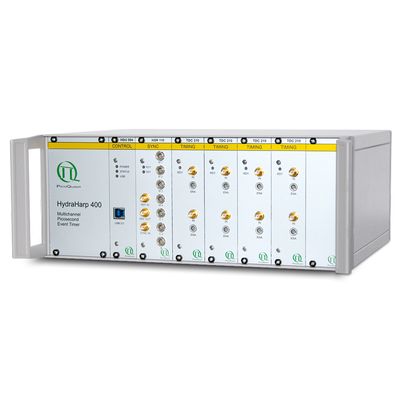
HydraHarp - Model 400 -Multichannel Picosecond Event Timer & TCSPC Module
The HydraHarp 400 is a high-end, easy to use, plug and play Time Interval Analyzer (TIA) and Time-Correlated Single Photon Counting (TCSPC) system with scalability for multiple channels (covered by patent DE 10 2008 004 549). It is connected to a PC through a USB 3.0 high speed interface. The high quality and reliability of the HydraHarp 400 is expressed by a unique 5-year limited warranty.
- Compact box with USB 3.0 connection and modular, scalable design (patented)
- Up to 8 independent input channels and common sync channel (up to 150 MHz)
- 65536 histogram bins per channel, minimum width 1 ps
- Count rate up to 12.5 million counts/sec per channel
- Adjustable input delay for each channel with 1 ps resolution
- Multi-stop capability for efficiency at slow repetition rates
- Histogrammer measurement ranges from 65 ns to 2.19 s
- Time tagging with sustained count rates up to 40 Mcps
- External synchronization signals for (fluorescence lifetime) imaging or other control events
- External reference clock input and output
- Drivers and demo code for custom programming
Multiple input channels for highly flexible use
The HydraHarp 400 is available in different sizes that permit to install up to 4 or up to 8 identical synchronized but independent input channels. They can be used as detector inputs for coincidence correlation experiments or as independent stop inputs for TCSPC. A dedicated common sync input is provided for TCSPC with fast excitation sources. This allows forward start-stop operation at the full repetition rate of mode locked lasers with stable repetition rate up to 150 MHz. Experiments with low repetition rate benefit from the HydraHarp`s multi-stop capability.
Independent channels, 1 ps resolution
The design of the HydraHarp 400 allows high measurement rates up to 12.5 million counts/sec per channel and provides a highly stable, crystal calibrated time resolution of 1 ps. Along with the extremely low differential non-linearity of the instrument, excellent data quality can be obtained. As a special feature, an external time base can be used to synchronize the internal clock in relation to other timing devices. The instrument`s timing resolution is well matched to even the fastest detectors currently available: the SPAD detectors of the PDM series or micro-channel plate Photomultiplier Tubes (MCP). All input channels are equipped with Constant Fraction Discriminators (CFD), sensitive on the falling edge.
Adjustable delay in each input channel
The HydraHarp 400 offers 65536 histogram bins per input channel and allows to collect more than 4 billion counts (32 bits) per bin. Each input channel even has an internal adjustable delay with ±100 ns range at 1 ps resolution. This unique feature eliminates the need for specially adapted cable lengths or cable delays for different experimental set-ups.
Operation as time tagger
A time-tagged mode for recording of individual photon events with their arrival time on all channels allows the most sophisticated offline analysis of the photon dynamics. Time-Tagged Time-Resolved (TTTR) data can also be correlated in real-time for monitoring of FCS experiments at count rates up to 1,000,000 counts/sec. In TTTR mode, the device can be synchronized with other hardware such as scanners.
Input Channels and Sync
Discrimination: Constant Fraction Discriminator (CFD) included in all channels, software adjustable
Input voltage range: 0 mV to -1000 mV, optimum: -100 mV to -500 mV
Trigger point: falling edge
Trigger pulse width: 0.5 ns to 30 ns
Trigger pulse rise/fall time: 2 ns max.
External Reference Clock
Input: 10 MHz, min. 200 mV, max. 1 V pp, 50 Ohms, AC coupled
Output: 10 MHz, 300 mV pp, 50 Ohms, AC coupled
Time to Digital Converters
Minimum time bin width: 1 ps
Timing precision*: < 12 ps rms
Timing precision / √2*: < 8.5 ps rms
Full scale range - histogram mode: 65 ns to 2.19 s (depending on chosen resolution: 1, 2, 4, ..., 33 554 432 ps)
Full scale range - time-tagged mode: infinite
Maximum count rate per input channel: 12.5 × 10⁶ counts/sec
Maximum sync rate: 150 MHz
Adjustable delay range for each input channel: ± 100 ns, resolution 1 ps
Dead time: < 80 ns
Differential non-linearity: < 2 % peak, < 0.2 % rms (over full measurement range)
Histogrammer
Count depth per time bin: 4.294.967.296 (32 bit)
Maximum number of time bins: 65536
Acquisition time: 1 ms to 100 hours
TTTR Engine
T2 mode resolution: 1 ps
T3 mode resolution: 1, 2, 4, ..., 33 554 432 ps
FiFo buffer depth (records): 2097152
Sustained throughput**
(sum of all channels): typ. 40 × 106 events/sec
Operation
PC interface: USB 3.0
PC requirements: min. 1 GHz CPU clock, min. 1 GB memory
Operating system: Windows 10/11
Power consumption: small mainframe < 50 W, large mainframe < 100 W at 100 to 240 VAC
The HydraHarp 400 can be used for various applications that can make use of a multi-channel TCSPC and/or time tagging system with independent channels, such as:
- Time-Resolved Fluorescence
- Fluorescence Lifetime Imaging (FLIM)
- Phosphorescence Lifetime Imaging (PLIM)
- Fluorescence Correlation Spectroscopy (FCS)
- Fluorescence Lifetime Correlation Spectroscopy (FLCS)
- Foerster Resonance Energy Transfer (FRET)
- Stimulated Emission Depletion Microscopy (STED)
- Dual Focus Fluorescence Correlation Spectroscopy (2fFCS)
- Pulsed Interleaved Excitation (PIE)
- Fluorescence Anisotropy (Polarization)
- Single Molecule Spectroscopy / Detection
- Singlet Oxygen
- Time-Resolved Photoluminescence (TRPL)
- TRPL Imaging
- Lanthanide Upconversion
- Bunch Purity
- LIDAR/Ranging/SLR
- Antibunching
- Diffuse Optical Tomography and Imaging
- Coincidence Correlation
- Quantum Communication
- Quantum Entanglement
- Quantum Teleportation
- Quantum Information Processing
- Positron Annihilation Lifetime Spectroscopy (PALS)
- Time response characterization of optoelectronic devices
- Intensity interferometry
- Time Interval Analysis (TIA)
- Thomas-Bollinger single photon method