

- Home
- Companies
- Petro Sep Corporation
- Products
- Petro Sep - Pervaporation (PV) System
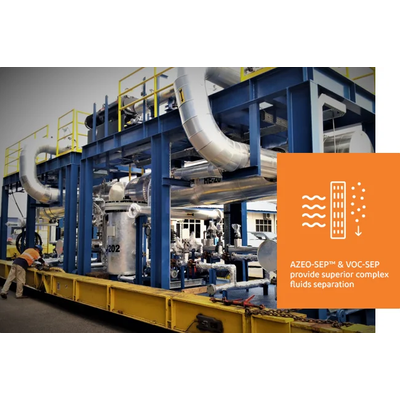
Petro Sep - Pervaporation (PV) System
In PV, the mirror component in the feed stream is separated from the bulk by preferential transportation through a semi-permeable barrier by its partial vaporization. Separation of azeotropic, close boiling, isomeric or heat sensitive liquid mixtures, recovery of volatile organic compounds (VOC), organic/ organic separation, recovery of trace concentrations of organic pollutants from industrial effluents and solvent dehydration are the major areas of application of PV process.
Petro Sep has developed VOC-SEP™ and AZEO-SEP™ that primarily utilize PV or possibly VP for separation.
In the PV process, the feed solution is kept at a specific temperature and pressure that ensure a liquid phase during the operation (i.e., temperature lower than the boiling point and pressure higher than the bubble point of the feed). A dense non-porous membrane is required to perform the selective separation process of a specific compound from the mixture and thus control the efficiency of PV process. The components that permeate through a non-porous perm-selective membrane vaporize somewhere inside the membrane until reaching the other side, that is, the permeate side. The permeate side is kept normally under vacuum so that a large driving force is ensured. The components that have permeated (the “permeate”) are condensed and collected again in a liquid phase. The liquid stream that did not permeate through the membrane is called “the retentate” and is concentrated in the less permeant species.
For the selection of a suitable membrane some parameters should be considered. Such as degree of hydrophilicity, chemical and thermal stability and the selectivity and permeability of the target component. Depending upon the feed composition, the desired permeate purity, the PV application can be classified into: