


- Home
- Companies
- APE Angewandte Physik & Elektronik GmbH
- Products
- Picosecond Laser Tunable
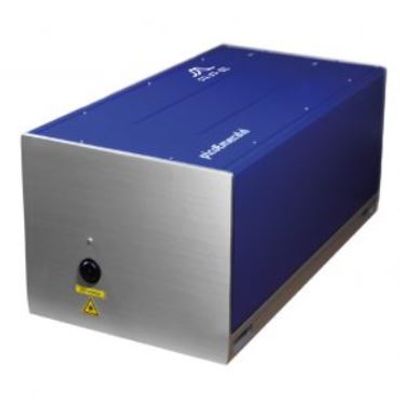
Picosecond Laser Tunable
The picosecond laser picoEmerald emits ultra-short pulses with a duration of 2 picoseconds (other durations possible). The wavelength tuning of the ps laser is fully automated across a tuning range of 700 nm to 990 nm (Signal) and 1080 nm to 1950 nm (Idler). The fundamental beam at 1032 nm is also available. A wavelength scan / sweep function for fast spectra acquisition over certain specific wavelengths is included.
- Wavelength 1 IR beam 1032 nm
- Wavelength 2 tunable 700 nm … 990 nm
- Wavelength 3 tunable 1080 nm … 1950 nm
- Temporal and spatial overlap of the output wavelengths
- Integrated time-delay between the wavelengths
- A common output port for all beams
- Fully automated wavelength tuning
- EOM optionally integrated
picoEmerald provides ultra-short picosecond laser pulses with a pulse repetition rate of 80 MHz.
With the picosecond laser picoEmerald, Idler and Signal beams and the IR beam (1 µm from the pump laser) are designed to come from one and the same output. They are perfectly overlapping in space and time. Therefore, there is no need for the user to use additional optics to guide the different beams into one location.
Users often want to use the entire wavelength range provided by the IR beam and the Signal and Idler output. Some applications, such as Coherent Raman Spectroscopy, even require the different beams being spatially and temporally overlapped. The difficulty with most laser systems is that IR, Signal and Idler beam come from different outputs. The different beams can therefore not easily be coupled into one and the same experiment. With the common single output port of the picoEmerald, the user has the certainty and comfort of not having to create their own beam path for the individual beams.
The picoEmerald has an integrated delay management (GDD dispersion compensated output). This allows the perfect adjustment of the time delay between the IR and the Signal beam even for external optics, in order to deal with dispersion differences at the different wavelengths. Each time the picoEmerald picosecond laser is tuned to a new Signal wavelength the delay of the IR beam is adjusted automatically for achieving a temporal overlap between Signal and IR pulse either at the output port or at an external experiment position.
All optical modules of the tunable picosecond laser picoEmerald were optimized by finite element analysis and mechanical stability algorithms (misalignment stability optimization). This ensures maximum mechanical stability. In addition, active cavity control continuously maximizes the efficiency of the high-performance picosecond laser oscillator and the integrated optical parametric oscillator. The picoEmerald is supplied with an internal closed-loop chiller to ensure stable operation. A panel PC with pre-installed control software and a user interface are part of the delivery. The picoEmerald is designed to be a “hands-free” unit. It is not necessary for the user to interact with the laser except via the software interface.