


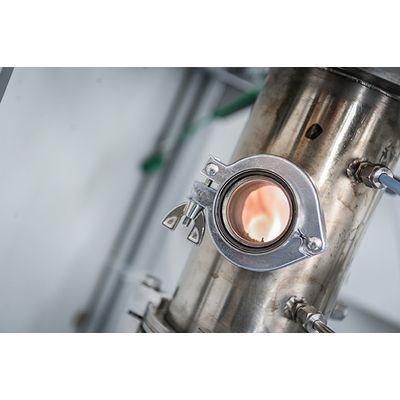
We have developed and patented an innovative proprietary low energy and CO2-free methane decomposition process, based upon Plasmalysis.
Our priorities has been to build a compact, modular, stackable and on-site unit:
- Compact – Optimized integration in your installations.
- On-demand – The use of microwave plasma allows you to produce when you want, adapting to the needs of a variety of industries and sectors.
- Stackable – The reactors can be added together to produce useful quantities and thus adapt to entities from 200 kg H2 per day, up to the needs of major industrialists in the oil and gas sector, severals hundred tons of hydrogen per day.
- On-site – The unit comes at the end of the gaz infrastructure, suppressing the need to build a dedicated hydrogene infrastructure one from scratch. In short, it unlocks a massive adoption from every industries and sectors.
Sakowin’s technology and product are protected by 3 patents, filed and pending, relating hydrogen production integrating a microwave plasma technology. The patents cover the production, distribution and scaling of a technology to produce sustainable hydrogen.
The energy transition rests on three pillars, all of which are essential to its success: process energy efficiency, the energy circular economy, and sustainability from both an environmental and economic perspective.
ENERGY EFFICIENCY
it is essential to aim for energy efficiency in processes and to take into account the entire life cycle of each energy source used.
CIRCULARITY
we need to move from global to local and promote technologies to recover waste and co-products.
SUSTAINABILITY
we need sustainable energy systems from both an environmental and economic point of view.
The process of producing black, brown and grey hydrogen produces CO2.
Blue hydrogen is a similar process combined with CO2 capture and storage to reduce emissions.
Green hydrogen is produced via water electrolysis. According to the World Economic Forum, about 30 to 35% of the energy used to produce green hydrogen is lost during the process of electrolysis. Furthermore, the current solutions using with renewable energies require massive state subventions to envision a large-scale deployment, and will induce significant land pressure. In addition, they lead to centralized production, which requires major investments in transport and storage infrastructures.
Turquoise hydrogen uses both electricity and methane, but with up to 5 times less electricity than electrolysis depending on the technology used.
2H2O → 2H2 + O2 570 kJ/mol
CH4 → C + 2 H2 75 kJ/mol
Hydrogen is light, storable, energy-dense, and produces no direct emissions of pollutants or greenhouse gases. As a clean energy vector, it will play a key role in decarbonizing industries and sectors where other alternatives might be unfeasible, including, long-haul transport, power generation, buildings, massive industrial projects, chemicals, iron and steel – where it is proven difficult to meaningfully reduce emissions.
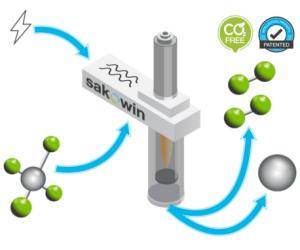
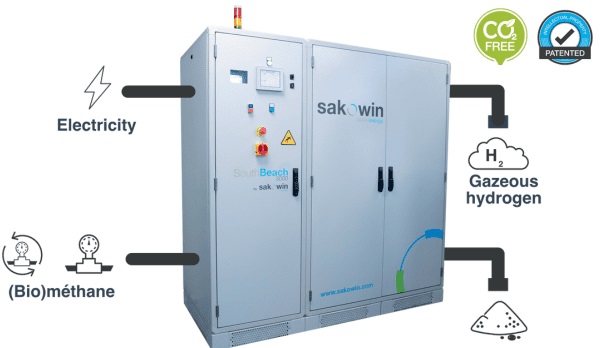
We have developed and patented a technology, called plasmalysis, to decompose without oxygen methane into Hydrogen and Solid Carbon. This process is CO2 free with a production capacity from 200 kg H2/day to severals hundred tons/H2/day.
Cost Competitive
Our technology aims to use 5 times less electricity than electrolysis to produce the same amount of hydrogen at a competitive cost. It does not consume water, a resource whose preservation is essential in the fight against climate change.
Sustainable hydrogen
Combined with biomethane, Sakowin’s solution is CO2 negative. Co-produced solid carbon has also a positive environmental impact.
On-site On-demand
Sakowin’s equipment/technological brick is compact, modular and stackable. As such, the technological brick can be integrated into existing industrial and gas infrastructures, for on-site & on-demand hydrogen production.
Sakowin’s business model is to address various vertical markets through system integrators and OEMs who will integrate our technological brick into a complete solution to answer all the major markets’ needs for hydrogen usage and production.
- Industrial processes
- Oil and Gas
- Mobility
- Solid carbon usage