

Confocal NL
  1. Companies
  2. Confocal NL
  3. Products
  4. Confocal - Model GAIA - Point REscan ...

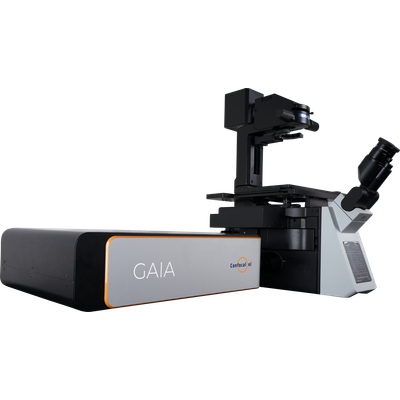
ConfocalModel GAIA -Point REscan Super Resolution Microscope

SHARE

GAIA Point REscan is an advanced super resolution microscope designed to deliver exceptional live cell imaging capabilities. Utilizing patented confocal technology, it enables imaging beyond the diffraction limit with minimal energy consumption. The system is characterized by its low phototoxicity, which is critical for preserving cell viability during extensive imaging sessions. It achieves high resolution by incorporating a synchronized rescanning technique and bespoke optical elements before and after the pinhole to improve field-of-view and resolution. The flagship version, GAIA λ, offers features such as a motorized switchable pinhole for flexibility and sensitivity, and supports a variety of imaging modalities. Its sensitive detector contributes to high quantum efficiency, advantageous for both visible and near-infrared wavelengths. With outstanding adaptability, the GAIA systems offer real-time resolution improvements and support integration with standard commercial microscope bodies, making them ideal for various imaging applications.

Most popular related searches

Image wide in super resolution

The disruptive technology in GAIA provides more than double the field of view in the sample plane compared to its predecessor. Consequently, GAIA enables super resolution imaging over a large FOV and using a wide range of objectives (30X -100X). For the best images high NA objectives are a must.

Image deep in super resolution

A combination of low laser power requirements, high sensitivity of the detector and a novel optical design present in GAIA Point REscan enables super-resolution beyond 500μm of depth. This makes GAIA Point REscan confocal a perfect solution for live cell super resolution imaging of even thicker specimens like cleared tissue, whole zebrafish embryos, organoids and spheroids.

Explore the benefits

Our flagship GAIA λ has a switchable pinhole, ensuring flexibility, sensitivity and optimal confocality.

Nyquisting every objective and adding fast multicolour imaging over a large FOV gives raise to the most light-efficient super resolution confocal system on the market.

Breaking the diffraction limit in a purely optical way

Here’s the layout of a standard laser scanning confocal microscope (LSCM):

From the detector signal at each position, an image of the sample is calculated.

Concept of RCM Point REscan

Instead of using a single detector, we use a second scanner, i.e. REscanner, which is synchronized with the first scanner and REscans the emission light onto a camera.

This way the signal automatically ends up at the right place on the camera and the image is reconstructed all by itself.

Optical redesign in GAIA Point REscan confocal

For GAIA, our revolutionary new Point REscan confocal, we added bespoke optical elements before and after the pinhole. This provides the improvement of resolution beyond the diffraction limit while increasing the effective field of view (FOV).

As an added value, we introduced a motorized switchable pinhole that enables perfect confocality for a wide range of objectives (4X-100X). For proper super resolution, one should use high NA objectives.

Super resolution with Point REscan confocal

In Point REscan confocal, the magnification of the image and the spot are decoupled. Thus, one can magnify the image compared to the spot.

In RCM, we do this by giving the REscanner a larger amplitude than the scanner. As a consequence, all the details in the image are pulled further apart and the image is in super resolution.

However, this does not give infinite improvement in resolution. It turns out that the optimal situation is provided by twice as large REscan amplitudes, which improves the resolution by 1.4x*.

Creating a smaller spot

In GAIA, we took a different approach. Here, we are making the spot smaller instead of the image larger by using bespoke optical elements before and after the pinhole.

At the same time, we are retaining 1.4x resolution improvement.

In addition, we gain more than double the FoV in the sample plane as well as an improvement in speed.

Low phototoxicity of Point REscan confocal

GAIA Point REscan confocal is a perfect solution for live cell super resolution imaging thanks to its very low phototoxicity.

Low phototoxicity is attributed to two important factors:

  • GAIA, as well as all members of Point REscan family, has the ability to image using a large pinhole, thereby collecting more light.
  • The sensor in Point REscan has a very high sensitivity.

REscanning means that we can open the pinhole without losing resolution

Without rescanning, one needs to close the pinhole pretty far, to only let the center of the spot through. 

The rest of the light comes from a different position in the sample. If you collect all of it at once, you lose resolution.

If the light is REscanned on the camera, each part of the spot automatically ends up in the correct pixel.

And the pinhole can stay wide open, so we collect more light

High sensitivity of the detector

In Point REscan we can use a camera as a detector. Scientific cameras provide a much higher quantum efficiency than PMTs in a wider wavelength range.

Motorized pinhole switch in GAIA Point REscan confocal

A pinhole serves to block the out-of-focus light. In practice, a pinhole size between 1 and 2 Airy units (1-2x times as large as the spot) gives the best images.

If the pinhole is smaller, the signal is sacrificed. If it is larger, confocality is lost.

WIth a motorized pinhole switch, we are ensuring optimal confocality for a wide range of objectives (4x-100X).

Our Point REscans can be mounted on pretty much any microscope body. Adding a camera and a laser gives rise to fully equipped confocal Super resolution microscope. Because it does not need a high laser power, it has a very low phototoxicity, making it perfectly suite for live cell imaging.