


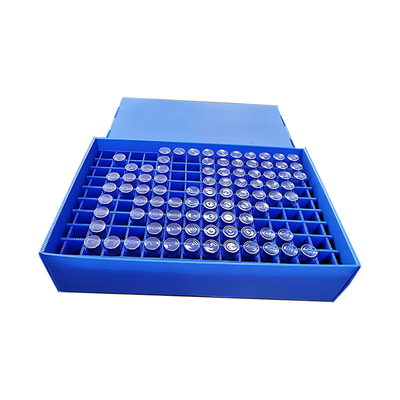
PPBOXY - Polypropylene (PP) Pharmaceutical Packaging
Discover PPBOXY’s PP Pharmaceutical Packaging, designed for superior protection and durability, offering features such as anti-static, moisture resistance, and customization options for pharmaceutical products.
Why PP Packaging for Pharmaceuticals?
Pharmaceutical packaging is not a logistics decision — it is a compliance decision. Every material that contacts or encloses a drug product must satisfy regulatory requirements for safety, traceability, and stability. Polypropylene (PP) corrugated packaging has become the standard for pharmaceutical companies not because it is inexpensive, but because it is the only common packaging material that simultaneously meets sterilization, zero-leachable, and traceability requirements.
Three properties make PP indispensable in pharmaceutical supply chains:
1. Full Regulatory Traceability — Single-Polymer Transparency
PP corrugated board is a single-polymer system — one resin, one material, no adhesive layers, no hidden contaminants. This structural simplicity is its greatest regulatory advantage:
- Batch traceability: Every PPBOXY pharmaceutical packaging batch can be traced from resin lot number through extrusion, conversion, and shipment — satisfying FDA 21 CFR Part 211 traceability requirements and EU GMP Annex 1 documentation standards.
- No hidden inputs: Cardboard corrugated board contains adhesives between flutes and liners, sizing agents in the paper, and potential residual bleaching chemicals. Each of these is an uncontrolled variable in a compliance audit. PP has none of them.
- Documentation-ready: Each shipment includes a Certificate of Compliance (CoC) documenting resin lot, manufacturing date, dimensional tolerances, and test results. In pharmaceutical supply chains, compliance without documentation is non-compliance.
2. Zero Leachables — USP Class VI Certification
USP Class VI (USP <87> and <88>) is the highest biological reactivity classification for plastics. It certifies through in-vivo testing that a material causes no systemic toxicity, no intracutaneous reactivity, and no implantation effects. PP achieves this certification. Cardboard cannot.
The reason is structural: cardboard contains adhesives (often formaldehyde-based), sizing agents (alkyl ketene dimer), and lignin-based compounds — all of which can off-gas, migrate, or leach into pharmaceutical products under conditions of elevated temperature or humidity. PP, as a pure hydrocarbon polymer with no additives beyond stabilizers and anti-static agents, produces zero extractables under USP <661> testing protocols.
Practical implication: PP pharmaceutical boxes can safely contact tablets, capsules, and diagnostic reagents in direct-contact scenarios where cardboard would require a secondary barrier (polybag, foil pouch) — adding cost, complexity, and waste to the packaging process.
3. Sterilizable — All Three Primary Methods
PP is compatible with all three pharmaceutical sterilization methods — autoclave, gamma irradiation, and EtO gas. Cardboard fails all three:
- Autoclave (121°C, 15 psi): Cardboard absorbs moisture and loses 80%+ structural rigidity. PP maintains full dimensional stability.
- Gamma irradiation (25 kGy): Cardboard undergoes cellulose chain scission, becoming brittle and discolored. PP cross-links at the surface but retains mechanical properties.
- EtO gas (400–1,200 mg/L): Cardboard’s porous structure traps EtO residues, requiring extended aeration (48–72 hours) to reach safe levels. PP’s non-porous surface allows aeration in 8–12 hours.
- Material: Polypropylene (PP) corrugated board
- Resin Grade: Homopolymer PP, FDA 21 CFR 177.1520
- USP Classification: USP Class VI (USP <87>, <88>)
- Moisture Absorption: <0.02% (ASTM D570)
- Wall Type: Twin-wall / Fluted
- Thickness Range: 2–8 mm (standard: 3 mm, 4 mm, 5 mm)
- Density: 0.90–0.91 g/cm³
- Operating Temperature: -40°C to +135°C
- Autoclave Tolerance: 121°C, 15 psi, 30 min
- Gamma Irradiation Tolerance: Up to 25 kGy
- EtO Sterilization: Compatible
- Surface Resistivity (Anti-Static): 10?–10¹¹ Ω/sq (IEC 61340-5-1)
- Flammability: UL 94 V-2 (with FR additive)
- UV Resistance: (with UV absorber additive)
- Chemical Resistance: Ethanol, isopropanol, acetone, acids pH 2–12, bases pH 2–14
- Food Contact: FDA 21 CFR 177.1520 / EU Regulation 10/2011
- Recycling Code: #5 PP
- Load Capacity: 5–50 kg (varies by form factor and thickness)
- Custom Printing: Flexographic / Screen / UV Digital
- Custom Colors: (Pantone matching available, MOQ applies)
- Certificate of Compliance: Included with every batch
- MOQ: 200 pcs (standard) / 500 pcs (custom)