


Model 1313 -Pre-Method
This method is designed to provide aqueous extracts representing the liquid-solid partitioning (LSP) curve as a function of pH for inorganic constituents (e.g., metals and radionuclides), semi-volatile organic constituents (e.g., polycyclic aromatic hydrocarbons or PAHs) and non-volatile organic constituents (e.g., dissolved organic carbon) in solid materials. This method is not applicable for characterizing the release of volatile organic analytes (e.g., benzene, toluene, xylenes)
The solvents used in this method include dilute solutions of nitric acid (HNO3) and potassium hydroxide (KOH) in reagent water. In the preparation of solid materials for use in this method, particle-size reduction of samples with a large grain size is performed in order to enhance the approach towards equilibrium under the designated contact time interval of the extraction process. The extract contact time for samples reduced to a finer maximum particle size will consequently be shorter
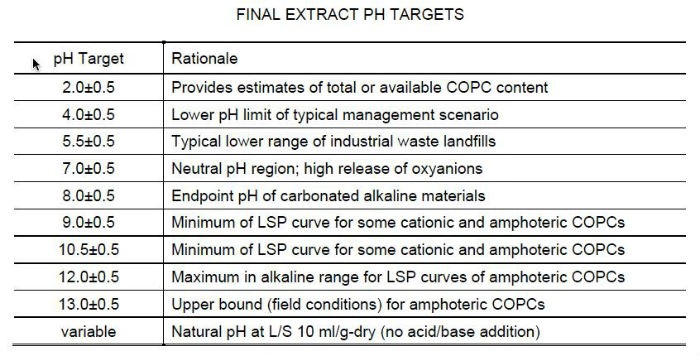
A known mass of solid material is placed in each of nine extraction vessels and contacted with water at a liquid-solid ratio (L/S) of 10 mL/g-dry. Nitric acid or sodium hydroxide is added to each vessel to obtain a specified final pH value based on a pre-test titration curve. The nine vessels are tumbled in an end-over-end fashion for a time comensurate with the maximum particle-size. Eluate pH and conductivity are recorded. Analytical samples are filtered and preserved for chemical analysis.
Constituent concentrations [mg/L] or mass release [mg/kg] are plotted as a function of eluate pH. Constituent concentrations over the pH range typically show characterisitic LSP behavior for cationic, amphoteric, oxyanionic and high soluble species. The results of this test are used to (i) obtain maximum (available) release values, (ii) show equilibrium concentrations when the environment dominates pH. Results form the basis for geochemical speciation modeling of release-controlling phases.