


- Home
- Companies
- Körber Technologies GmbH
- Products
- Körber - Process Equipment
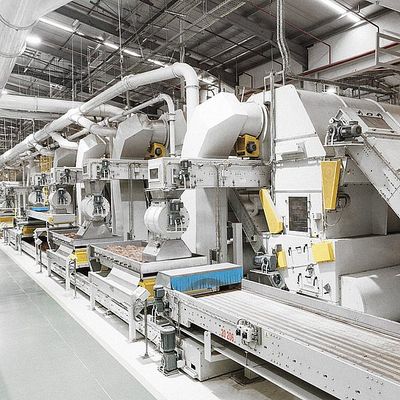
Körber - Process Equipment
Processing tobacco is a complex operation: it involves turning green tobacco leaves into high-quality final products that meet your standards and specifications. Our machinery and equipment ensure maximum efficiency and excellent quality, at every stage of the process.
Green leaf is processed in around 150 factories worldwide, and many of them use our machines, which can process up to 12 tons of leaves an hour. The tobacco leaves have already undergone the first step of the process when they arrive at the factory. “Curing” involves drying the leaves after they have been harvested in order to initiate chemical processes that make them fragrant and supple.
Blending
In the factory, the tobacco is assembled by hand according to the customer's specifications. Employees sort the leaves according to size, color, intended use and quality. We supply suitable sorting tables for this purpose. The deciding factor when it comes to quality is where the leaf grew on the stem.
Cutting the tips and unpacking
The actual processing operation begins by cutting the tobacco leaves into two halves. The tips of the leaves, which contain only a few very thin stems, are moistened and unwanted components are removed. The sleeves that hold the tobacco bundles together are also removed at this station.
Conditioning
Leaves that are stuck together in clumps are separated from one another in a conditioning cylinder. So that this occurs as gently as possible, steam and water are applied to make them more pliable. This ensures that the leaves do not break and can be processed in the threshing machine more effectively.
Sorting and selection
Heavy foreign objects such as stones or polystyrene are sorted out by hand. The same goes for leaves whose quality is sub-standard, because they are the wrong colour or damaged, for example. Optical systems complement the process. They detect small items such as feathers, plastic, pieces of wood or paper. Sorters often use air pressure to remove them.
Threshing and classifying
The tobacco leaves are separated from the stems by a “thresher”. Classifiers then sort the tobacco leaves by weight. Light, de-stemmed lamina pieces are passed on to the next station, and heavy lamina pieces that still contain stems are recycled back into the thresher.
Re-drying
After the stems have been removed, the moisture content in the cut tobacco is 18 percent. The tobacco cannot be stored for a long period of time with a moisture content this high, so it is dried in a re-drying plant until the residual moisture content is only 8 to 9 percent. It is then moistened with steam again until it has a consistent final moisture content of about 12 percent.
Filling cartons
In carton presses, the leaves are filled into cartons via funnels while they are still warm. A hydraulic plunger compresses them so powerfully that 200 kilograms can fit into each carton. Packed in this manner, the tobacco is shipped to a raw tobacco warehouse. There, it matures until it has reached its full aroma, sometimes for up to two years.
Körber is the global market leader in Primary equipment. During this complex process, the raw tobacco is processed for later use in cigarette production. Our equipment ensures that every step of the process runs smoothly and is monitored seamlessly. So you end up with a product that always meets your standards and requirements.
Unpacking
The tobacco leaves are delivered to the cigarette factories in 200 kg cartons or bales. There, unpacking stations unpack up to 48 cartons an hour, which is up to 12,000 kg of tobacco. The equipment can be converted to handle different types of carton in a few simple steps.
Slicing
A slicer cuts the leaves, which have been tightly compressed in cartons or bales for two years, into smaller slices. This prepares them for the next step of the process: conditioning and casing.
Conditioning and casing
The leaves are loosened and moistened with water and steam. As a result, the moisture content increases from 10 to 21 percent and the pores of the leaves open. This is followed by the “casing” process, in which the tobacco is sprayed with casing, a sugary liquid that can contain glycerin or flavors such as liquorice, chocolate or plum. These flavors penetrate into the leaf’s interior through the pores.
Storing and blending
Careful blending of the tobacco produces homogeneous and consistent blends. This process is crucial to ensuring the quality of a cigarette. The blending plants are not just used to blend the tobacco, they can also be used for other purposes, such as storage silos or buffers, for example.
Removal
Even the tiniest particles of non-tobacco material can adversely affect the appearance and taste of the final product. A number of systems are used to detect and remove these particles. These include magnets, conveyor belts with screens, separators, metal detectors and sophisticated optical detection systems.
Cutting
After blending, the leaves are cut. The blades on the tobacco cutters must be extremely sharp and clean to ensure a high-quality final blend, so they are sharpened automatically on a regular basis. Our tobacco cutters can process up to twelve tons of fine-cut tobacco and three tons of stems an hour.
Expansion
The tobacco is heated very rapidly to over 100 degrees. Steam condenses during this process. This accelerates the heating process and causes the water in the cells to expand. As a result, the tobacco expands and its filling power increases. At the same time, its moisture content increases from 21 percent to approx. 25 percent.
Expansion and drying
First, the tobacco is heated very rapidly in combined expansion and drying plants. The water expands into the cells of the tobacco and increases its filling power. The moisture content increases from 21 to 25 percent. The tobacco is then dried just as rapidly in a flow of superheated steam. Its moisture content drops to 13 percent as a result. However, the cells remain expanded.
Drying
The tobacco is dried in a flow of superheated steam with a temperature of up to 300 degrees and a low oxygen content. This causes the tobacco’s moisture content to drop from 25 to 13 percent. The process is extremely gentle, thereby ensuring that the cell expansion previously achieved is maintained.
Cooling & separation
After drying, the tobacco is cooled. This stabilizes the additional filling power achieved and prevents the dried tobacco from losing any of its aroma before it enters the flavoring cylinder. Larger particles such as stems are also removed in the cooling plants.
Flavoring
In the last tobacco preparation step, flavors are sprayed evenly onto the cut tobacco, during which the tobacco is gently blended. This gives it its characteristic taste which ensures that distinctive smell when the cigarette pack is opened.
Rollers
The stems of the tobacco leaf are rolled flat, which widens them so that they can be processed more easily. The stems are low in nicotine and sugar. For this reason, they are often used to produce light, low-nicotine cigarettes.
Filling crates
Filling stations enable cigarette production to be scheduled with maximum flexibility. Here, cut tobacco is gently filled into containers or cartons, from which it can be removed as required during production. Among other things, the stations are equipped with mobile tippers or gantry robots as well as a storage area and fully automatic logistics equipment.
Feeding
Several tobacco feed plants are connected directly to the Secondary. They ensure that the cigarette makers receive a continuous supply of tobacco. They do so by transferring the tobacco via air pressure through long pipelines to the makers. The transfer capacity and air speed can be adjusted and controlled fully automatically.
Dust extraction
At all stations of the Primary, extractors and dust extraction systems clean the air of any tobacco dust whirled up during tobacco processing. Air-flow dust filters remove dust, and cyclones remove solid particles from the air. Both are collected and, if necessary, re-used.