


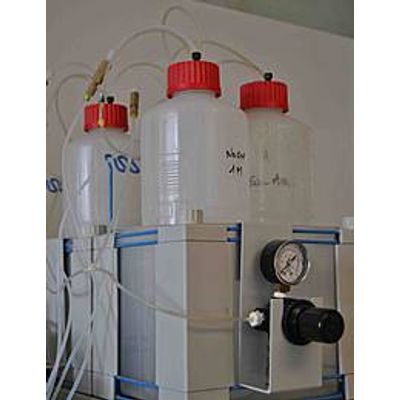
Phytosafe - Model HPAE-PAD -Pulsed Amperometric Detection Unit
High-Performance Anion-Exchange Chromatography with Pulsed Amperometric Detection (HPAE-PAD) is an analytical method mainly used for precise determination of anionic analytes without derivatization. This technique is particularly beneficial in analyzing carbohydrates, which are challenging due to their high polarity and lack of suitable chromophores. The process involves the ionization of carbohydrates using hydroxide-based eluents, enabling separation by anion-exchange chromatography. The subsequent pulsed amperometric detection employs a gold working electrode in an alkaline solution to oxidize electroactive compounds. The resulting current, which changes with potential variations, provides a proportional measure of analyte concentration. This method's specificity is significant for electroactive compounds, ensuring a high level of detection sensitivity and selectivity. By comparing the analyte response to standards, HPAE-PAD ensures accurate and reliable analytical results.
HPAE: Carbohydrates have pKas in the range of 12-13. Hydroxide-based eluents allow carbohydrates to become ionized as the pH rises above the pKa of the analyte. Consequently they can be separated by anion-exchange chromatography.
Coupled Pulsed Amperometric Detection is a direct detection technique. Potential variations of the detector result in oxidizing the carbohydrates on the surface of a gold working electrode in highly alkaline solution. This generates a current that can be measured.
HPAE-PAD is highly specific of electroactive compounds, i.e. those compounds that become ionized at high pH values and contain functional groups which become oxidized at the detection voltage employed. Neutral or cationic components elute in, or close to, the void volume of the column.
The presence of an analyte gives a response assumed to be proportional to the concentration. The instrument’s response to the analyte in the unknown should be compared with the response to a standard.